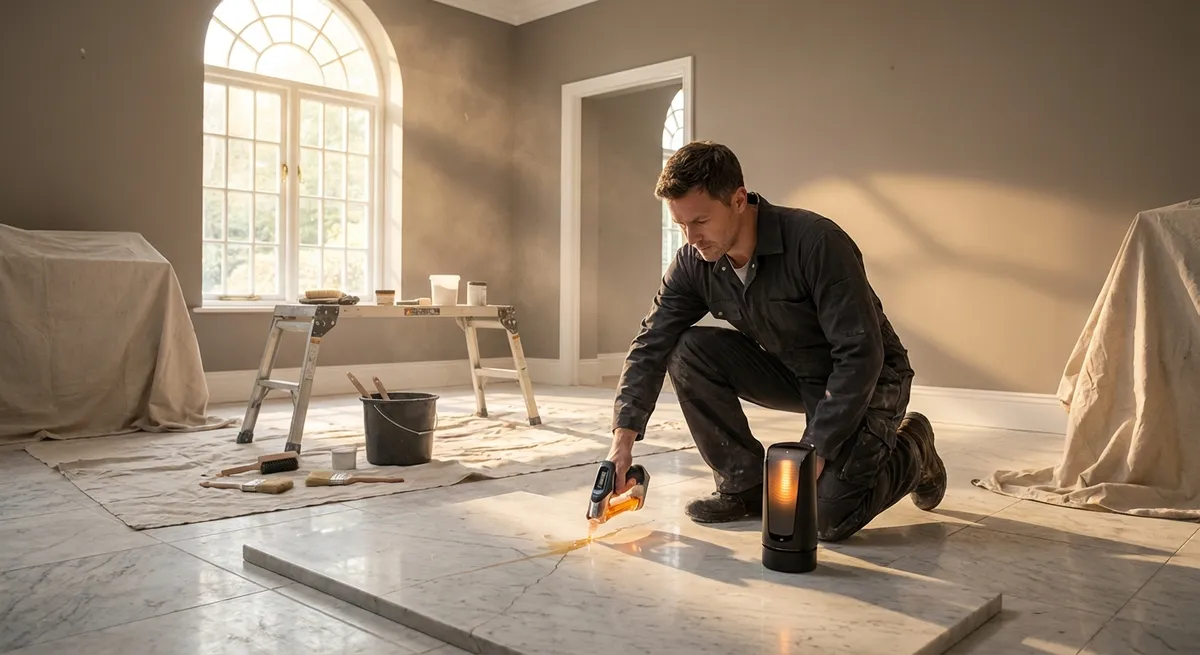
This guide explores repair solutions that respect design vision as much as durability, with five exclusive insights that discerning homeowners and design‑led renovators will truly appreciate.
Reading the Surface: Diagnosing the Real Problem
Elegant repair begins with precise diagnosis. A visible crack is rarely the full story; it is often the symptom of deeper forces at play.
Subtle cues matter. A faint “click” or hollow tone beneath a tile indicates debonding—where the adhesive has parted ways with the substrate. A network of fine, spiderweb cracks across multiple tiles often hints at substrate movement or an insufficiently cured slab, rather than a failure of the tile itself. Cracks following straight, linear paths may reveal structural joints that were tiled over without proper accommodation.
Moisture mapping can be invaluable in bathrooms, wet rooms, and near exterior doors. Persistent discoloration in grout lines, efflorescence (that powdery white residue), or soft grout can suggest water ingress behind the surface. In such cases, a superficial “patch” is not sophistication; it is merely postponement.
A refined repair strategy always begins with this question: are we treating a tile, or are we addressing a system? The answer determines whether discreet spot repairs or more comprehensive intervention will yield lasting, elegant results.
Seamless Substitution: Replacing Tiles Without Visible “Scars”
Tile replacement is often imagined as disruptive and visually obvious, but done well, it can be almost invisible—even under close inspection.
The first priority is preserving adjacent tiles. Precision cutting tools, controlled depth settings, and methodical scoring protect surrounding edges from chipping. Heat and moisture applied judiciously can soften older adhesives and make removal less aggressive. An experienced installer will work tile by tile, corner to center, rather than prying from the middle outward.
Matching replacement tiles requires consideration beyond color alone. Batch variation (shade and caliber) can introduce subtle but jarring differences in tone or dimension. Whenever possible, use attic stock from the original installation. If that is unavailable, selecting replacement tiles under the same lighting conditions as the installed surface—daylight vs. warm interior lighting—prevents unwelcome surprises once the repair is complete.
The adhesive bed is another area where refinement shows. A carefully combed, full‑coverage bond coat avoids voids that can cause future “drumming” sounds underfoot. Proper alignment with adjacent grout joints and plane ensures the new tile sits perfectly flush, maintaining the quiet continuity essential to a premium space.
Beyond Color-Matching: Sophisticated Grout and Finish Repairs
For many interiors, grout is the subtle frame that either elevates or undermines the entire composition. In repair work, it becomes a powerful design tool.
Color consistency is paramount. Over time, grout can lighten through cleaning and UV exposure, or darken through absorption of environmental contaminants. Rather than attempting to match fresh grout to an aged appearance solely by eye, professionals often rely on grout color charts, small test patches, and, increasingly, grout colorant systems that can tint existing grout to a uniform, curated tone.
Regrouting is not always necessary across an entire room. Skilled repair can focus on specific zones—such as high‑traffic corridors or wet areas—while feathering new grout into existing joints to maintain visual harmony. This demands meticulous cleaning of the old grout, precise depth removal, and a controlled application of the new product to avoid weak edges or “picture framing” around tiles.
Finish levels matter as much as color. A refined repair will consider whether the space calls for a matte, satin, or slightly polished result—particularly in natural stone or honed porcelain. In some cases, a subtle honing or resealing of the repaired area maintains uniform sheen, preventing the new work from catching light differently than its surroundings.
Structural Grace: Respecting Movement and Expansion
Truly elevated tile repair acknowledges that rigidity is not the goal—controlled movement is. Ignoring this principle is one of the fastest paths to repeat failures.
Every tiled surface exists in a dynamic environment: temperature fluctuations, minor structural deflections, seasonal humidity changes. Thoughtful repair work often involves discreetly introducing or restoring movement joints rather than simply filling or bridging over existing cracks.
In large floors, for example, strategic soft joints (using color‑matched flexible sealant instead of rigid grout) can be incorporated along long runs, transitions to other materials, or changes in substrate. On walls, especially in showers and wet rooms, corners and plane changes should rarely be grouted rigidly; flexible joints here absorb micro‑movement and prevent stress lines radiating through tiles.
One of the most sophisticated decisions in a repair project is recognizing when the most elegant solution is partially deconstructive: removing a band of tiles to correct an omitted movement joint, or reworking a threshold to accommodate expansion, rather than perpetually “chasing” cracks with cosmetic fixes. Long‑term stability is a hallmark of premium workmanship.
Five Exclusive Insights for Discerning Homeowners
These five insights separate routine patching from truly refined tile preservation:
- Micro‑crack triage is a design decision, not just a technical one.
Not every hairline crack demands replacement. In low‑stress, low‑visibility areas, a high‑quality, color‑matched epoxy or resin fill can stabilize a tile while keeping disruption minimal. However, in focal points—entryways, feature walls, shower niches—prioritizing visual perfection with full tile replacement preserves the design intent.
- Acoustic testing reveals what your eyes cannot.
A simple, controlled tap test with a non‑metallic tool can map detachment across a floor or wall, identifying areas that are compromised but not yet visibly failed. Addressing these zones proactively during a localized repair prevents a patchwork of future failures and maintains a unified, solid feel underfoot.
- Moisture‑aware repairs protect both aesthetics and air quality.
In bathrooms, spa spaces, and near exterior thresholds, insist on moisture‑tolerant mortars, membranes, and sealants when repairs are made. Proper waterproofing behind the surface is not just about preventing tile damage; it also reduces the risk of hidden mold, efflorescence, and musty odors that undermine the perception of a clean, luxurious space.
- Underlayment upgrades can be quietly transformative.
When a section of flooring is opened for repair, consider whether this is an opportunity to introduce a modern uncoupling membrane or sound‑attenuating underlay beneath the new assembly. Even if only in specific zones—below a high‑traffic hall or above a living space—these upgrades can dramatically improve comfort, longevity, and acoustic elegance.
- Documenting your repair is an investment in future control.
Premium projects benefit from a “materials dossier”: records of tile brand, series, size, batch, grout color and type, adhesives, and membranes used. When repairs are completed, updating this dossier—along with photos of what was discovered behind the surface—ensures that any future work can be executed with surgical precision and accurate product matching.
Conclusion
Refined tile repair is less about disguising damage and more about curating continuity—of surface, of performance, and of design intent. When diagnosis is meticulous, materials are carefully matched, and movement and moisture are treated as first‑class considerations, repairs can extend the life and beauty of your interiors indefinitely.
For homeowners who value quiet luxury and tailored detail, approaching tile repair as a precise craft rather than a quick fix ensures that every intervention, no matter how small, contributes to the long‑term elegance of the space.
Sources
- Ceramic Tile Education Foundation – Tile Installation & Standards – Technical insights and best practices for professional tile installation and repair
- Tile Council of North America (TCNA) Handbook – Authoritative industry guidelines on tile assemblies, movement joints, and substrate requirements
- U.S. Environmental Protection Agency – Mold, Moisture, and Your Home – Background on moisture management and its impact behind tile and in wet areas
- Schluter Systems – Movement Joints and Uncoupling Principles – Technical resources explaining uncoupling membranes, movement accommodation, and their role in preventing tile failures
- LATICRETE Technical Data Sheets – Detailed product guidance on mortars, grouts, and repair materials for high‑performance tile installations