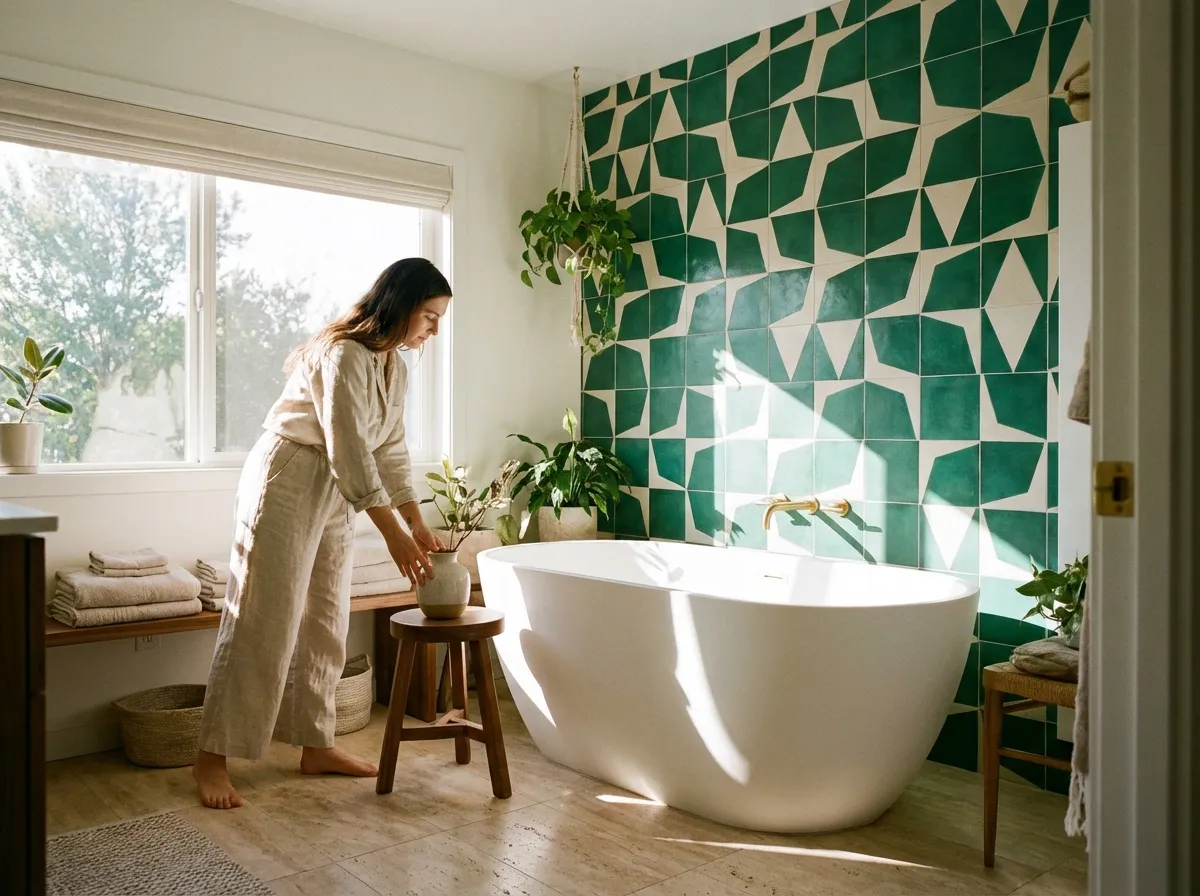
Below are five exclusive, design-forward insights for homeowners who want their tile choices to feel intentional, architectural, and enduring rather than trend-driven.
1. Start with Scale, Not Color
Most homeowners begin with color, yet in elevated interiors, scale does the heavy lifting.
Large-format tile can elongate sightlines, make thresholds feel grand, and reduce visual noise through fewer grout joints. Conversely, smaller formats—mosaics, herringbone, or elongated subways—introduce cadence and fine detail, functioning almost like textile weave on the floor or wall.
Before you fall in love with a particular shade, study the room’s dimensions: ceiling height, window placement, and natural light direction. A tall but narrow bathroom may benefit from vertically laid planks or elongated rectangles, accentuating height. A wide, open kitchen can feel exquisitely grounded with large-format porcelain “slabs” that read almost as continuous planes.
Only once you’ve established the ideal scale should you refine color. This sequence ensures that the tile supports the architecture instead of fighting it.
2. Use Grout as a Deliberate Design Line
In sophisticated tile work, grout is never an afterthought; it is a drawn line that either disappears or intentionally articulates the pattern.
A near-perfect grout match to the tile’s base tone yields a seamless, monolithic read—excellent for calm, gallery-like rooms where art, furnishings, or views should lead. In contrast, a slightly contrasting grout (one to two shades lighter or darker) outlines each tile, subtly echoing millwork reveals, window mullions, or stair balustrades.
Refined projects often reference grout tone elsewhere in the room: the color of metal frames, cabinet pulls, or even stitching on upholstered pieces. This creates a visual through-line that makes the tile feel custom and integrated rather than “applied.”
When selecting grout, request physical samples and evaluate them under the actual room lighting at different times of day. A sophisticated interior is rarely about the tile alone; it’s about how the grout calibrates the rhythm and perception of the surface.
3. Align Tile Layouts with Architectural Sightlines
The difference between “nice” tile and exceptional tile work is frequently a matter of alignment.
Before installation, map how your eye moves through the space. From the entrance, what is the first full tile you see? Where does a primary grout joint fall relative to major features: the centerline of a vanity, a shower niche, a fireplace, or a kitchen island?
Premium tile layouts often:
- Center full tiles on focal elements (like a range or a freestanding tub), pushing cuts to less visible edges.
- Align key joints with door thresholds so the transition feels intentional rather than accidental.
- Maintain pattern continuity across planes—carrying a floor joint up a step or reflecting a wall layout in a shower niche for an almost tailored effect.
This level of planning may require a scaled drawing and, ideally, dry-laying a small portion of the tile before committing. When every joint relates to the architecture, the room reads as composed rather than merely finished.
4. Curate Texture for the Way the Room Is Used
Texture is where truly luxurious tile design often reveals itself. While color is seen immediately, texture is felt over time: underfoot, in the way light grazes a surface, in how easily it cleans.
For high-use floors—entry halls, kitchens, or family rooms—a soft-matte or honed surface balances elegance with practicality, minimizing slips and disguising small imperfections. In wet areas, look for tiles with subtle structure or micro-texture; they catch light beautifully without feeling overtly “utilitarian.”
On walls, texture can be bolder. A gently rippled ceramic backsplash can make even a monochrome kitchen feel layered and artisanal. A fluted or three-dimensional tile in a powder room, lit from the side, can rival artwork in presence.
The most successful interiors often combine no more than two distinct textures within one continuous zone, ensuring the room feels quietly complex rather than visually restless.
5. Treat Tile Transitions as Jewelry, Not Utility
Transitions are where premium tile projects either falter or become extraordinary. Rather than defaulting to generic metal strips or abrupt changes, treat every transition as an opportunity to refine the room’s narrative.
Consider:
- Thresholds: Use a single stone or porcelain “saddle” that aligns with grout joints and echoes other stone elements in the home.
- Material shifts: When moving from tile to wood, aim for flush transitions where feasible, selecting edge profiles and underlayments that keep surfaces level and intentional.
- Edge details: Mitered corners, bullnose edges, or factory-finished trims can turn terminations into design features, especially on niches, benches, and fireplace surrounds.
In elevated spaces, these details are almost subliminal. Guests may not consciously notice a perfectly aligned threshold or a carefully mitered corner—but they will register the overall space as exquisitely resolved.
Conclusion
Designing a room around a single signature tile is less about spectacle and more about discipline. By prioritizing scale over color, using grout as a deliberate design line, aligning layouts with architecture, curating texture to the way a room is lived in, and treating transitions as jewelry, you move beyond simple decoration into considered composition.
The result is a home where tile does not shout for attention yet unmistakably elevates every surface it touches—a quiet assurance of craftsmanship and intention.
Sources
- American National Standards Institute (ANSI) – Tile Installation Standards - Industry standards that inform best practices for tile layout, joints, and detailing
- Ceramic Tile Education Foundation - Technical and design-focused articles on tile selection, installation, and performance
- Architectural Digest – Tile Trends and Ideas - Design-forward perspectives on how tile is used in high-end residential projects
- Porcelanosa Official Site – Tile Collections - Reference for luxury tile formats, textures, and finishes used in premium interiors
- University of Minnesota – Flooring and Slip Resistance Guidance - Practical insight into surface texture and safety considerations for floor finishes