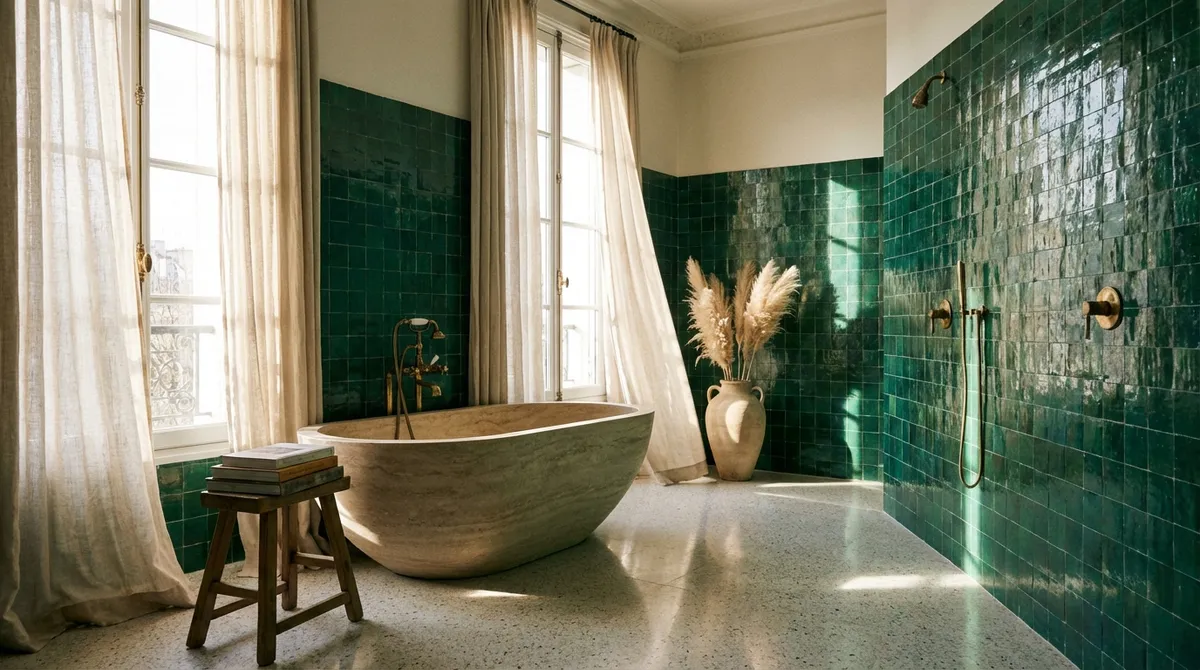
Below are five exclusive, design-forward insights that move beyond basic trends and into the realm of truly curated tile work.
1. Treat the Floor as a Field, Not a Background
In sophisticated interiors, the floor is not a passive backdrop; it is a calibrated field that anchors everything above it.
Consider your tile layout the way a gallery treats its floor: a continuous plane that supports and organizes activity. Large-format porcelain in a honed finish can create a gentle visual “hush,” allowing furnishings and art to stand forward without competition, while still exuding quiet luxury. When you extend the same floor tile between adjacent rooms, subtle shifts in pattern or border detail can discreetly signal program changes—dining, living, circulation—without resorting to harsh thresholds.
Pay special attention to the perimeter of the space. A refined design often “frames” the room with a border of the same tile laid in a different direction or size, similar to a mat around fine artwork. This technique creates the sense that furniture is thoughtfully placed within a composed field rather than randomly set on a generic surface. Align tile joints with architectural elements—doorways, window mullions, island edges—so the geometry of the floor reinforces the room’s architecture.
2. Compose Walls Like Millwork, Not Merely as Cladding
Wall tile can read as an integral architectural element when it is approached with the rigor usually reserved for custom millwork.
Instead of stopping tile at an arbitrary height, determine your termination lines based on existing architectural cues: window heads, door frames, ceiling coffers, or the underside of floating shelves. This alignment instantly elevates the space, as if the tile was original to the architecture rather than an afterthought. In bathrooms, for example, bringing tile to the ceiling in the shower and precisely to the bottom of a wall sconce plate at the vanity can create a composed, tailored look.
Consider using two related tiles—perhaps a matte field tile combined with a subtly glossy version of the same color—to create “paneling” effects. You might frame vanity mirrors with a vertical band of slightly smaller or glossier tile, echoing the idea of a picture frame or wall panel. Corners and transitions deserve equal attention: mitred edges, carefully aligned grout joints, and minimal trim pieces ensure the tile feels built-in rather than applied.
For truly premium results, coordinate grout color with your wall palette, not just the tile. A carefully tuned grout tone that bridges the wall color and tile can make the installation feel architecturally integrated, rather than a separate layer.
3. Use Pattern as a Whisper, Not a Shout
Patterned and textured tiles are most powerful when they operate like a signature fragrance—present, memorable, but never overwhelming.
Instead of covering entire rooms with strong motifs, reserve pattern for locations where the eye naturally pauses: beneath a soaking tub, behind a cooktop, or within a shower niche. This restrained application allows you to specify bolder designs—mosaics, geometric patterns, or intricate stone inlays—without tipping into visual chaos. Think of these areas as “chapters” within the room, each with its own refined detail that rewards a second look.
Scale is crucial. A heavily veined large-format marble may feel sumptuous on the floor, but can become visually aggressive if taken up all four walls. Conversely, a small geometric mosaic on the floor can create a sense of delicate craftsmanship underfoot, especially when paired with simpler wall tiles. For a particularly elegant touch, echo a pattern in a second location with a different material expression—perhaps a soft stone-inspired porcelain on the floor and a glossy ceramic in the same pattern language on a feature wall.
The most sophisticated spaces often rely on layered subtlety: a very gentle shift in texture, a low-contrast pattern, or a barely-there tonal variation that reveals itself slowly rather than demanding immediate attention.
4. Curate Transitions to Feel Intentional, Not Inevitable
Moments of transition—the threshold between wood and tile, the change from one format to another, the edge of a shower—are where a space either feels bespoke or merely adequate.
Approach these junctions with the same care you’d devote to a custom piece of furniture. Instead of default metal strips or abrupt material changes, consider a “bridge” detail: a slim band of stone, a narrow row of contrasting tile, or a flush transition with perfectly aligned grout joints. These gestures signal intention and craftsmanship, even when the materials themselves are understated.
In open-plan spaces, you can use tile transitions to gently choreograph movement. A subtle change in tile orientation around a kitchen island, or a quiet border that defines an entry area, can organize the floor plan without erecting physical barriers. Similarly, in bathrooms, a thoughtful shift from smaller, higher-traction floor tiles in the shower to slightly larger tiles in the dry zone creates both functional and visual clarity.
For truly elevated results, study sightlines from adjacent rooms. A tile line that terminates in the middle of a prominent doorway or cuts awkwardly across a view can undermine even the most beautiful materials. Adjust layouts so that key transitions either align with framing elements or are tucked out of primary sightlines, leaving only a sense of seamless continuity.
5. Elevate Everyday Rituals with “Quiet Luxury” Details
The most memorable tile work often hides in plain sight, enhancing the rituals of daily life without announcing itself.
Consider how the placement and detailing of tile can support touch and movement: a gently rounded edge at a shower bench, a perfectly flush tiled niche for bath products, or a continuous backsplash that eliminates awkward seams behind a faucet. These details not only look refined but also feel better in use. Integrating warmed floor tile in specific locations—such as the path from bed to bath—transform simple routines into indulgent experiences.
Material selection also plays a role. Matte or honed finishes often read more sophisticated than high gloss in larger areas, especially under natural light. Reserve higher gloss or more reflective tiles for small accents where you want a subtle play of light—inside a niche, behind open shelving, or above a vanity. Thoughtfully chosen mosaics can introduce tactile richness at the scale of the hand: a band of smaller tiles along a tub deck or on a vanity face can create a jewelry-like moment in an otherwise streamlined scheme.
Finally, coordinate the “supporting cast”: grout, caulk, trim pieces, and even drain covers. When these elements harmonize in tone and finish with your tile and fixtures, the entire installation reads as one continuous, considered gesture rather than a collection of parts.
Conclusion
Refined tile design is less about spectacle and more about composition, proportion, and grace. When floors are treated as fields, walls as architectural elements, pattern as a whisper, transitions as curated moments, and daily rituals as opportunities for subtle luxury, tile becomes an essential part of a home’s identity—not just its finish.
For homeowners who expect their spaces to feel as considered as a well-edited wardrobe or art collection, these approaches ensure that every surface speaks the language of intention and quiet confidence.
Sources
- Porcelain Tile Installation and Design Guide – Tile Council of North America - Technical guidance and background on porcelain tile characteristics and best practices
- Ceramic Tile Selection & Design – Ceramic Tile Education Foundation - Educational articles on choosing and designing with ceramic tile
- Resilient, Ceramic, and Porcelain Tile Flooring – U.S. Department of Energy - Overview of performance, durability, and considerations for tile flooring
- Bathroom Planning Guidelines – National Kitchen & Bath Association - Professional planning standards that influence tile layout and detailing
- Natural Stone Tile: Design and Installation Recommendations – Marble Institute of America (Natural Stone Institute) - Guidance on using stone tile effectively and elegantly in residential settings