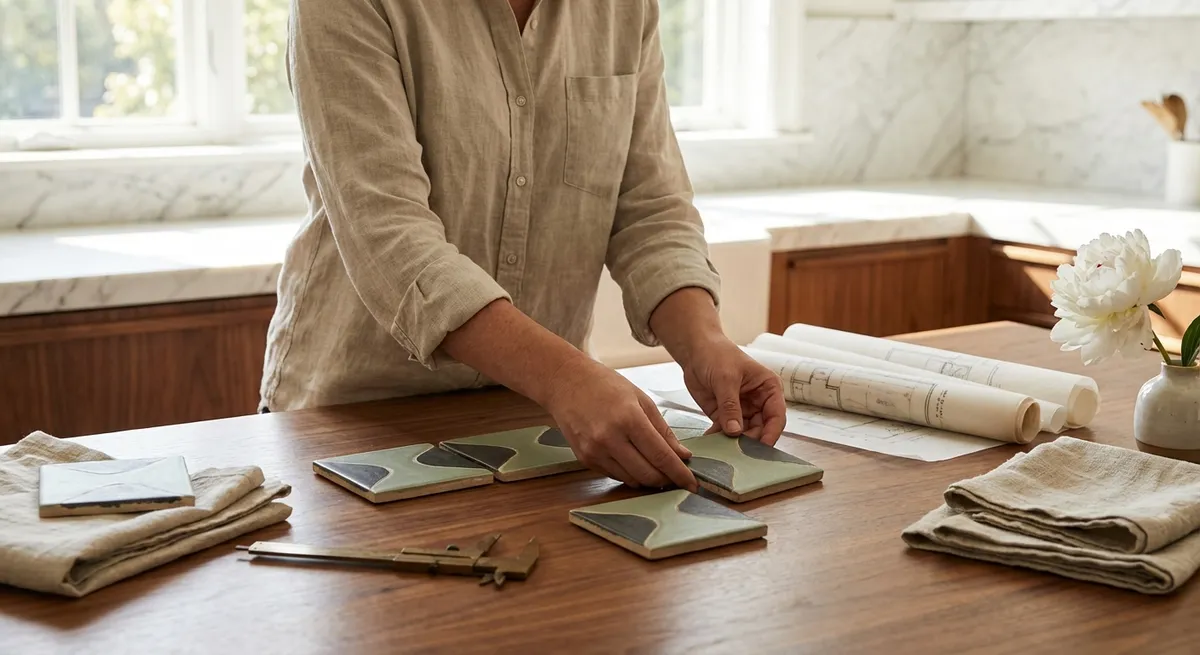
Below, you’ll find five exclusive, detail-driven insights that move past trend-chasing and into the realm of considered, enduring tile design.
1. Designing the “Field” Before Choosing the Tile
Most homeowners start with the tile sample. Discerning spaces begin with the field—the expanse where tile will live, and how it will be read in the room.
Think first about the visual weight of each tiled surface: floors, shower walls, backsplashes, fireplace surrounds. In sophisticated interiors, one field quietly leads while the others support. For example, a honed limestone floor in a generous format can become the calm anchor, while a shower niche or stove wall takes on a more expressive finish. Consider sightlines from adjacent rooms: what is the first tiled surface you see when you enter, and what do you want that first impression to be?
Scale is essential. A large-format tile in a compact powder room can elongate walls and minimize grout, while smaller formats (like 2x8 or 3x12) give you more rhythm and shadow play on vertical surfaces. Sketch the tiled “fields” on a simple floor plan and elevations before falling in love with a specific tile. This pre-selection discipline allows you to choose materials that genuinely suit the architecture, rather than forcing a beautiful tile into a poorly thought-out canvas.
2. Elevating Grout from Afterthought to Design Instrument
In premium spaces, grout is never an afterthought—it is an instrument of control. The right choice can make tile reads as monolithic stone, or as a delicate grid of intentional joints.
For a more architectural, quiet aesthetic, select grout that is closely matched to the tile—particularly on large-format porcelain or natural stone. This approach minimizes visual noise and allows the eye to read the surface as a single plane, perfect for serene bathrooms and expansive kitchen floors. Conversely, a slightly contrasting grout on elongated subway or small square tiles can celebrate the pattern, especially in spaces where you want texture and energy, such as a bar wall or shower floor.
Consider grout joint width as seriously as you would consider baseboard height or door casing. Narrow joints (1/16"–1/8") on rectified tiles lend a bespoke, tailored look; slightly wider joints can be more forgiving on handmade or irregular tiles, embracing their artisanal character. Also explore grout finish: sanded vs. unsanded, and even epoxy options in high-performance areas. Grout that is properly specified and tested with samples on-site can mean the difference between “nice tile” and a truly composed surface.
3. Composed Transitions: Where Tile Begins, Ends, and Yields
The mark of exceptional tile work isn’t always the field itself—it is the transitions. Sophisticated interiors resolve every threshold, corner, and edge with intention.
Think beyond the simple metal trim strip. Consider stone saddles, flush transitions to wood, or custom-milled edge details. For instance, where a tiled bathroom floor meets a hardwood hallway, a flush transition—brought to the same finished height—feels richer and more architectural than a visible step or reducer. In showers, a single slab curb or mitered tile corner reads cleaner than multiple cut pieces and plastic profiles.
Pay particular attention to tile terminations on walls. Decide where tile stops: does a kitchen backsplash align with the upper cabinet edge, the window casing, or extend past for a more generous, gallery-like field? In a shower, should tile rise to the ceiling, or terminate at a specific datum line that aligns with door heads or window tops? These decisions create a subtle but powerful sense of order. When in doubt, align edges with existing architectural lines—it’s a quiet move that makes the space feel custom, even to an untrained eye.
4. Reading Light: Harmonizing Tile with Natural and Artificial Illumination
Light can elevate or compromise even the most luxurious tile. To design at a premium level, tile selection must be tested against the real lighting conditions of the room.
Glossy tiles, while glamorous under evening pendants, can produce harsh glare near large windows or in sun-drenched bathrooms. In such settings, a soft matte or satin finish often feels more expensive and forgiving, allowing the texture and color to show without reflection overpowering the space. Conversely, in lower-light rooms—like interior powder baths or evening-centric bar areas—selective use of gloss or a crackle glaze can add depth and luminous sparkle.
Study how natural light moves through the space across the day, then layer artificial lighting accordingly. Wall-washer fixtures along a tiled feature wall can gently exaggerate texture on a ribbed or fluted tile. Recessed lighting over a shower wall can create tight, elegant shadows on a geometric pattern. Always review tile samples on-site, at scale if possible, under both daylight and your planned fixtures. True refinement lies not just in what tile you choose, but in how that tile behaves at 8 a.m., 2 p.m., and 9 p.m.
5. Curated Mixes: Combining Tile Types with Restraint and Intention
Mixing tiles is where many projects falter, tipping into visual clutter rather than layered sophistication. The most elegant interiors use a curated mix: deliberate contrasts, unified by a clear underlying logic.
Begin with a primary surface language—perhaps a large-format porcelain in a stone look, or a quiet honed marble—and let that be your anchor. Supporting tiles should either echo the dominant color palette or introduce a controlled counterpoint in a single, intentional way (such as a different texture or a subtle shift in hue). For example, pairing a warm limestone-look floor with a small-format, glossy ceramic in a slightly deeper tone for the shower niche creates depth without chaos.
Limit your palette: many elevated projects succeed with just two or three tile types throughout an entire home, articulated differently from room to room. Maintain consistency in at least one element—color family, finish, or pattern direction—so spaces feel related. The goal is not to showcase every beautiful tile available, but to orchestrate a few exceptional choices into a cohesive, livable whole. When each surface feels like it belongs to the same narrative, the home reads as thoughtfully designed rather than merely decorated.
Conclusion
Refined tile design is less about spectacle and more about control—of scale, of junctions, of light, and of how each surface participates in the larger story of the home. When you approach tile as a composed architectural element rather than a decorative afterthought, every detail begins to matter: the width of a grout joint, the line where tile meets plaster, the way a floor flows from room to room.
By focusing on the field before the finish, elevating grout, perfecting transitions, reading light carefully, and curating tile mixes with restraint, homeowners can achieve spaces that feel tailored, enduring, and unmistakably premium—rooms where the tile work doesn’t just clad the architecture, but completes it.
Sources
- Ceramic Tile Education Foundation – Installer Standards - Outlines best practices and standards for high-quality tile installation and detailing
- TCNA Handbook – Tile Council of North America - Provides technical guidance for tile assemblies, transitions, and performance considerations
- National Kitchen & Bath Association (NKBA) – Design Guidelines - Offers professional design recommendations for kitchens and baths, including surfaces and lighting coordination
- American Society of Interior Designers (ASID) - Glossary and resources that clarify design language around materials, light, and architectural detailing
- Harvard Graduate School of Design – “The Architecture of the Interior” Reading List - Academic perspective on interior surfaces and material relationships within architectural space