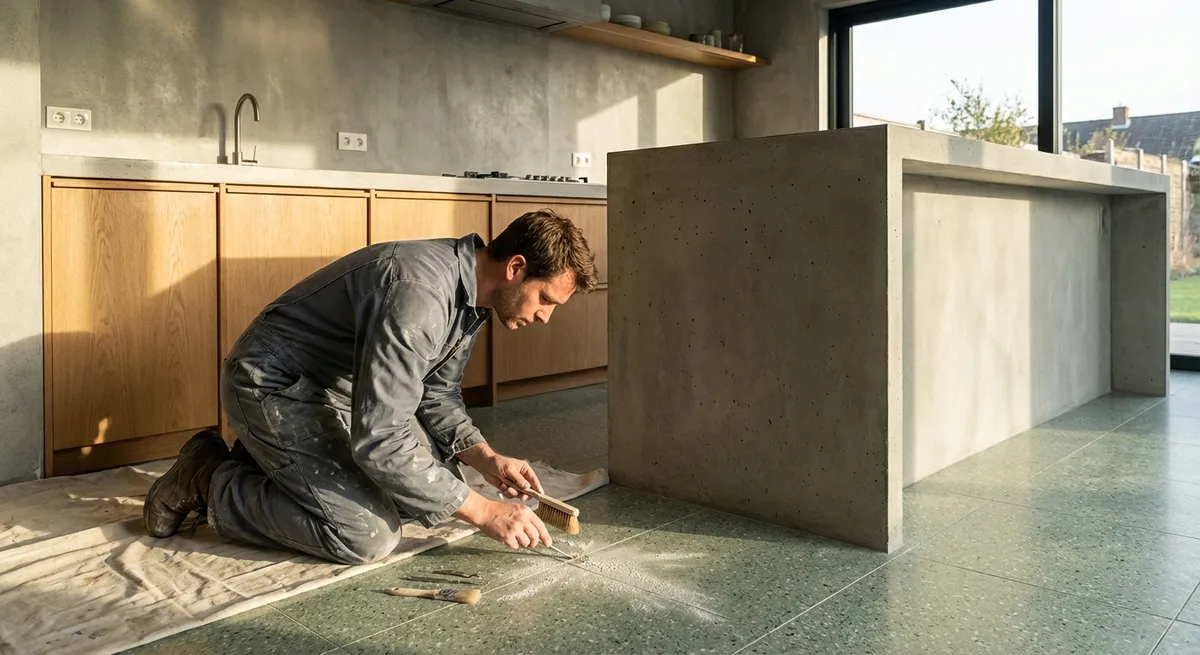
Understanding When Tile Should Be Repaired—Not Replaced
Not every flaw requires a full-section demolition. An expert eye distinguishes between superficial blemishes and structural concerns, allowing for interventions that are measured rather than excessive.
Hairline cracks in otherwise stable tiles, localized chips, or isolated stains in grout often respond beautifully to precision repair techniques. Conversely, repeating cracks along a line, hollow-sounding tiles across an area, or widespread grout failure usually signal substrate or movement issues that demand a deeper remedy.
Sophisticated repair begins with diagnosis: understanding why the damage occurred before deciding how to correct it. Moisture migration, thermal expansion, incorrect mortar choice, or inadequate movement joints all leave clues. A premium repair strategy addresses the cause as carefully as the symptom, so the same problem doesn’t reappear in a few seasons.
Exclusive Insight #1: Treat patterns of damage as a “map.”
Before authorizing any work, ask your tile professional to explain the pattern of failures—not just the individual defects. A brief walkthrough with a straightedge, moisture meter, and a rubber mallet (for sounding hollows) offers a surprisingly precise picture of underlying conditions and prevents piecemeal, ineffective fixes.
Precision Matching: Color, Sheen, and Micro-Texture
The true test of refined tile repair is not whether damage is “covered,” but whether the surface reads as uninterrupted in real daylight. That requires more than picking “white” or “gray.”
For tile surfaces, resin-based fillers and epoxies can be tinted with artist-grade pigments to mirror veining, speckles, or cloudy tonal shifts. Matching the sheen is equally critical: a repair that’s the right color but the wrong gloss level will pop visually. Skilled technicians layer matte and satin sealers or micro-abrasive polishing pads to dial the finish until it disappears at a casual glance.
Grout introduces its own challenges. Cementitious grout ages and absorbs contaminants, subtly shifting tone over time. A luxury-level repair respects the patina rather than fighting it. Instead of regrouting a single joint with “fresh” color, an expert may blend pigments and use grout colorant or stain to softly unify new and existing lines.
Exclusive Insight #2: Approve repairs under natural light—not just work lights.
Ask to review sample patches or test areas in mid-day ambient light, not under harsh task lamps. North-facing light and indirect daylight reveal mismatched tones and incorrect sheen levels that might go unnoticed under bright, direct illumination.
Structural Integrity: Subtle Interventions Behind the Surface
The most elegant repair is anchored in structural stability, even when that work is invisible once complete. Movement, moisture, and substrate failure are the quiet saboteurs of even the most beautiful installations.
In select cases, micro-injections of low-viscosity epoxy beneath hollow tiles can re-bond them to the substrate without full removal, preserving factory edges and intricate layouts. Where cracks telegraph from below, modern crack-isolation and uncoupling membranes can be surgically introduced in small zones after lifting targeted tiles, then re-tiled with salvaged or carefully sourced replacements.
In wet areas, understanding waterproofing continuity is non-negotiable. Penetrations created during repair—around niches, drains, or linear channels—must be re-sealed with manufacturer-approved membranes or liquid-applied waterproofing systems, not generic caulk.
Exclusive Insight #3: Request documentation of materials behind the tile.
For any repair that touches substrates or waterproofing, ask your contractor to list specific membranes, mortars, and sealants used, including brands and product names. This “behind-the-wall spec sheet” becomes invaluable if you later remodel, extend a shower, or troubleshoot a warranty issue.
Curated Strategies for Legacy and Discontinued Tile
High-end homes often feature imported, custom-run, or discontinued tile that can’t be replaced with a simple reorder. Here, unsophisticated repairs can permanently downgrade a space; refined strategies protect both the aesthetic and the investment.
The first step is an inventory: counting every loose, cracked, or at-risk tile and comparing it to any attic or basement storage stock. Smart professionals will remove intact tiles from inconspicuous areas (inside closets, behind appliances, under toe kicks) to “harvest” exact matches for high-visibility zones, then backfill the hidden areas with close cousins or different formats altogether.
For truly irreplaceable tiles, conservation-minded approaches—fine crack stitching, edge reconstruction, and in-situ reinforcement—may be preferable to lifting. In historical or architect-specified spaces, this can preserve authenticity where substitution would feel jarring.
Exclusive Insight #4: Establish a “tile reserve” policy for your home.
After any future renovation, ask your installer to leave a curated box of spare tiles, trim pieces, and even partial cuts—clearly labeled by room and date. Store this “reserve” as carefully as you would extra hardwood planks or paint formulas. A well-managed tile archive is the single most powerful asset for seamless, premium repairs a decade later.
Finishing Details: Grout, Edge Profiles, and Visual Rhythm
Even flawless tile replacement can look compromised if the finishing details are treated as an afterthought. Grout width, alignment, and edge profiles quietly govern how polished a repair feels.
Where possible, grout joints should align precisely with existing layout grids, even if that means trimming replacement tiles by fractions of a millimeter. In premium work, installers will dry-lay tiles first, tuning joint spacing so that repaired sections do not introduce visual “hiccups” in long runs or feature walls.
Edges and transitions deserve the same care. High-end spaces often rely on metal trims, mitred corners, or flush thresholds rather than bulky, off-the-shelf solutions. During repair, matching the existing edge strategy—whether it’s a razor-thin stainless profile, a perfectly polished stone mitre, or an invisible Schluter-style termination—is what maintains the architectural intent of the original design.
Exclusive Insight #5: Ask for a “visual rhythm check” before grouting.
Before grout is installed, step back with your installer and assess the sightlines: along corridors, across shower walls, under cabinets, and at thresholds. This is the last moment when micro-adjustments to joint alignment, trim positioning, or tile orientation can still be made. A few minutes of patient review here can prevent lifelong annoyance with a misaligned or visually noisy repair.
Conclusion
In distinctive homes, tile is part of the architectural language, not a disposable surface. Elevated repair solutions respect that language by balancing technical rigor with visual sensitivity. The most successful interventions are those you never consciously notice—they simply restore continuity, function, and a sense of calm completion.
By insisting on thoughtful diagnosis, nuanced color and sheen matching, robust structural techniques, strategic tile stewardship, and meticulous attention to finishing details, you transform tile repair from emergency patchwork into a disciplined, design-conscious practice. The result is not merely a fixed flaw, but a revived surface that continues to support the larger story your home is telling.
Sources
- Tile Council of North America (TCNA) Handbook - Industry guidelines and standards for tile installation and related repair best practices
- Schluter Systems: Tile Installation Systems - Technical details on membranes, waterproofing, and profiles used in professional repair and remodeling
- Mapei Technical Resources - Manufacturer specifications for mortars, grouts, epoxies, and crack-isolation products relevant to advanced tile repair
- U.S. Environmental Protection Agency – Moisture Control Guidance - Authoritative guidance on moisture issues that often underlie tile and grout failures
- International Association of Certified Home Inspectors – Tile Floor Inspection Guide - Professional inspection perspectives on common tile defects and underlying causes