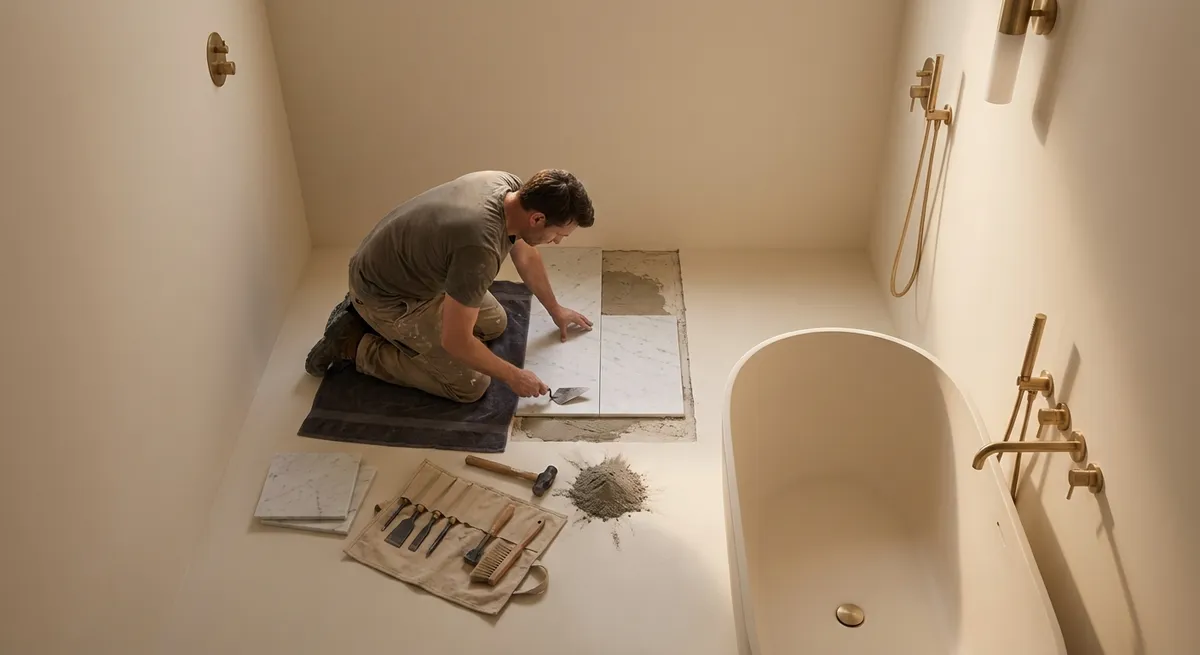
Reading the Surface: Diagnosing Before You Touch a Tile
The most sophisticated repair begins with disciplined observation. Before lifting a single tile, note how light travels across the surface throughout the day: grazing light at dawn or dusk will exaggerate lippage, hairline cracks, and subtle plane shifts that are nearly invisible at noon. Photograph the area from multiple angles and distances; zoomed-in images can reveal micro-fissures, pinholes in grout, or very slight hollow sounds that suggest debonding beneath.
Tap gently with a coin or the plastic end of a tool, listening for changes in tone: a clear, sharp sound generally suggests solid bonding, while a dull or echoing note often indicates voids or failure in the setting bed. Pay attention to patterns rather than isolated anomalies—an entire edge of a shower niche sounding hollow may signal movement or inadequate waterproofing, whereas a single tile may simply have poor coverage. This investigative phase allows you to distinguish aesthetic concerns from structural ones and to choose a repair strategy proportional to the actual risk, rather than reacting out of anxiety.
Material Fidelity: Sourcing Replacements with Architectural Discipline
When replacement becomes inevitable, the manner in which you source new material determines whether your repair reads as a quiet continuation or a jarring punctuation. Begin by identifying the original tile with as much specificity as possible: manufacturer, series name, color code, finish (matte, honed, polished), caliber, and shade rating. Many high-end manufacturers maintain detailed product archives and can advise whether existing stock, overrun material, or an updated equivalent is available.
If the original line has been discontinued, resist the temptation to approximate casually. Instead, treat the repair like a miniature restoration project. Order samples of potential matches and view them on-site in the same orientation and lighting as the installed tile. Test them both dry and slightly damp; natural stone and many porcelains deepen or shift in color when wet, and this behavior matters in showers, entries, and kitchens. For surfaces where an exact match is impossible, consider a deliberate offset: using subtly framed “field replacements” in a border, threshold, or inset that reads as an intentional design gesture rather than a near-miss patch. In a refined home, honesty in the transition is more elegant than a failed attempt at invisibility.
Insight 1: Strategic “Invisible” Repairs Through Pattern and Joint Management
One of the most underutilized techniques in tile repair is exploiting the existing pattern and grout joints to render interventions nearly imperceptible. Instead of replacing a single conspicuous tile in the middle of a large field, consider lifting tiles along a natural break: a doorway, an alignment with casework, or a change in direction. By distributing new tiles along a joint line or in a band, the human eye reads the change as part of the geometry rather than as damage control.
Similarly, grout joints can be refined during repair to quiet visual noise. If your grout has suffered minor cracking or discoloration but the tiles are structurally sound, a professional regrout—or, in select cases, a carefully executed grout overlay with a premium, color-consistent product—may restore visual unity without disturbing the tile bed. This approach also allows subtle correction: slightly deepening or sharpening joint lines can enhance shadow play and crispness, making a once-tired installation appear newly intentional.
Insight 2: Elevating Grout Selection from Afterthought to Performance Layer
In many homes, grout is treated as a commodity; in considered interiors, it functions as a performance layer as important as the tile itself. During repair, upgrading grout technology can meaningfully improve both longevity and daily ease of living. Cementitious grout may be appropriate in many contexts, but for high-use or high-moisture areas—kitchens, master showers, entry vestibules—epoxy or high-performance hybrid grouts can provide superior stain resistance, color stability, and reduced maintenance.
This is especially relevant when blending new grout with old. A skilled installer can feather transitions and color-match more closely by working with premium lines that offer sophisticated shade ranges and stable pigments. In some cases, lightly cleaning and then sealing existing grout prior to working with new material prevents uneven absorption and mottling between zones. The result is a repair that reads as a calm, continuous surface rather than a patchwork of slightly different tones and textures.
Insight 3: Respecting Movement—Substrates, Transitions, and Micro-Flexibility
Many tile failures trace back not to the tile or grout, but to ignored movement. Subtle shifts in substrates, thermal expansion, and differential movement between materials (tile to hardwood, tile to concrete, tile over heated floors) accumulate over time. When repairing, this is your opportunity to upgrade the underlying conditions, not merely address the symptom.
Look critically at transitions between rooms and materials. Introducing properly placed movement joints—whether visible as slender, color-matched profiles or concealed at perimeters—can prevent future cracking and tenting. In areas prone to expansion (large south-facing floors, sunrooms, exterior-adjacent spaces), a premium decoupling or crack-isolation membrane during a localized repair can significantly reduce stress transfer from the substrate. These membranes allow a degree of micro-flexibility, protecting the tile layer from hairline cracks in the slab or minor substrate shifts, and can be precisely integrated only where needed, preserving as much of the original assembly as possible.
Insight 4: Water as a Silent Editor—Upgrading Waterproofing with Surgical Precision
In wet areas, water is the quiet critic of flawed assemblies. Any repair in showers, steam rooms, or around tubs should presume that moisture management is as important as visual matching. Before retiling, explore the opportunity to open and inspect vulnerable zones: shower corners, niches, benches, thresholds, and window returns. If there is any sign of darkening, swelling, or musty odor, partial demolition to the substrate, followed by a modern waterproofing system, is not an extravagance—it is insurance.
Contemporary waterproofing membranes and liquid-applied systems allow targeted improvements. For example, a failing niche can be rebuilt with a preformed waterproof unit integrated into the existing wall system, then retiled with your matched material. Upgrading the slope on benches and thresholds within the repair zone helps water shed efficiently rather than lingering. The visible outcome is calm and seamless, but behind the scenes, you have converted a vulnerable point of failure into a robust, engineered assembly.
Insight 5: Curating Patina Versus Perfection—Knowing When Not to Repair
In sophisticated spaces, the most elevated decision is sometimes restraint. Not every minor imperfection warrants intervention; some become part of a curated patina that gives a room character and depth. Honed natural stone, for instance, will often acquire micro-etching, faint scratches, or slight matte spots over years of use. Attempting to erase every sign of life can lead to over-polishing, patchy sheen levels, or unnecessary thinning of the stone surface.
Learn to differentiate between “healthy patina” and actual degradation. If a flaw does not affect structural integrity, safety, or hygiene—and can be softened through gentle cleaning, professional honing, or sealing—it may be more elegant to preserve it as part of the room’s narrative. This philosophy is particularly compelling in older homes or in spaces where the tile has been in place for decades. There, the measure of refinement is not in how new everything appears, but in how gracefully it has aged, and how intelligently true damage is addressed without erasing history.
Coordinating with Craftspeople: Setting an Elevated Standard
Finally, the caliber of a repair is often determined less by the materials and more by the ethos of the craftsperson executing it. When engaging a tile professional, speak in terms of performance and intent, not just tasks. Explain that your priority is preserving sightlines, maintaining plane continuity, and protecting substrates—not simply “replacing damaged tiles.” Request dry layouts, on-site sample boards for grout, and mockups for complex transitions.
Clarify tolerance expectations: a refined project may demand tighter alignment, cleaner joint terminations, and sharper edge treatment than a standard renovation. Ask how dust, noise, and protection of adjacent finishes will be managed; a premium repair respects not only the tile but the entire home. When owner and installer share an understanding that the goal is a quiet, disciplined intervention rather than a quick fix, the resulting work will harmonize with the original installation instead of competing with it.
Conclusion
Truly elevated tile repair is less about dramatic transformation and more about cultivated continuity. By diagnosing with care, sourcing materials with architectural rigor, upgrading hidden assemblies, and embracing patina where appropriate, homeowners can steward their tile installations with the same discernment used in their original selection. The reward is a home in which surfaces age gracefully, interventions are almost impossible to detect, and every refinement—visible or concealed—supports a life lived beautifully.
Sources
- TCNA Handbook – Tile Council of North America - Industry reference for tile installation methods, movement joints, and substrate preparation
- Schluter Systems – Movement Joints and Uncoupling Membranes - Technical guidance on managing movement and protecting tile assemblies
- LATICRETE Technical Data Sheets - Detailed information on grouts, waterproofing, and crack-isolation products
- Mapei Grout and Sealant Guide - Overview of grout technologies, performance characteristics, and selection considerations
- Natural Stone Institute – Care and Maintenance - Best practices for preserving and refining stone surfaces, including patina and repair considerations