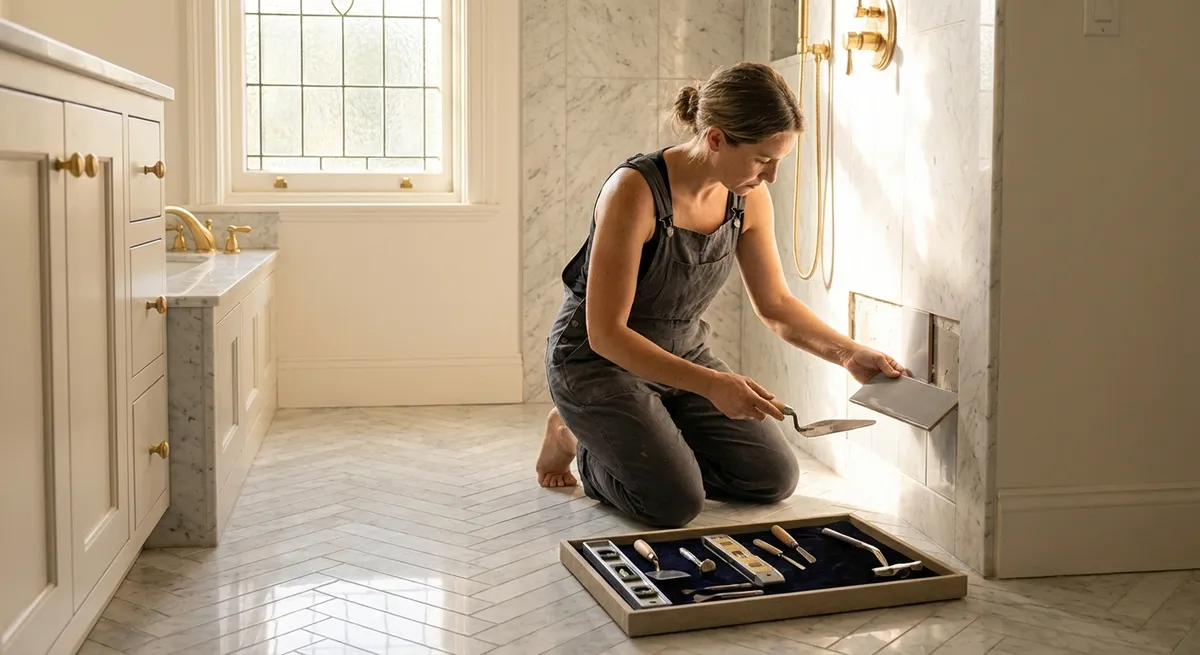
Reading the Surface: Diagnosing Before You Touch a Tile
Before a single tool comes out, a refined repair begins with observation. The objective is to understand whether you are dealing with superficial damage, a localized failure, or a symptom of a deeper structural issue. Hairline cracks in grout alone, for example, may indicate normal movement and aging; repeating cracks in the same pattern across tiles might point to substrate issues, improper expansion joints, or structural deflection beneath the assembly.
A discerning homeowner will look for patterns rather than isolated flaws: hollow sounds when you tap tiles lightly with a wooden handle, consistent discoloration around a specific area, or grout lines that shrink, darken, or powder. In wet zones, subtle signs such as persistent dampness, efflorescence (white crystalline deposits), or musty odor may signal water intrusion behind the tile. These indicators often determine whether a localized repair will suffice, or whether the assembly needs more extensive remediation.
The most elegant repairs are those that respond to the cause of the problem, not just its aesthetics. Taking time to diagnose properly—sometimes with professional moisture meters or inspection cameras—ensures that your repair will feel invisible not only on day one, but years later.
The Art of Partial Replacement: Matching Tile, Grout, and Aging
When a single broken or loose tile interrupts an otherwise flawless installation, the question becomes: can you replace just that tile without creating a visible “new” square in a field of aged material? The answer lies in a tightly controlled process: sourcing, removal, and integration.
Sourcing is your first refinement. Ideally, you’ve kept attic or garage stock from the original install—an investment that pays exponential dividends during repairs. If not, you’ll need to go beyond color alone and match tile body, surface finish, edge profile, and even nominal size variances between production batches. Under warm lighting, slight differences in glaze sheen or micro-texture become more apparent, especially on larger-format or polished surfaces.
Removal demands precision. Rather than prying and risking damage to neighboring pieces, a professional-grade approach involves cutting through the grout perimeter, then carefully segmenting the damaged tile (often with an angle grinder or oscillating multitool and appropriate dust controls) before lifting it away in sections. The goal is to preserve the setting bed and adjacent tiles as much as possible.
Integration—the final aesthetic test—requires meticulous grout color matching, sometimes including intentional subtle variation or “soft aging” techniques to ensure the new installation doesn’t look clinically fresh. The most successful partial replacements are the ones you forget the moment you stand up and view the entire surface.
Substrate Secrets: Quiet Corrections Beneath the Finish
The refinement of a tile repair is determined long before new grout is applied; it begins with how you address what lies beneath. Many persistent issues—recurrent cracking, tenting tiles, or drums when tapped—trace back to compromises in the substrate or setting system, not the tile itself.
When opening up a problem area, an exacting homeowner (or their contractor) will assess substrate flatness, structural integrity, and moisture conditions. Cement backer boards should be properly fastened and taped; concrete slabs should be checked for excessive moisture or shrinkage cracks; wood subfloors need to meet minimum stiffness requirements and be suitably prepared for tile. If an underlayment or membrane was omitted or improperly installed, a targeted upgrade during repair can transform the long-term performance of the entire assembly.
In select cases, modern decoupling or waterproofing membranes can be introduced only where needed, beneath a repaired area, to address localized movement or moisture while maintaining continuity with the existing installation. The key is to transition these materials with precision: feathering heights, preserving movement joints, and making sure the repaired zone responds in harmony with the rest of the surface. Done well, these “quiet corrections” beneath the tile prevent a cycle of recurring visible failures.
Intelligent Blending: Treating Grout as a Design Element, Not Filler
Grout is often miscast as a secondary material, but in a refined repair, it is the element that either reveals or conceals your intervention. Its color, texture, joint fullness, and sheen affect the entire composition of the tiled field.
When addressing stained, cracked, or deteriorated grout, sophisticated repair goes beyond simply “regrouting.” In many situations, a controlled grout removal to an appropriate depth, followed by a premium, color-consistent replacement can unify the appearance and reset performance—especially when paired with a penetrating sealer selected for the specific tile and use environment.
Color-matched caulks or sealants at changes of plane (corners, tub-to-wall, countertop-to-backsplash) are another detail that separates a quick fix from a considered repair. Where brittle grout may have been incorrectly used, replacing it with an appropriate flexible sealant preserves the visual rhythm of the joints while accommodating expected movement.
For homeowners seeking elevated subtlety, professional grout colorants or tinting can fine-tune tone to blend old and new zones, particularly in cases where entire grout removal would be unnecessarily invasive. This approach requires careful surface prep and product selection to ensure longevity and stain resistance. When executed with care, the grout becomes a deliberate visual thread tying the installation together rather than a patchwork of multiple repair eras.
Five Exclusive Insights for the Detail-Driven Homeowner
Within the realm of tile repair, a few rarely discussed practices distinguish truly elevated work from the merely competent:
Micro-Mapping Before Intervention
Photograph and mark the existing field—literally mapping hairline cracks, hollow spots, and grout irregularities. This record not only guides surgical repairs today but also serves as a baseline reference if you reassess the surface in a year, helping you confirm that issues are resolved, not migrating.
Staged Lighting Assessment
Evaluate the area under multiple lighting conditions: daytime natural light, evening accent lighting, and grazing light (from a flashlight held low to the surface). Many imperfections, lippage issues, or sheen discrepancies are only visible when light rakes across the tiles. Designing your repair to satisfy the most unforgiving lighting condition ensures day-to-day perfection.
Respecting Original Layout Logic
When replacing tiles, preserve the original layout hierarchy—centering lines, focal points, and cuts. If you must alter more than one tile, expand outward in a way that maintains balanced cuts at edges and corners. Disregarding the original layout turns a repair into a visual interruption rather than a continuation of the designer’s intent.
Moisture and Movement Documentation
Where moisture or structural movement is suspected, capture quantitative facts: moisture meter readings, crack width measurements, and notes on seasonal variations. These details help you and any future professionals distinguish between normal building behavior and conditions that demand more extensive intervention.
Finishing the Repair with a System, Not a Product
Think in terms of systems—substrate, adhesive, grout, sealant, and maintenance regimen—rather than isolated materials. Premium repair work aligns all components: a higher-performance thinset or mortar where necessary, compatible membranes, grout chosen for stain resistance or flexibility, and a scheduled care routine. This holistic view ensures that the repair does not become the weakest link in an otherwise excellent installation.
Conclusion
Sophisticated tile repair is a discipline of restraint and precision. It is about reading the story your surfaces are telling, intervening only where necessary, and honoring both the material and the original design intent. When homeowners embrace careful diagnosis, substrate refinement, intentional blending, and system-level thinking, repairs cease to be mere fixes and become curated adjustments—quietly elevating the entire space.
In a well-considered home, the most successful tile repairs are not the ones you notice; they are the ones that allow the surface to continue its life, seamlessly, beautifully, and with renewed integrity.
Sources
- American National Standards Institute (ANSI) – Tile Installation Standards - Overview of industry standards for tile installation and repair performance
- Tile Council of North America (TCNA) Handbook - Authoritative reference for recommended methods, substrates, and detailing for tile assemblies
- Schluter Systems – Substrates and Preparation - Technical guidance on preparing substrates and using membranes in new work and repairs
- U.S. Environmental Protection Agency – Mold & Moisture in Buildings - Background on diagnosing and addressing moisture issues that can affect tiled wet areas
- National Institute of Standards and Technology (NIST) – Building Materials and Structures - Research-based information on building material performance, movement, and durability