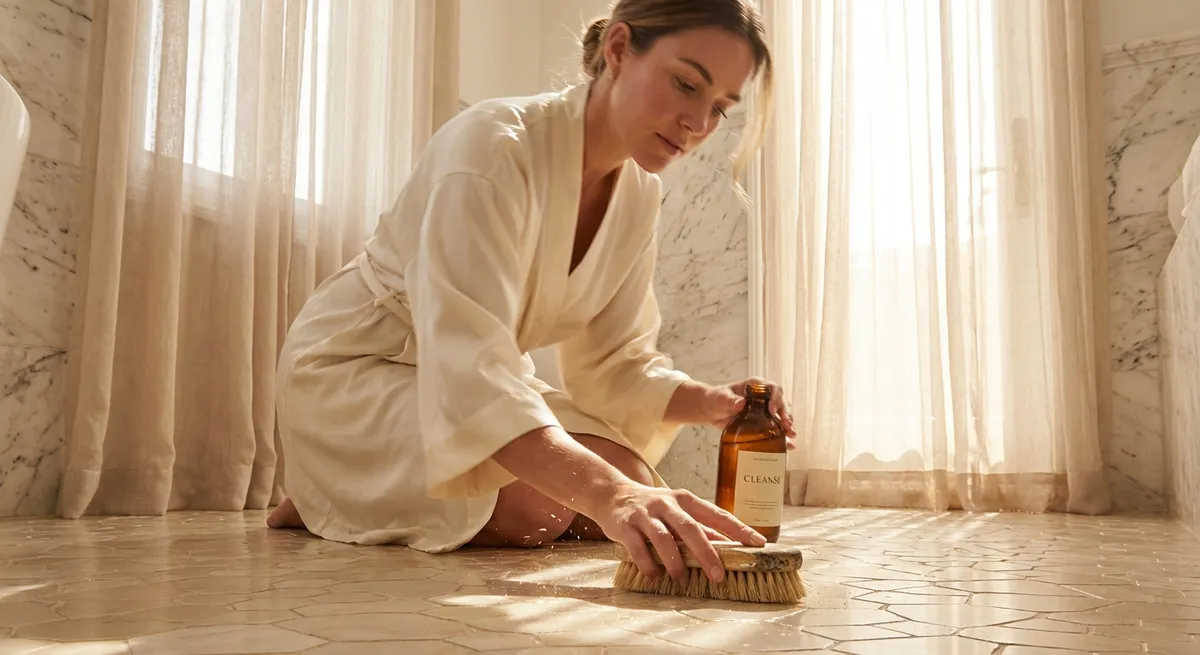
Below are five exclusive, detail-driven insights that elevate tile maintenance from routine to ritual—subtle practices that discerning homeowners and design professionals rely on to keep surfaces looking composed for decades.
1. Calibrating pH: Why “Gentle” Cleaners Still Matter at a Molecular Level
The difference between a tile surface that gleams for years and one that dulls in a season often comes down to pH balance. Many off-the-shelf products labeled “multi-surface” or “deep clean” quietly erode grout lines, etch natural stone, or leave polymeric films on porcelain and ceramic.
Mild, pH-neutral cleaners (around pH 7) are ideal for most glazed ceramic, porcelain, and sealed stone because they lift soils without interacting aggressively with cementitious grout or sealers. Acidic formulations (like vinegar or citrus-based solutions) can be especially damaging to marble, limestone, and travertine, dissolving microscopic layers and leaving a matte, blotchy appearance. Alkalis (like ammonia or heavy-duty degreasers) can dry out grout, soften certain sealers, and create a hazy film that traps dirt.
The refined approach is to select tailored cleaners by tile type and finish. For example, satin or honed surfaces benefit from regularly scheduled, low-impact cleaning rather than occasional “strong” cleanings. Investing in a high-quality, pH-neutral floor cleaner and a separate stone-safe formula—used sparingly but consistently—maintains clarity of color and sheen while protecting the microstructure of both grout and tile.
2. Grout as a Design Asset: Protecting Color and Texture Before It Fades
In many luxury spaces, grout is the quiet design element that makes the composition feel intentional: the exact warm gray that softens veining, the whisper-thin joint that makes a large-format installation feel monolithic. Maintenance that treats grout as expendable quickly undermines this carefully curated effect.
The first step is sealing: not as an afterthought, but as part of the original maintenance plan. High-performance, penetrating sealers reduce the absorption of oils, pigments, and everyday grime, meaning stains tend to sit on or near the surface where they can be lifted instead of permanently embedded. This is particularly critical for light-colored grout in kitchens, entries, and primary baths, where beauty and heavy use intersect.
Refined maintenance goes further. Instead of aggressive scrubbing with stiff brushes that fray or gouge grout, use a soft-bristle brush targeted only where needed. Periodic, focused refresh sessions—where grout lines receive a dedicated clean and, if necessary, a re-seal—keep joints crisp and visually even. If a line has darkened in high-traffic zones, an early, precise intervention is far more effective (and less disruptive) than waiting until full recoloring or regrouting is required.
3. Micro-Zoning Your Cleaning: Traffic Mapping for Luxury Surfaces
In high-end interiors, maintenance should be as thoughtfully zoned as the lighting and furnishings. Treating every square foot identically is an efficient way to accelerate wear where it matters most. Instead, consider a “micro-zoned” approach, where maintenance intensity is aligned with how the space is actually used.
Entry corridors, kitchen work aisles, and the path from bedroom to bath often bear the heaviest foot traffic. These areas benefit from more frequent dry maintenance—vacuuming with a soft-brush head or dust-mopping—to remove grit that can abrade glazed surfaces and matte finishes alike. Wet cleaning can then happen more selectively, with higher frequency in these bands and a lighter schedule in low-traffic corners, under large furniture, or in decorative niches.
For particularly precious finishes (such as hand-made tiles, specialty glazes, or ultra-large slabs), consider subtle “sacrificial” measures: elegant, low-profile mats at doorways, a runner in a high-traffic gallery, or felt pads beneath moveable furnishings. The visual impact is minimal; the benefit to the tile surface over years of use is substantial. This kind of nuanced zoning respects both the material and the way your household genuinely lives in the space.
4. Managing Moisture with Intention: Beyond “Just Let It Dry”
Water is both tile’s natural companion and its quiet adversary. While tile itself is often highly resistant to moisture, the surrounding systems—grout, thinset, substrate, and adjacent materials—can be compromised by chronic dampness. In luxury baths, steam showers, and spa-inspired suites, elevated maintenance focuses not just on cleaning, but on disciplined moisture management.
Daily habits make a pivotal difference: using a squeegee on shower walls and glass immediately after use, gently toweling niche shelves and benches, and ensuring ventilation fans run long enough to exhaust residual humidity. These small rituals reduce mineral buildup, soap film, and mildew pressure on grout and silicone joints, preserving their elasticity and color.
Periodic inspections are equally important. Look for hairline cracks in grout, missing caulk at transitions, or slight discoloration along corners and perimeters. Addressing these issues early prevents moisture from migrating behind the surface, where it can compromise backing materials and eventually telegraph through the tile assembly. In a meticulously finished room, the most sophisticated maintenance is often invisible—quiet reinforcement before anything looks “wrong.”
5. Preserving Finish Integrity: Protecting Sheen, Texture, and Edge Detail
Premium tile installations are defined by nuance: the way a honed stone softens light, the sculptural relief of a dimensional wall tile, or the precise edge at a stair nosing. Maintenance that respects those details avoids generic, high-friction tools and “one-solution-for-every-surface” thinking.
For floors, opt for soft microfiber mops over traditional string mops, which can leave excess water in grout joints and push dirt into surface texture. When dealing with textured or slip-resistant tiles, choose brushes that are firm enough to reach into the micro-texture without scratching the glaze—nylon over metal, and always tested in an inconspicuous area first. Avoid abrasive powders or pads unless explicitly recommended by the tile manufacturer; many polished and specialty glazes can be permanently dulled by a single overly aggressive session.
Edge protection is another overlooked refinement. Be cautious when moving ladders, barstools, or rolling furniture across tiled areas: a protective layer (felt, rubber, or a temporary runner) prevents impact chips and micro-fractures along edges. In stair applications and step-downs, confirm that anti-slip strips, metal nosings, or integrated trims are kept clean and free of grit, which can act like sandpaper underfoot.
In essence, the most elevated maintenance philosophy is this: clean to reveal the beauty of the finish, never to “force” it back to perfection through intensity. When you respect the original materiality, your tile responds with enduring, quiet luxury.
Conclusion
Exceptional tile work deserves maintenance that is as considered as the design itself. By balancing pH, honoring grout as a design component, zoning your effort according to real-world traffic, handling moisture with discipline, and protecting finishes with precision, you transform cleaning from a chore into a stewardship ritual.
Over time, these understated practices create a home where tile surfaces do not merely endure—they age gracefully, holding their color, clarity, and composure even under daily use. That is the true mark of a well-kept, beautifully resolved space: the luxury of surfaces that always feel quietly “just right,” without ever revealing the work it takes to keep them that way.
Sources
- U.S. Environmental Protection Agency – Safer Choice: Finding Safer Products – Guidance on selecting cleaning products with safer chemistries, useful when choosing pH-neutral, low-impact cleaners.
- University of Tennessee Extension – Care and Cleaning of Ceramic Tile Floors (PDF) – Practical, research-based recommendations on cleaning methods and the impact of different products on tile and grout.
- Natural Stone Institute – Stone Care and Maintenance – Authoritative information on proper maintenance of natural stone surfaces, including pH considerations and sealer use.
- Tile Council of North America (TCNA) – Ceramic Tile: Cleaning and Maintenance Tips – Industry-level guidance on the correct cleaning practices for ceramic and porcelain tile and grout systems.