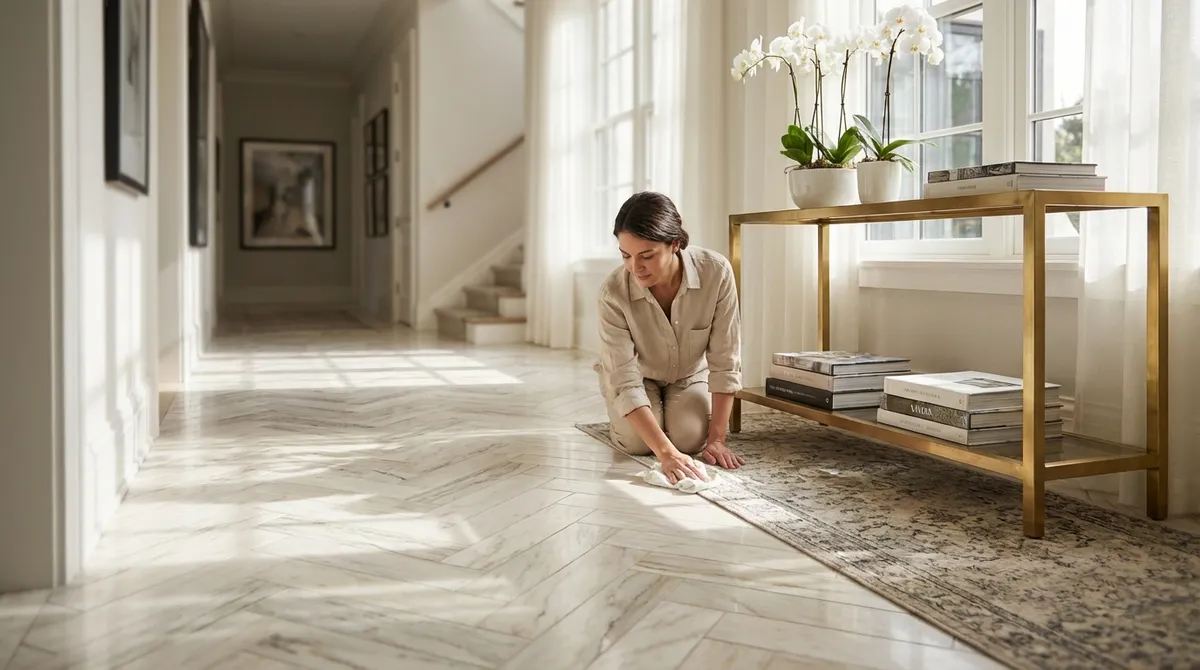
Below are five exclusive, detail-driven insights that discerning homeowners can use to keep tile work looking impeccably composed for years.
1. Calibrating Cleaners to the Finish, Not Just the Material
Many homeowners choose a cleaner based solely on what the tile is made from—ceramic, porcelain, marble—without considering the finish. Yet it’s the finish (polished, honed, matte, textured) that most determines how the surface responds to daily care.
Polished stone, for instance, may technically withstand pH-neutral cleaners, but a formula with surfactants designed for “shine enhancement” can leave a faint film that dulls clarity over time, especially under raking light. Honed or matte finishes, conversely, can become visually “splotchy” when silicone- or wax-based products are used, as residue collects in microscopic surface variations.
For a refined result, select products in two steps: first, confirm they are appropriate for your tile’s material (e.g., no acids on natural stone, non-abrasive on glazed ceramic). Then refine your choice by finish:
- For polished stone: pH-neutral, residue-free cleaners specifically labeled “no-rinse” or “no streaking,” and free of waxes or “shine boosters.”
- For honed or matte surfaces: matte-safe formulations with low surfactant load, avoiding anything promising added gloss.
- For high-texture tiles: solutions with slightly higher surfactant content that can lift dirt from crevices, ideally applied with microfiber or soft-bristle tools.
This finish-forward approach helps your tile reflect (or absorb) light as intended, preserving the designer’s original vision.
2. Managing Light and Reflection to Reveal (and Prevent) Wear
A truly elevated maintenance routine doesn’t start at the cleaning closet; it starts with the lighting plan. The way light falls across your tile dramatically influences how wear reads to the eye—streaks, etched spots, micro-scratches, and uneven sheen are almost always revealed by directional light.
Raking light from floor-to-ceiling windows or low-mounted wall sconces highlights even minor surface irregularities. This doesn’t mean avoiding dramatic light; it means cleaning with that light in mind:
- Observe your tile at different times of day and under both natural and artificial light. Note where streaking or fine scratches become most apparent.
- Align cleaning strokes with the dominant light direction. When mopping, move in the same direction as the light flow, not across it—this reduces the perception of streaks.
- For glossy tiles, use ultra-low-lint microfiber and wring it thoroughly; excess water combined with directional light exaggerates swirl marks and water trails.
- In high-exposure zones (south-facing entries, sun-soaked kitchens), consider matte or honed finishes from the outset; they are more forgiving to both light and life.
By treating light as part of your maintenance strategy, you preserve not only the cleanliness of the tile, but the way the surface visually performs in your space.
3. Rethinking Grout: From Afterthought to Precision Maintenance Zone
Most tile maintenance conversations underestimate grout, even though it is the element most prone to visible aging. A refined approach treats grout as its own material system, with its own care strategy, rather than simply the space between tiles.
First, understand what you have: cementitious grout, epoxy grout, or a specialty formulation. Cementitious grout is porous and more vulnerable to staining, while epoxy is denser and more resistant. Both benefit from considered care:
- Spot-treat, don’t saturate. When addressing stains, use a small brush (a soft-bristle toothbrush or dedicated grout brush) and apply cleaner directly to the line rather than flooding the entire floor. This avoids overworking adjacent tile and keeps moisture away from underlying substrates.
- Neutralize after deep cleaning. If you’ve used an alkaline or specialty cleaner on grout, follow with a clean water rinse and thorough drying to avoid leaving chemical residue in the joints.
- Consider color-consistent touch-ups. In areas of heavy wear, a professional recoloring or grout stain sealer can restore uniformity and build in extra protection, especially in light-toned or high-contrast grout lines.
Treating grout as a precision maintenance zone, not a maintenance afterthought, keeps the overall surface looking cohesive and quietly luxurious—particularly in bathrooms and kitchens where visual continuity is paramount.
4. Silent Protection: Understated Measures That Preserve Luxury
The most effective tile protection is often invisible. Refined maintenance favors subtle interventions that don’t advertise themselves but significantly reduce long-term wear.
A few examples:
- Entrance choreography: Instead of a single doormat, consider a short “runway” of discrete, high-quality mats just inside the entry. The first captures grit, the second captures residual moisture. Both protect your tile from micro-abrasion and water spotting without intruding on the design.
- Furniture interface: Replace standard felt pads with dense, high-quality versions and inspect them seasonally. Cheaper pads compress or accumulate grit, turning chair legs into fine sandpaper on polished tile.
- Water discipline: In bathrooms and around kitchen sinks, teach a simple habit—towels or floor cloths used immediately after heavy splashing. Tile itself tolerates water; it’s the repeated wetting and incomplete drying that can leave mineral traces, promote mildew in grout, and strain subfloors.
- Zoned footwear policies: A quietly enforced “indoor shoe” approach—or at minimum, no outdoor shoes beyond the entry—dramatically reduces grit, oils, and de-icing salts that are especially harsh on natural stone.
These understated measures allow you to preserve a sense of ease and openness while quietly extending the life and luster of your tiled spaces.
5. Scheduling Maintenance by Use Pattern, Not Just by Time
Most guidance suggests cleaning tile on a weekly or monthly schedule. A more elevated approach recognizes that different zones of your home age at different speeds. High-traffic corridors, powder rooms used frequently by guests, and kitchen prep zones require a more nuanced cadence than seldom-used formal spaces.
Instead of a rigid calendar, observe how your tile actually lives:
- Identify “primary wear lanes” where feet, chair legs, or water exposure are concentrated. Those may merit light, frequent cleaning and periodic deeper attention.
- Reserve more intensive treatments—like deep grout cleaning, re-sealing of natural stone, or machine buffing of certain finishes—for when the surface shows subtle visual cues, not purely based on date.
- In rarely used areas, avoid over-maintenance. Excessive scrubbing, aggressive chemicals, or unnecessary polish cycles can cause more wear than daily use would.
- Track interventions. A discreet note in a household log or design file—recording when stone was last sealed or grout was last professionally serviced—helps prevent both neglect and over-treatment.
By calibrating maintenance to how each space is actually used, you preserve the integrity of your tile installation with fewer, more intentional interventions—exactly the kind of quiet rigor that distinguishes a refined home.
Conclusion
Enduring tile luxury is not defined solely by the quality of the materials or the precision of the installation, but by how gracefully the surface lives over time. When your maintenance routine is guided by finish, light, grout behavior, subtle protection, and real-world use patterns, you elevate cleaning from a chore to a form of stewardship. The result is a home where tile doesn’t simply look “well kept,” but remains visually composed, texturally pleasing, and architecturally coherent—year after year.
Sources
- MAPEI – Guide to Tile and Stone Care & Maintenance – Technical guidance on appropriate cleaners, sealers, and maintenance practices for various tile and stone types
- Custom Building Products – Tile & Stone Care and Maintenance – Practical recommendations for preserving grout, sealers, and finishes in residential installations
- University of Tennessee Extension – Care of Natural Stone Flooring – Educational overview of proper cleaning methods and the effects of pH and abrasion on natural stone
- U.S. General Services Administration – Flooring Maintenance Best Practices – Evidence-based strategies for hard-surface floor maintenance, including considerations for finishes and traffic patterns