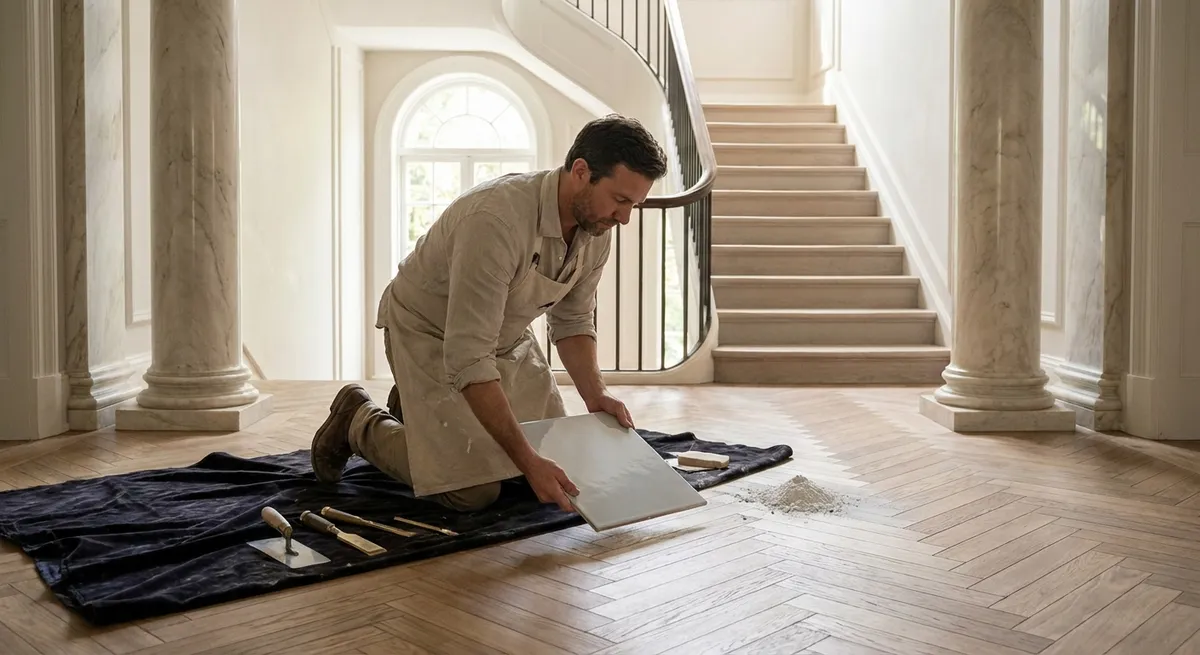
This guide explores elevated tile repair strategies for homeowners who value craftsmanship, continuity, and quiet excellence. Beyond basic patching, we’ll look at how to treat each repair as a micro-restoration, preserving both performance and design integrity.
Reading the Surface: Diagnosing Before You Touch a Tile
Sophisticated repair begins long before any adhesive is mixed. The first task is to “read” the surface: understand what has gone wrong and why. A cracked tile in an entryway may indicate subfloor movement; a cluster of hollow-sounding tiles might point to poor original bonding; efflorescence along grout lines could signal moisture migration. Each symptom has a structural story behind it.
Begin with methodical observation: note patterns in damage, proximity to transitions (doorways, corners, structural beams), and environmental stresses such as radiant heat or direct sun. Lightly tap tiles with a wooden dowel or the plastic end of a tool to identify hollow spots. For wet areas, observe how water drains and where it lingers. If a high-value installation—natural stone, large-format porcelain, or heated floors—is involved, consider a brief consultation with a tile specialist or structural engineer before authorizing any invasive work. Elegant repair is never guesswork; it is informed intervention.
Five Exclusive Insights for Discreet, High-End Tile Repairs
The difference between a visible patch and a seamless restoration often comes down to small, disciplined decisions. These five insights reflect the kind of refined approach that discerning homeowners quietly insist on.
1. Insist on Tile “Auditions” Under Real Lighting
Color, veining, and surface sheen shift significantly under different light sources. What appears to be a nearly perfect replacement tile on a workbench may read as a jarring mismatch once installed under your actual ambient and accent lighting.
For visible areas—foyers, primary baths, open-plan kitchens—ask your installer to “audition” candidate replacement tiles in situ. Place them dry-fit in the repair area and observe them at different times of day and under varied lighting scenes (task, accent, and dimmed evening light). For patterned or veined materials, review the orientation as well; a subtle direction change in marble veining or stone pattern can disrupt the visual flow more than a tiny color variance. Only when the tile passes this real-world test should it be permanently set.
2. Treat Grout as a Design Element, Not a Filler
In premium interiors, grout is a deliberate design choice, not a byproduct. During repairs, many installers focus on matching tile and treat grout as secondary. This is a mistake. Even slight differences in grout color, sand size, or sheen can announce a repair line from across the room.
Have your contractor prepare small test joints using the actual grout proposed for the repair, applied between old and sample tiles. Evaluate the color when wet and when fully cured, because grout often dries lighter. If your existing grout has aged, consider a broader grout-refresh strategy in the immediate zone so the repaired area blends, rather than looks unnaturally new. For very exacting spaces, professional grout colorants or sealers tinted to match the current tone can be used to “age” new grout subtly, bending it toward the surrounding field.
3. Protect the Subtle Geometry of the Layout
In refined tilework, the layout is sacred. The way joints align with architectural features—the center of a vanity, the sightline from an entry, the alignment of thresholds—creates an understated sense of order. Poorly executed repairs often fracture this quiet geometry by allowing a single tile to sit slightly off-line, out of plane, or rotated.
Before any tile is removed, ask your installer to mark critical reference lines: major grout lines, centerlines, and any alignments that connect to door frames, cabinetry, or other architectural elements. When replacing, they should check not only level and lippage (the height difference between adjoining tiles) but also the continuity of joint width and orientation. Even a 1–2 mm shift, if repeated or introduced in a focal area, can visually “tilt” the surface and betray the repair.
4. Use Repairs as an Opportunity to Upgrade Performance Quietly
An elegant repair can do more than restore appearance; it can quietly elevate the performance of the installation. When an area must be opened up, ask whether there is an opportunity to discreetly improve what lies beneath.
In wet areas, this might mean upgrading to a modern waterproofing membrane where the tile has failed, or reinforcing transitions where glass, metal, and tile meet. On older floors, it may be possible to stiffen a subfloor section, address minor deflection, or introduce modern crack-isolation products under a small repair. In heated floor zones, a repair can be a chance to verify, map, and document heating cable locations more precisely to prevent future damage. These improvements are largely invisible when finished, yet they meaningfully extend the life and comfort of the tiled surface.
5. Archive Your Installation: Samples, Codes, and Methods
Ultra-discreet repairs years down the line are only possible when the original installation was documented thoughtfully. If you are undertaking any significant repair now, treat it as a chance to create (or update) an “installation dossier” for your home.
Include: leftover tiles labeled with manufacturer, series, color, size, and batch or shade code; grout brand and exact color number; adhesive and waterproofing products used; and notes on substrate construction (backer board type, uncoupling mat, or mortar bed). Photograph the repair in progress, capturing what lies beneath the tile before it is closed. Store this dossier with your home records. Future repairs—whether performed by the same artisan or a new one—will be faster, more precise, and far less invasive when this information is at hand.
Balancing Restoration with Preservation
Gracious tile repair is a constant negotiation between intervention and restraint. The goal is to correct only what must be corrected, while preserving as much original material and intent as possible. In heritage homes or bespoke installations, this often means favoring micro-repairs—stabilizing a hairline crack, consolidating a loose tile, reconditioning grout—over automatic full replacement.
Where health or safety is involved (significant water intrusion, structural movement, mold, or failing substrates), more extensive work may be essential. In these cases, a sophisticated approach looks beyond the immediate flaw, planning the repair so that future service access, moisture management, and long-term movement are anticipated. Proper expansion joints, correctly detailed transitions, and improved drainage all contribute to an installation that ages gracefully rather than fraying at the edges.
The most successful repairs disappear not because they are invisible on close inspection, but because they restore the calm, ordered experience of the space. The tile once again feels inevitable—quiet, intentional, and entirely at home.
Conclusion
In refined interiors, repair is part of the lifecycle of excellence. Tiles crack, grout ages, and substrates shift, but none of this diminishes the space when corrections are handled with intelligence and care. By reading the surface before acting, auditioning materials under true conditions, protecting layout geometry, using access to upgrade performance, and archiving every intervention, homeowners can ensure that each repair becomes a subtle act of preservation rather than a conspicuous patch.
The result is a home where every surface—new, repaired, or original—speaks the same design language: considered, cohesive, and enduring.
Sources
- Tile Council of North America (TCNA) Handbook - Industry reference for tile installation standards and best practices
- Schluter Systems – Tile and Stone Installation Details - Technical guidance on waterproofing, uncoupling, and movement joints used in advanced repair strategies
- Custom Building Products – Tile and Stone Installation Guides - Practical information on thin-set mortars, grouts, and surface prep relevant to high-quality tile repairs
- U.S. Department of Housing and Urban Development – Residential Rehabilitation Guide - General principles of residential rehabilitation, including moisture management and structural considerations
- National Institute of Building Sciences – Whole Building Design Guide - Technical overview of ceramic tile as part of the building envelope, including substrate and performance considerations