Below are five exclusive, under-discussed insights that help transform tile repair from a necessary chore into an exercise in architectural refinement.
Reading the Room: Diagnosing the Cause Before Touching the Tile
Elegant repair begins with restraint. Before reaching for a chisel or adhesive, a discerning homeowner (or their contractor) studies the context: movement joints, subfloor composition, grout condition, and even the room’s microclimate.
Loose or hollow-sounding tiles in a large open space often signal insufficient movement accommodation—expansion joints that are missing, undersized, or improperly placed. Hairline cracks following straight lines across multiple tiles can reveal structural or substrate movement, not “bad tile.” Grout that repeatedly powders or fractures near exterior doors can point to moisture intrusion or temperature swings rather than a simple grout failure. By understanding the origin—structural deflection, improper thinset coverage, vapor pressure, or thermal expansion—you avoid cosmetic “bandage” fixes that will re-fail. The most sophisticated repair plans start with an honest, forensic read of the entire assembly, not just the damaged tile.
Precision Demolition: Removing a Single Tile Without Disturbing the Field
One of the most refined skills in repair work is surgical removal: extracting one or two problem tiles while leaving surrounding units pristine. Rather than prying at edges (which risks chipping neighboring pieces), professionals typically work from the center outward.
A controlled approach begins with scoring the grout joint fully to the substrate to decouple the tile from its neighbors. Small, precise cuts through the tile surface—often in a grid pattern—allow sections to be removed in fragments instead of in one stubborn slab. The goal is not speed; it is containment. Foam, tape, and dust control measures protect adjacent tiles and finishes, while vacuum-equipped tools minimize airborne silica dust. Preserving the original underlayment or membrane as much as possible—as opposed to grinding indiscriminately—reduces the need for patchwork and helps keep the replacement tile flush. When done properly, the repair site becomes an isolated stage, not a construction zone.
Color Memory: Matching Aging Grout and Tile With Subtle Interventions
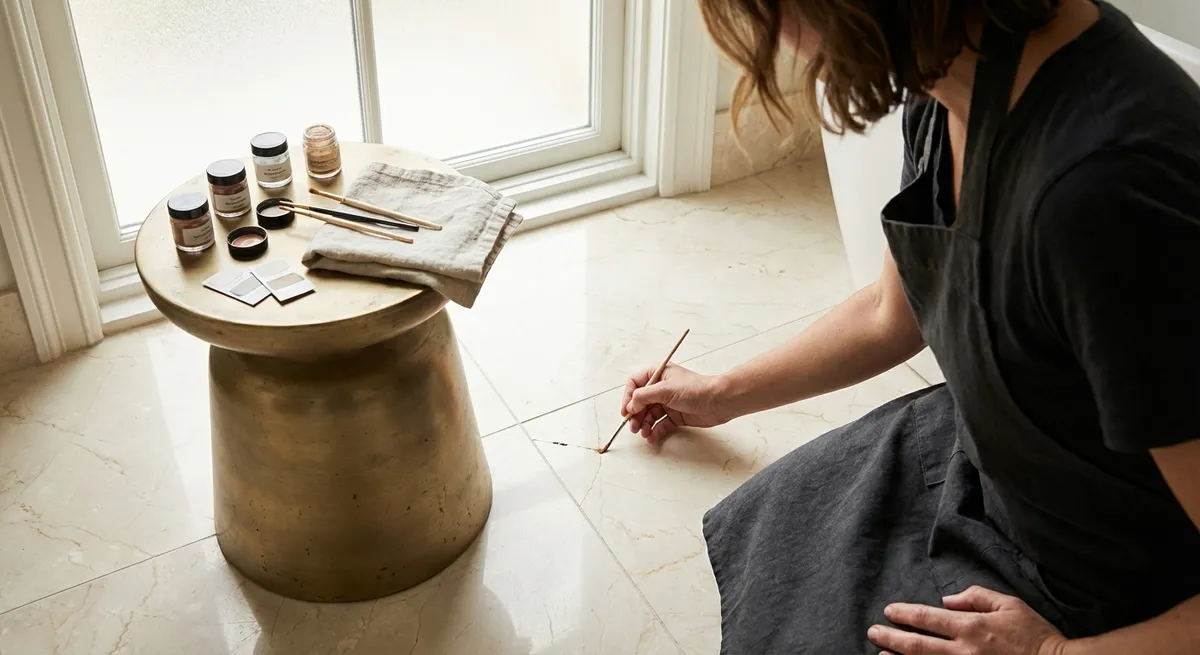
One of the most frustrating aspects of tile repair is color matching—especially in older installations where grout has gently mellowed with time. Fresh grout from the same manufacturer often appears too bright, too cool, or simply “new” compared with the surrounding joints.
Instead of resigning yourself to visible patchwork, consider a layered strategy. Start with a grout formulation whose base tone is slightly softer than the original; a gently under-saturated color tends to blend more successfully once sealed and exposed to light. After curing, specialized grout colorants or penetrating stains can be used to nudge the tone toward the existing field, rather than force a perfect match in one step. For natural stone, subtle honing or light abrasion of a new tile’s surface can reduce that unmistakable “fresh-from-the-box” sheen, helping it settle into an older layout. The most successful color integrations rely on intentional imperfection—embracing an almost undetectable variation that reads as patina, not patch.
Quiet Reinforcements: Strengthening Substrates Without Full Replacement
When tile failure is traced back to a compromised substrate, the default assumption is often “tear everything out and start again.” In some cases this is necessary, but there are refined, intermediate solutions that can restore integrity and extend the life of the existing assembly.
Decoupling membranes, cementitious backer units, and self-leveling underlayments can, when used judiciously in localized areas, re-establish proper support and reduce stress transfer to the tile surface. For example, if a small area of subfloor deflection has caused recurring grout cracking, a strategic removal and rebuilding of that section with a modern underlayment system can stabilize it—without disturbing the entire room. Moisture-related issues near showers or exterior thresholds can sometimes be addressed by carefully opening and rebuilding the affected zone with contemporary waterproofing membranes, integrated flashing, and sloped planes that correct original errors. These “quiet reinforcements” require a precise understanding of how old and new materials interact, but when executed well, they deliver modern performance in a legacy installation.
Future-Proofing the Patch: Repair Details That Protect Tomorrow’s Finish
The most sophisticated tile repairs are designed not only to solve today’s dilemma, but also to protect against tomorrow’s. Each intervention is an opportunity to introduce better detailing into the assembly.
Where tiles meet dissimilar materials—wood thresholds, metal frames, cabinetry—repaired areas should be re-detailed with flexible sealant and, where applicable, movement joints that absorb expansion and contraction. Around heated floors, patch work should respect the heating element layout, avoiding cuts or compressive buildup that create hot spots or stress points. In wet zones, any opened area becomes a chance to upgrade to a continuous waterproofing plane, complete with properly formed inside corners, penetrations, and transitions. Even seemingly minor choices—like selecting a higher-performance grout with lower absorption, or using a premium polymer-modified thinset—can greatly influence the longevity of the repair. A refined homeowner views each repair not as a concession, but as a strategic upgrade to the hidden systems behind the tile.
Conclusion
Distinguished tile work is not only about perfect installation on day one; it is about how gracefully that work adapts, ages, and, when necessary, recovers. By diagnosing the true cause of damage, practicing surgical removal, blending new with old through subtle color strategies, reinforcing what lies beneath, and planning for future resilience, homeowners can ensure that repairs feel like a continuation of the original design intent—not an interruption.
Tile repair, handled with this level of attention, becomes a quiet expression of stewardship: a commitment to surfaces that are not merely beautiful, but intelligently maintained for years to come.
Sources
- Tile Council of North America (TCNA) Handbook - Industry standards and guidelines for tile installation and repair best practices
- Schluter Systems – Movement Joints and Uncoupling Membranes - Technical guidance on managing movement, decoupling, and substrate challenges
- Custom Building Products – Grout & Colorant Technical Resources - Detailed data sheets and instructions for grout selection, color matching, and maintenance
- U.S. Environmental Protection Agency – Lead-Safe Work Practices - Important safety considerations when disturbing older substrates during tile repair
- Laticrete Technical Data Sheets - Professional references for mortars, membranes, and repair materials used in advanced tile assemblies