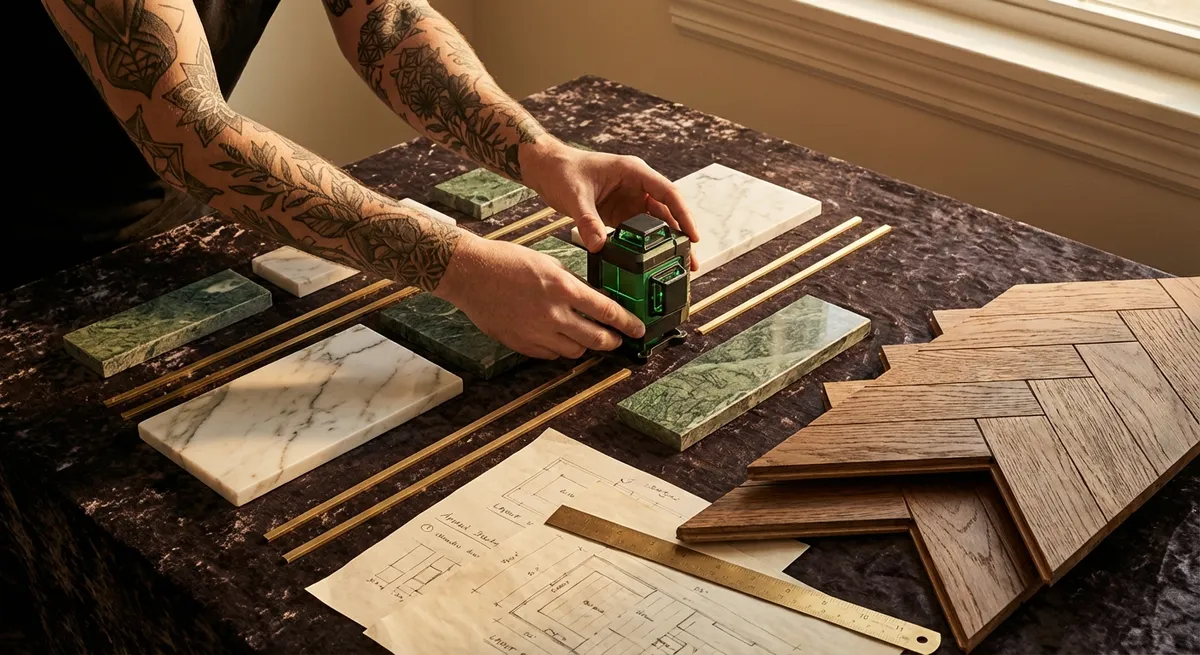
This guide moves past basic how‑to advice and into the nuanced considerations that distinguish an ordinary tiled surface from one that feels architect‑designed. Along the way, you’ll find five exclusive, often overlooked insights that sophisticated homeowners can use to collaborate more effectively with their tile professionals.
The Luxury Starts Below the Tile: Substrate as Design Foundation
Every impeccably tiled room begins long before the first piece is set. The substrate—the layers beneath your tile—is where luxury is quietly engineered. High‑end installations typically rely on a deliberate combination of underlayment, waterproofing, and decoupling systems that are tailored to the specific room and tile selection rather than applied as a one‑size‑fits‑all solution.
Discuss deflection, movement joints, and moisture management with your installer as early as possible. For large‑format porcelain or natural stone, even minor substrate irregularities can translate into lippage and shadow lines that undermine a premium aesthetic. A properly flattened substrate (often to tighter tolerances than standard code) will allow crisp grout joints, clean reflections, and a surface that feels intentionally monolithic.
An elegant bathroom or entry hall should also include a thoughtful approach to sound and thermal comfort. Consider whether an uncoupling membrane with integrated sound control or radiant heating systems should be part of the assembly. These are not afterthoughts; they are integral to how the finished space feels and performs.
Exclusive Insight #1: Specify flatness, not just level.
Most homeowners ask if the floor will be “level.” For high‑end tile work, request that your installer confirm flatness tolerances instead (e.g., per industry standards for large‑format tile). A surface can be slightly out of level yet perfectly flat—and flatness is what eliminates distracting lippage and uneven reflections.
The Subtle Power of Layout: Aligning Tile with Architecture
Premium tile installations read like they were born with the architecture. This illusion is created through meticulous planning of layout before a single tile is cut. Instead of starting at a random wall and working inward, your installer should map tile centerlines to the key sightlines and architectural axes of the room.
Consider how tile joints align with window mullions, door openings, cabinet edges, and focal fixtures such as a freestanding tub or fireplace. A well‑planned layout minimizes sliver cuts at perimeters, ensures a sense of balance from every vantage point, and allows pattern continuity as tile moves through rooms and thresholds.
For large spaces, ask for a dry layout or at least a chalk‑line mock‑up to visualize how the pattern will resolve at all boundaries, including under doors and around built‑ins. The quiet sophistication of a space often lies in the fact that you don’t see awkward cuts or mismatched joints—only an effortless visual rhythm that supports the architecture.
Exclusive Insight #2: Choose your “primary view.”
Walk into the space from the most common entry point and declare that perspective as the primary view. Ask your installer to prioritize joint alignment, symmetry, and pattern resolution in that viewing cone first, then work outward. This single decision can radically elevate the perceived quality of the room.
Grout as a Design Instrument, Not a Filler
In refined interiors, grout is treated as a design material in its own right, not merely the substance that fills the gaps. Its color, texture, and joint width profoundly influence how tile appears—whether it reads as a quiet surface, a graphic grid, or a soft, continuous field.
Narrow joints (for rectified porcelain or precision‑cut stone) tend to feel more architectural and contemporary, but they demand a very flat substrate and accurate setting. Wider joints can lend warmth and Old World character, particularly with hand‑crafted or zellige‑style tile where slight irregularities are celebrated rather than corrected.
Color selection is equally critical. Tone‑on‑tone grout can create a seamless, spa‑like envelope, while a slightly contrasting shade can define geometry without feeling busy. Advanced grout technologies also offer stain resistance, color consistency, and flexibility that support long‑term beauty in demanding areas like kitchens and showers.
Exclusive Insight #3: Sample grout vertically and with real light.
Request a small mock‑up board with your selected tile and two or three grout candidates, then evaluate it in the actual room, both day and night. Grout colors change significantly under warm, cool, or directional lighting; choosing from a tiny paper chart rarely yields the most refined result.
Edges, Transitions, and Terminations: Where Craftsmanship Shows
In high‑end projects, the most revealing details are often at the margins: corners, thresholds, and transitions where tile meets other materials. These are the moments where an installation either whispers craftsmanship or exposes shortcuts.
Discuss the edge strategy early. Will you use bullnose pieces, metal or stone trims, or perfectly mitred tile corners for a minimalist look? Each choice communicates a different design language, from classic to ultra‑contemporary. In showers, a well‑resolved niche with precisely aligned grout joints and thoughtful edge treatment can become a quiet focal point instead of a visual interruption.
Floor transitions deserve equal attention. Where tile meets hardwood, carpet, or polished concrete, consider height differences, movement requirements, and aesthetic lines. A carefully detailed threshold—perhaps in stone or a slim metal profile—can act as a discreet punctuation mark between spaces, rather than a functional necessity that breaks the visual narrative.
Exclusive Insight #4: Standardize a “transition philosophy” for the home.
Rather than choosing transitions room by room, establish a consistent language for edges and thresholds across the entire residence (e.g., brushed stainless profiles in all wet areas, stone saddles at primary doorways, flush transitions where tile meets wood). This coherence creates a subtle sense of architectural intent and reduces visual noise.
Water, Heat, and Time: Quietly Engineering Longevity
Truly luxurious tile work remains beautiful not just at installation but after years of real use. Behind this longevity is disciplined attention to waterproofing, expansion, and thermal movement that the casual eye never sees.
In wet areas, confirm that a continuous, properly overlapped waterproofing system is in place before tile is installed—whether it’s a sheet membrane, liquid‑applied barrier, or foam‑board system. Slopes in showers, on benches, and at linear or point drains should be deliberate and tested. The goal is elegant control of water, not merely its containment.
For floors with radiant heating or areas subject to strong sun exposure, movement joints are essential. They can be integrated discreetly along perimeters and in larger expanses without detracting from the design. Skipping these details may not show immediately, but over time it can lead to cracking, tenting, or grout failure. A well‑engineered installation accepts that buildings move and quietly accommodates that reality.
Exclusive Insight #5: Ask to see the work before it disappears.
Request a brief on‑site review of key invisible stages—such as waterproofing and underlayment—before tile is set. This isn’t about micromanaging; it’s about aligning expectations and ensuring that the performance of the assembly matches the finish quality you’re investing in.
Conclusion
A refined tile installation is less about conspicuous luxury and more about unwavering respect for detail. When substrate preparation, layout, grout strategy, transitions, and hidden engineering are approached with intention, the result is a surface that feels calm, coherent, and enduringly elegant.
As a homeowner, you don’t need to master every technical nuance. But by asking the right questions and focusing on these five subtle areas, you position your project for a level of craftsmanship that resonates every time you step into the room—underfoot, in the way light glides across the surface, and in the quiet confidence of work done exceptionally well.
Sources
- Tile Council of North America (TCNA) Handbook - Industry reference for tile installation methods, substrate requirements, and performance standards.
- American National Standards Institute – ANSI A108/A118/A136.1 - Technical standards governing ceramic, glass, and stone tile installation, mortars, and grouts.
- Schluter Systems – Tile Installation Best Practices - Detailed guidance on underlayments, waterproofing, movement joints, and transitions.
- Mapei Technical Library - Professional resources on substrate preparation, large-format tile, and grout technologies.
- U.S. Department of Energy – Radiant Heating Systems - Overview of radiant heating considerations that intersect with tile floor assemblies.