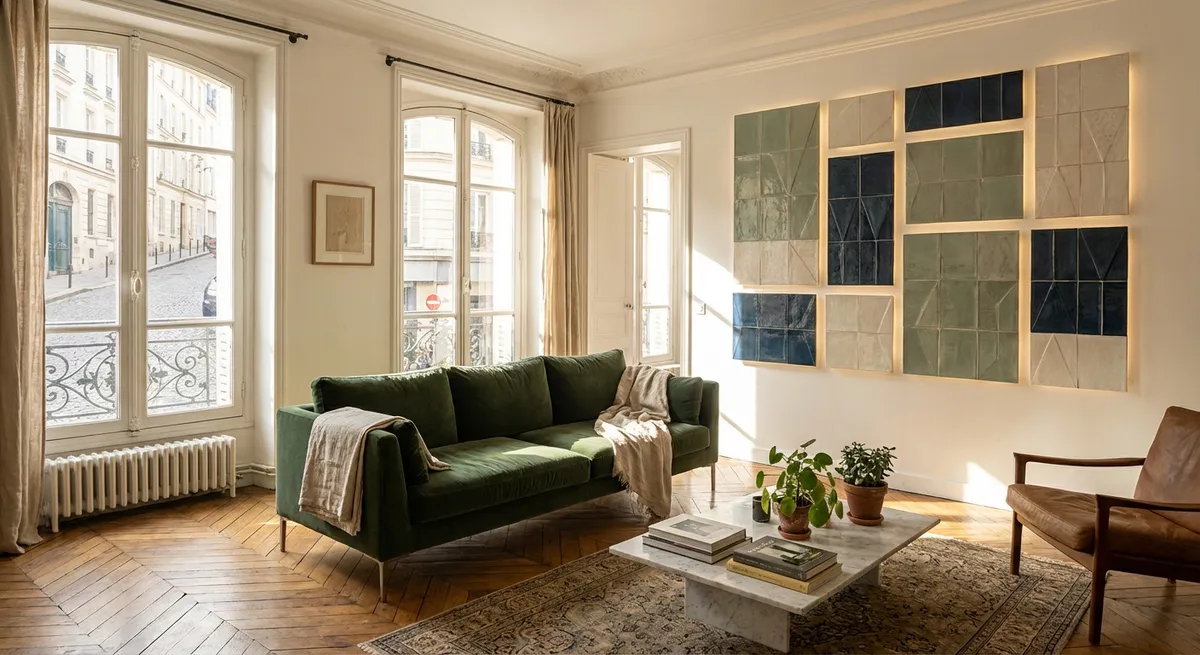
Below are five exclusive, design‑forward insights that move beyond trends and into the realm of enduring elegance.
1. Treat Grout as a Design Material, Not a Necessity
In elevated interiors, grout is never an afterthought—it is an equal partner to the tile. The wrong choice can flatten an exquisite stone; the right choice can make modest ceramic feel bespoke.
A tone-on-tone approach (grout closely matched to tile) produces a soft, monolithic calm, ideal for serene bathrooms and spa-like ensuites. By contrast, a deliberately contrasted grout emphasizes pattern and module, best suited for spaces where rhythm and geometry are key design gestures, such as kitchen backsplashes or entry floors.
Beyond color, grout joint width is a critical design decision. Tighter joints with rectified porcelain evoke a tailored, almost stone-like continuity, while slightly widened joints can lend old-world charm to handmade or tumbled tile. For large-format slabs, ultra-fine joints reduce visual interruptions and enhance the sense of expansiveness. Specify grout performance as carefully as its tone—high-performance, stain-resistant formulations preserve not only hygiene but the visual clarity of your design over time.
2. Compose with Multiple Finishes of the Same Tile
One of the most sophisticated moves in tile design is not mixing patterns or colors at all, but orchestrating finishes. Using the same stone or porcelain in polished, honed, and textured versions creates a layered composition that feels intentionally quiet yet deeply nuanced.
Imagine a bathroom where honed marble wraps the walls, a subtly textured finish defines the shower floor for safety and tactility, and a gently polished version frames the vanity splash as a reflective accent. The palette is technically singular, but the experience is richly dimensional. In living spaces, pairing matte floor tile with a semi-polished border can create the effect of an inlaid rug without introducing a second material.
This approach is especially powerful in open-plan homes, where visual continuity is paramount. By varying sheen and texture instead of color, you can subtly zone areas—dining, lounging, cooking—without breaking the flow. It is a strategy that feels bespoke rather than busy, particularly when the finish transitions align with architectural elements like columns, beams, or changes in ceiling height.
3. Align Tile Layout with the Architecture, Not the Room Perimeter
Refined tile work is as much about alignment as it is about material. The most quietly luxurious spaces are those where tile joints seem to “understand” the architecture—meeting door casings cleanly, centering under pendants, and echoing the geometry of windows and built-ins.
Rather than defaulting to a layout that simply starts at a corner and runs to the walls, anchor your tile grid to key sightlines and focal points. In a kitchen, consider centering the backsplash layout under the range hood, then allowing cuts to fall at less conspicuous edges. On floors, align tile joints with the long axis of the room or with prominent features such as kitchen islands or fireplaces.
For hallways and galleries, running tile lengthwise can elongate the space, while a crosswise layout can subtly shorten an overly long corridor. In large spaces, consider a modular pattern—such as combining different rectangular formats in a repeating module—that respects proportions and avoids awkward slivers. When tile and architecture are in conversation, the room feels composed even before furnishings arrive.
4. Use Tile to Create “Architectural Moments,” Not Just Surfaces
Tile need not be confined to the predictable: floors, showers, and backsplashes. In well-considered homes, it becomes an architectural device—framing views, anchoring vignettes, and giving weight to otherwise ordinary elements.
Cladding a window recess in stone or porcelain, for example, turns a simple opening into a sculpted reveal that catches light beautifully. A tiled plinth beneath a freestanding tub creates a sense of stage and proportion, while a full-height tiled niche behind a console or bar area introduces a tactile backdrop that feels more permanent than paint or paper.
In living rooms, a floor-to-ceiling tiled fireplace surround, executed with precision joints and restrained materiality, can act as the quiet heart of the space. Entryways benefit from a defined “threshold field” of tile—perhaps a refined pattern inset into timber floors—signaling arrival and protecting from outdoor wear. Thinking of tile as a way to build moments rather than merely cover areas leads to spaces that feel curated rather than simply finished.
5. Curate Transitions with the Same Care as the Main Fields
What distinguishes exceptional tile work from competent installation is often not the main field, but the transitions. Edges, thresholds, and junctions are where craftsmanship and design intelligence are most visible.
Where tile meets another flooring material—timber, stone, or concrete—consider a metal or stone trim in a slender profile that complements your hardware and fixtures. This not only protects the tile edge but creates a deliberate, jewelry-like line. At walls, bullnose and traditional trims are no longer the only option; mitered edges, pencil liners, or minimalist metal profiles can achieve a more contemporary, gallery-like finish.
In showers and wet rooms, carefully proportioned curb details, linear drains aligned with grout joints, and subtle slopes that are visually imperceptible yet functionally precise are all hallmarks of elevated work. Even the decision to wrap tile around an external corner versus terminating it with a slim edge profile alters the perceived architecture of the room. When every transition appears intentional, the entire space reads as crafted.
Conclusion
Tile, in the most considered homes, is not a decorative afterthought but a foundational design language. By elevating decisions around grout, finish variation, layout alignment, architectural application, and transitions, homeowners can move beyond the merely attractive and into a realm of enduring, quiet luxury.
The most successful tile schemes are those that feel inevitable—as if they could never have been otherwise. Achieving that sense of inevitability is not accidental; it is the result of thoughtful planning, disciplined restraint, and a commitment to impeccable detail at every scale.
Sources
- Porcelain Tile Institute – Design Considerations – Industry guidance on tile layout, joints, and design planning
- American National Standards Institute (ANSI) – Tile Installation Standards via TCNA – Technical standards informing best practices for grout joints, finishes, and transitions
- Ceramic Tile Education Foundation – Educational resources on professional installation, detailing, and advanced tile techniques
- National Kitchen & Bath Association (NKBA) – Design Resources – Design-driven insights into kitchen and bath planning where tile plays a central role
- The Spruce – Tile Layout and Design Basics – Practical overview of layout decisions that influence visual balance and alignment