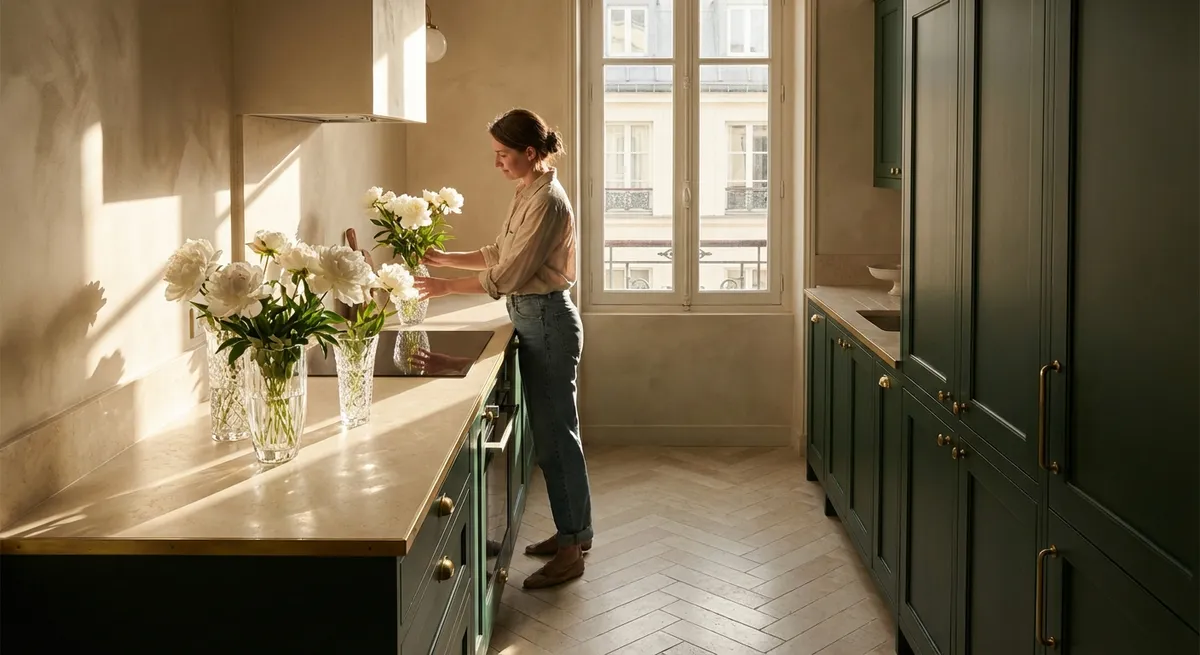
Below are five exclusive, design-forward insights for homeowners who expect more from their tile than mere durability. Each one is crafted to help you collaborate intelligently with designers, architects, and tile pros—and to ensure the final space feels composed rather than simply completed.
1. Treat Grout as a Design Instrument, Not a Technical Afterthought
In cultivated interiors, grout is never an accident. It shapes how your eye reads the pattern, the scale, and even the “quietness” of a surface.
A tone-on-tone grout (very close to the tile color) compresses visual noise and allows the silhouette of the room—walls, openings, cabinetry—to take precedence. This is ideal for spaces where stone veining, custom millwork, or art are meant to lead. In contrast, a high-contrast grout emphasizes geometry and rhythm, turning a simple subway tile into a graphic statement, or a herringbone layout into a soft, woven visual texture.
Consider finish as well: a slightly darker, satin grout around glossy tiles can reduce glare halos and make joints appear crisper. In wet areas, a carefully chosen grout width (often narrower for more contemporary, tailored looks) can subtly signal craftsmanship. Ask your installer for a large mock-up—at least 2' x 2'—using your actual tile and two grout options. The difference in mood under real lighting can be astonishing.
2. Use Scale Shifts to Quietly Define Zones Without Walls
Sophisticated tile design often relies on transitions that you feel before you consciously see them. One of the most elegant tactics is shifting tile scale, not material, as you move through a space.
For example, imagine a primary suite where a large-format porcelain with stone veining runs from bedroom to bath. On the bathroom floor, the same material appears in a slightly smaller plank, scaled down just enough to offer more grip and articulate the change in function. In the shower, that material might reappear again in a mosaic or narrow stack to handle slopes and drainage while still reading as part of a single, orchestrated composition.
This continuity of material, paired with deliberate shifts in size, gives the home a sense of narrative progression—rooms feel related, not repetitive. It’s particularly powerful in open-plan spaces: a subtle change from large tiles to a refined mosaic under a dining area can visually anchor the table without resorting to rugs or bulky dividers. The goal is not drama; it’s coherence.
3. Orchestrate Light With Finish, Not Just Color
Color often gets the credit, but in premium tile design, finish is the true director of light. How a tile reflects, diffuses, or absorbs illumination will determine whether a room feels serene, vibrant, or quietly opulent.
Matte tiles, especially in nuanced neutrals, tend to soften light, diminishing glare and reflections—a sophisticated choice for large, sunlit floors where you want calm rather than sparkle. A honed or silk finish on stone-look porcelain can offer a velvety, tactile quality that feels luxurious underfoot and visually calming in photographs and real life.
By contrast, high-gloss ceramic on a vertical surface can amplify even modest natural light, introducing subtle movement as reflections shift throughout the day. The key is restraint: limit very reflective finishes to carefully chosen planes—backsplashes, feature walls, or shower niches—so they act as light accents rather than turning the entire space into a mirror.
When planning, ask your tile supplier for samples of different finishes in the same color. View them in morning, midday, and evening light. Notice how the sheen interacts with shadows, not just brightness. That observation will guide more elevated choices than color swatches alone.
4. Align Tile With Architecture, Not Just Walls
In refined interiors, tile layout is mapped to architecture rather than arbitrarily following the nearest wall. This approach creates a subtle sense of order that most guests can’t immediately explain, but everyone feels.
Before installation, study the axes of the room: the centerline of a vanity, a fireplace, a window, a tub, or the primary sightline from an entry. A premium installation might center tile courses on the focal element, allowing cuts to fall in less noticeable areas, such as under cabinetry or behind doors. For long planks or large-format porcelain, consider aligning the lengthwise direction with view corridors or natural walking paths, so the tile appears to elongate the room rather than work against it.
In showers and feature walls, continuing a critical grout line across inside corners—and then matching that line to niches, ledges, or built-ins—signals exceptional craftsmanship. This level of planning may require small adjustments to framing or substrate, but the visual payoff is immense: the room feels tailored to the tile, not the other way around.
5. Layer Pattern Intensity, Not Just Pattern Style
Designers often talk about mixing patterns; the more refined conversation is about controlling pattern intensity. With tile, this means curating a hierarchy of visual energy across surfaces so the eye has places to rest.
A common strategy in upscale interiors is to choose one primary “character” surface—perhaps a richly veined porcelain or a geometric mosaic—and then support it with secondary surfaces that are quieter in both contrast and scale. For instance, a bold marble-look shower wall might be balanced by large, nearly solid tiles on the floor and a very subtle, small-format mosaic on the shower base purely for traction, not attention.
Consider also the directionality of patterns. Linear planks, directional veining, and stacked layouts all have a “flow.” By allowing only one or two of these flows to dominate—and keeping others restrained or orthogonal—you avoid the feeling of a visually restless room. The most elevated spaces feel intentional because their patterns are layered like music: a clear melody, a gentle harmony, and a quiet rhythm, with no one element overwhelming the composition.
When working with your tile professional, request layouts that illustrate where the highest pattern intensity appears and how it will be balanced elsewhere. This moves the conversation from tile selection to tile orchestration—the hallmark of a truly cultivated design.
Conclusion
Exceptional tile work rarely announces itself in a single dramatic gesture. It reveals its quality in alignment that feels inevitable, transitions that feel natural, and surfaces that behave beautifully in light and shadow. By elevating your decisions around grout, scale, finish, alignment, and pattern intensity, you move beyond simply choosing “nice tile” and begin composing a home where every surface feels considered.
These five insights are levers you can actively use in discussions with designers, architects, and installers. When you engage with tile at this level, your spaces don’t just look finished—they feel resolved.
Sources
- Tile Council of North America (TCNA) – Handbook for Ceramic, Glass, and Stone Tile Installation - Industry reference for best practices in tile layout, substrates, and installation standards
- Ceramic Tile Education Foundation (CTEF) - Technical articles on grout selection, tile layouts, and professional installation insights
- Porcelanosa – Tile Collections and Design Inspiration - Examples of high-end tile finishes, formats, and applications in refined interiors
- Crossville, Inc. – Design Resources - Guidance on tile scale, pattern, and architectural coordination for residential and commercial spaces
- MIT School of Architecture + Planning – Materials and Design Research - Broader context on how material choice and surface treatment influence spatial perception and light behavior