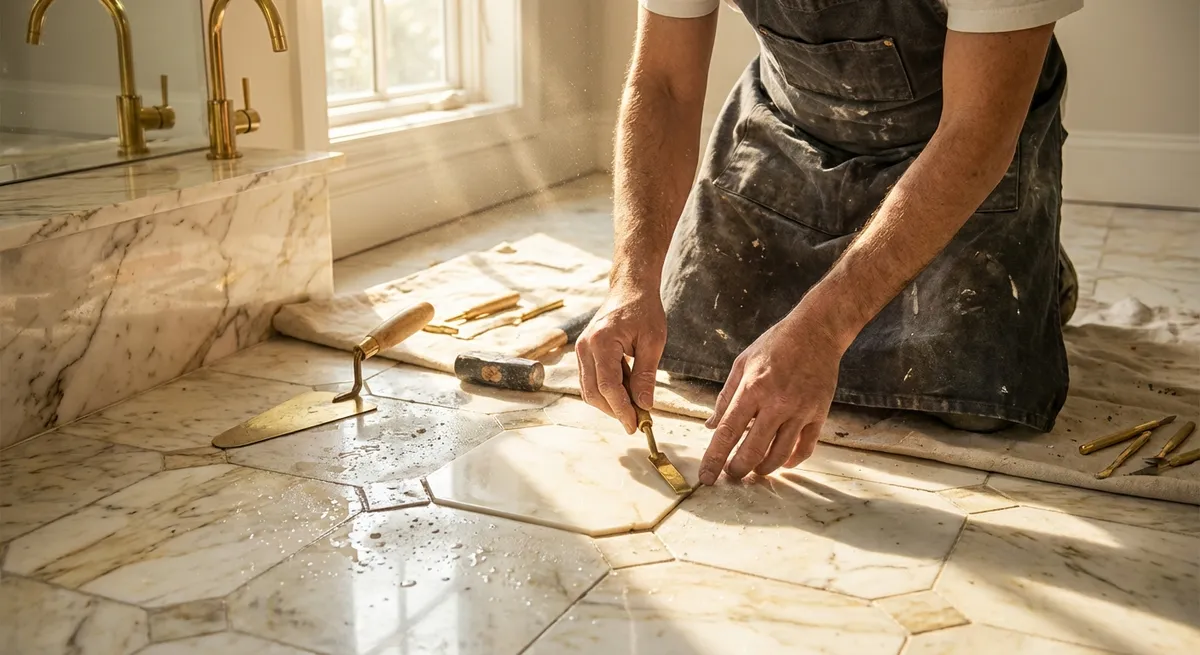
Instead of treating repairs as “damage control,” consider them a chance to elevate the standard of work on your floors and walls. With the right strategy, a repair can become invisible to the eye, structurally superior to what came before, and fully aligned with the way you actually live in the space.
Below are five exclusive, detail-driven insights that separate a quick fix from a truly premium tile repair.
1. Map the Failure, Not Just the Crack
A cracked or hollow tile is often only the visible symptom of a larger condition, not the entire problem. Before authorizing any repair, insist on a failure “map”: a deliberate assessment of where, how, and why the system is breaking down. This includes tapping adjacent tiles to detect hollow sounds, checking grout lines for micro-fissures, and examining movement joints—if they exist at all. A premium repair strategy considers structural shifts, substrate deflection, moisture migration, and even daily traffic patterns, not just the single tile in distress. By treating the entire area as an interconnected system, you avoid the superficial patchwork that looks fine today but fails again in six months. This approach is less about replacing what’s broken and more about understanding why it broke in the first place.
2. Insist on Substrate “Etiquette,” Not Just Surface Perfection
True luxury in tile work begins beneath the surface, where no guest will ever look—but every failure is born. When making repairs, homeowners often focus on color-matching the tile and grout, while the real refinement lies in how the substrate is corrected. A skilled professional will remove damaged tiles and thinset cleanly, then evaluate flatness, rigidity, and bonding surfaces with almost forensic attention. High-end repair may involve upgrading to a more appropriate mortar, adding crack isolation or uncoupling membranes in localized zones, and correcting slope issues in showers or wet rooms. This level of substrate etiquette ensures the new tile is not just attached but properly supported, with stress dispersed and movement anticipated. The result is a repair that doesn’t simply “blend in” but quietly upgrades the performance standard of the entire installation.
3. Treat Color and Texture Matching as a Design Exercise
For a refined home, a “close enough” match is rarely acceptable. Tile repair at a premium level involves curating, not just sourcing. When original tile stock is unavailable, the solution is rarely to drop in the nearest visual neighbor and hope no one notices. Instead, think like a designer: how can the repair become intentional? This may mean subtly reframing a repaired area as a “field within a field,” using a slightly different tile to create a border, inset, or threshold that appears purposeful rather than patched. Texture, sheen, and edge profile are just as critical as color; a perfect color that reflects light differently will still read as a repair. A sophisticated tile specialist will test combinations under your actual room lighting, both day and evening, and may adjust grout tone to create a perceptual bridge that visually unifies the old and new.
4. Elevate Grout from Background Detail to Performance Feature
Most homeowners think of grout only in terms of shade—“what color should it be?”—but in a premium repair, grout is treated as both a visual line and a technical joint. When repairing tiles, this is a moment to evaluate whether the existing grout type is truly serving your space. In high-traffic or wet areas, upgrading to a high-performance grout (such as a quality epoxy or advanced cementitious blend) can dramatically increase stain resistance, color consistency, and overall longevity. The joint width and profile also matter: a fractionally refined joint can make an older installation feel sharper and more deliberate. During a repair, an expert may recommend selectively regrouting a broader area to eliminate visual “patches” and create continuous, consistent lines. Done correctly, the eye doesn’t stop at the repair—it simply reads a room where every joint feels precise and well considered.
5. Use Repairs to Future-Proof, Not Just Restore
A truly sophisticated repair doesn’t aim to return the space to its previous state; it aims to quietly surpass it. When a section of tile is opened up, you have a rare opportunity to incorporate refinements that would be impossible later without disruption. This might include adding or improving movement joints to relieve stress in large floor expanses, upgrading waterproofing behind shower walls, or introducing sound-dampening underlayments in upper-level rooms. Even small adjustments—such as improving transitions between tile and adjacent materials or refining edge profiles at thresholds—can significantly affect how the space feels and wears over time. In other words, a repair can function as a micro-renovation: a discreet but strategic intervention that future-proofs your tilework and raises the overall standard of craftsmanship throughout your home.
Conclusion
Tile repair in a refined home should never feel improvised or reactionary. When approached with intentionality, every intervention—no matter how small—becomes an opportunity to elevate structure, performance, and aesthetic coherence. By mapping failures intelligently, insisting on substrate excellence, treating matching as a design discipline, leveraging grout as a performance tool, and using each repair to quietly future-proof your space, you transform the notion of “fixing tile” into a practice of continuous refinement.
The most beautiful tile installations are not the ones that have never been touched—they are the ones where every repair, every adjustment, has been carried out with the same level of care as the original work.