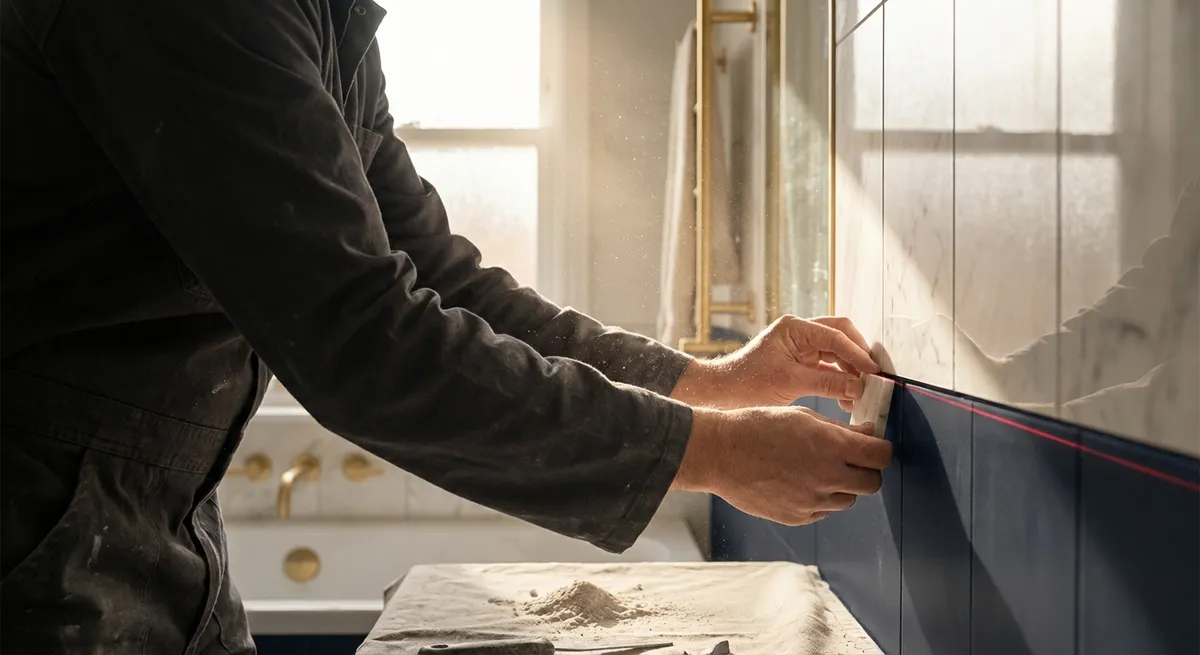
Reading the Floor Like a Conservator
Before a single tool is lifted, an exceptional repair begins with an almost forensic assessment of the surface. Where a basic repair focuses on the obvious chip or crack, a more elevated approach studies the entire field: grout lines, light reflection, pattern continuity, and structural behavior beneath the tile.
A refined inspection passes through several lenses. First, structural: are there subtle changes in sound when you tap across the surface, suggesting voids or debonding thinset? Next, aesthetic: do any tiles catch the light differently, indicating a past repair, a slight lippage, or a misaligned pattern? Finally, environmental: is there a moisture source (especially in showers and near exterior doors) that quietly undermines the installation? Thinking like a conservator ensures that when you repair one tile, you are also safeguarding the integrity of the entire assembly.
This level of reading the surface demands patience: slow walks across the floor at different times of day, observing how natural light exposes imperfections; gentle tapping with the plastic end of a tool to detect hollows; and a careful check of grout hairline fractures that may signal underlying movement. The result is a repair strategy that addresses the true cause, not just the visible symptom.
Color, Texture, and Sheen: The Hidden Art of Invisible Blends
What separates a premium tile repair from an obvious patch is not only the quality of the workmanship, but the nuance of color, texture, and sheen matching. Tile, particularly natural stone and high-end porcelain, is never just “white” or “grey.” It is layered—veining, inclusions, micro-texture, and surface reflectivity all play a role in how the eye perceives continuity.
Grout is often the most revealing element. Over time, its color shifts through cleaning, UV exposure, and normal wear. When repairing or replacing tiles, selecting a grout that matches not the original bagged color, but the aged, lived-in tone of the existing installation is essential. This may require custom blending grout powders or test-mixing small batches until the dry result aligns with the surrounding joints. The experienced eye understands that grout appears darker when wet and lighter when fully cured, and plans accordingly.
For chipped edges or surface pitting, a premium repair often uses color-tinted epoxy or resin fillers, layered in multiple micro-shades rather than a single, flat tone. Subtle stippling or feathering of the fill can imitate the natural irregularity of stone or textured porcelain. Lastly, sheen must be respected: a matte tile with a glossy patch is just as jarring as a mismatched color. Selecting repair materials that dry with the correct luster—or finishing them with light mechanical abrasion to tune the sheen—ensures that the repair dissolves visually into the original field.
Structural Correctives: Beyond the Simple Tile Swap
Homeowners often assume that a cracked tile is simply a defective piece. In a premium repair context, a cracked tile is treated as a diagnostic signal. It may indicate substrate movement, inadequate underlayment, thermal expansion issues, or insufficient expansion joints.
A thoughtful professional will lift not only the visibly damaged tile, but sometimes the adjacent ones to inspect the condition beneath. Is the thinset fully bonded, or are there ghosted trowel lines with empty ridges? Is the substrate appropriate—cement board, properly installed uncoupling membrane, or a stable mortar bed—or was tile bonded directly to marginal material such as old particleboard or unprepared concrete? Addressing structural deficiencies might involve introducing an uncoupling membrane in a limited repair area, properly installing movement joints at transitions, or correcting an uneven subfloor that was never adequately flattened.
Though these interventions may seem invasive for a “simple repair,” they prevent repeating failures. A well-conceived repair aims for long-term stability: a floor that feels as solid ten years from now as it does the day the work is completed. This is the quiet difference between cosmetic patching and authentic restoration.
Curated Materials: Sourcing, Aging, and Smart Substitutions
In higher-end homes, a missing or broken tile often presents a more nuanced challenge: the original material may be discontinued, rare, or uniquely patterned. The sophisticated response is not to settle for the nearest hardware-store approximation, but to curate a thoughtful replacement strategy.
For natural stone, this might involve ordering small lots from multiple quarries or suppliers to find a vein and tonality that aligns with the existing field, then hand-selecting individual pieces that best echo the surrounding pattern. For porcelain or ceramic, it may require tracking lot numbers, liaising with manufacturers, or engaging specialty distributors to locate archived or end-of-line stock.
When an exact match is impossible, an elegant solution is to turn a limitation into an intentional design moment. Instead of inserting one obviously different tile, a cluster of tiles may be replaced in a way that establishes a deliberate inset panel, border, or threshold detail—using a complementary material so the repair reads as a design decision rather than a compromise. “Aging” replacement tiles through controlled surface honing, light abrasion, or even slightly easing edges can further harmonize old and new, ensuring that the repaired area feels integrated rather than newly stamped.
Intelligent Protection: Designing Repairs for Future Maintenance
Truly elevated tile repair considers not just today’s perfection, but tomorrow’s resilience. Every intervention is an opportunity to refine how the surface will age, be maintained, and—if ever necessary—be repaired again with minimal disruption.
This mindset influences material and method. Where appropriate, opting for high-performance, stain-resistant grouts or epoxy in high-traffic and wet areas can drastically reduce future discoloration and joint erosion. In showers and wet rooms, ensuring meticulous waterproofing behind the tile—properly installed membranes, sealed penetrations, and protected transitions—means that any future surface repair remains superficial, not structural.
Subtle design decisions support future care as well. Establishing access points behind tiled plumbing walls, using removable stone thresholds at doorways, or creating discreet expansion joints that double as intentional design lines all contribute to a system that can be serviced without destructive demolition. Sealers are chosen not only for their immediate enhancement of color and sheen, but for their balance of protection, breathability, and compatibility with the specific stone or tile body.
When a repair is executed from this long-term perspective, you are not just restoring a floor, shower, or wall—you are calibrating a system that will continue to look composed and perform reliably even under the quiet pressures of daily life.
Conclusion
Luxury in tile work is not defined solely by the cost of materials, but by the intelligence and restraint with which they are repaired and maintained. A chipped edge or cracked tile need not be a permanent scar; in the hands of a detail-focused professional—and a homeowner who demands more than basic patchwork—repairs can become almost curatorial acts. By reading the surface like a conservator, mastering color and sheen, correcting structural causes, curating materials with intent, and designing for future maintenance, tile repair transcends damage control and becomes an integral part of a home’s architectural narrative.
In a refined home, perfection is not loud. It is simply the quiet absence of anything that feels out of place—tile included.
Sources
- U.S. Department of Housing and Urban Development – Residential Rehabilitation Guide - Offers technical guidance on building rehabilitation and substrate conditions relevant to tile work
- TCNA (Tile Council of North America) – Handbook for Ceramic, Glass, and Stone Tile Installation - Authoritative standards and methods for proper tile installation and repair strategies
- Schluter Systems – Uncoupling Membrane Technical Data - Details on uncoupling principles that inform long-term crack prevention and structural repair decisions
- Laticrete – Grout and Sealant Technical Resources - In-depth information on grout selection, color stability, and performance characteristics used in premium repair work
- Natural Stone Institute – Stone Maintenance and Restoration - Guidance on stone repair, color blending, and sealer selection for sophisticated stone tile surfaces