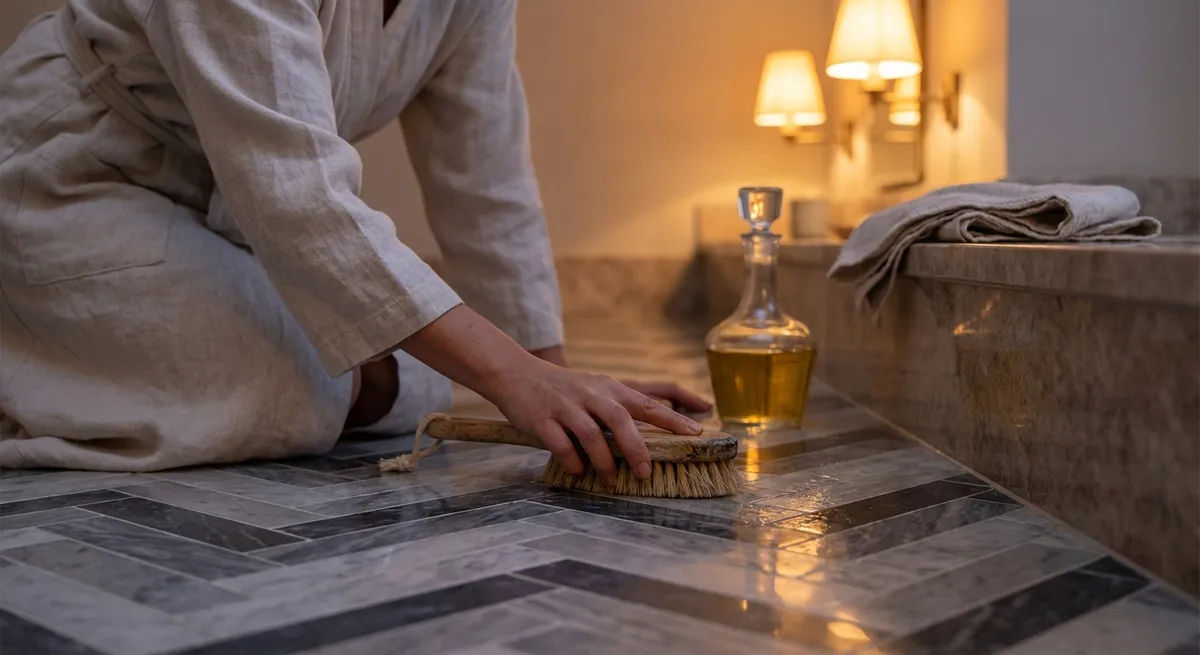
Below, you’ll find a refined approach to everyday maintenance, centered on five exclusive insights that discerning homeowners often overlook—but professionals rely on.
Reading the Surface: Understanding Your Tile’s “Finish Profile”
Every tile composition speaks its own language. Porcelain, marble, limestone, terrazzo, handmade ceramic, and cement all respond differently to water, cleaning agents, and abrasion. The first act of elevated maintenance is to understand what you are caring for.
Instead of relying on generic “for tile” labels, consider your tile’s finish profile: Is it honed or polished? Glazed or unglazed? Textured, tumbled, or rectified? A honed limestone entry, for instance, requires a very different routine than a high-gloss porcelain vanity wall. Glazed ceramic tends to resist stains, whereas unglazed porcelain or stone can absorb them if left unattended. Professionals often pair each room with a miniature “maintenance card” listing its surface material, grout type, and sealer schedule. Re-creating this at home—stored discreetly in a household binder or notes app—ensures that guests, housekeepers, and trades interact with your floors and walls in a way that respects their specific vulnerabilities.
This measured awareness doesn’t just prevent damage; it heightens your appreciation of the material itself. When you know that your kitchen backsplash is a high-fired, low-porosity porcelain while your bathroom floor is a more absorbent marble, your cleaning decisions become precise rather than improvised.
Insight 1: The 24-Hour Rule for Stain Prevention
One of the quiet secrets of immaculate tile is timing. Most permanent stains in grout and stone arise not from the nature of the spill, but from the delay in addressing it. Professionals often reference an informal “24-hour rule”: if a potential stain sits for more than a day on porous stone or unsealed grout, your options narrow dramatically.
The refined approach is both simple and disciplined. In kitchens, keep a soft, dedicated “spill cloth” at hand—microfiber or a lint-free cotton towel stored in a nearby drawer. The moment red wine, coffee, citrus juice, or cooking oil touches a porous surface, blot rather than wipe, drawing the liquid up rather than spreading it across the tile. Follow with a pH-neutral cleaner, not a degreaser or acidic solution, and rinse lightly with clean water. In bathrooms, treat hair dye, self-tanner, and cosmetics the same way: prompt, targeted removal rather than casual rinsing into grout lines.
This is not about panic or perfectionism; it’s about setting a quiet standard for response time. You’re not cleaning more often, you’re cleaning sooner and more precisely, turning potential crises into non-events.
Insight 2: Grout as a Design Element—Not a Sacrificial Layer
Grout is frequently treated as expendable: something that will inevitably discolor and crack. A more elevated perspective recognizes grout as a deliberate design element—its color, joint width, and texture are as considered as the tile itself. Maintaining grout with that same level of respect changes both technique and outcome.
First, understand whether your grout is cement-based, epoxy, or urethane; each responds differently to cleaners and sealing strategies. Cementitious grout often benefits from periodic sealing to reduce absorption and make routine cleaning more effective. Epoxy grout, by contrast, is more stain-resistant but can lose its refined appearance under abrasive pads or harsh chemicals. Second, retire stiff-bristled scrub brushes and powdered cleansers in most spaces. Opt instead for a soft-bristle brush used only on grout lines, paired with a pH-neutral solution formulated for stone and tile. Work in small sections, then remove residue with a slightly damp microfiber cloth rather than sloshing water across the entire floor.
By treating grout as part of the visual composition rather than a utilitarian filler, maintenance becomes more precise: targeted, respectful, and resistant to the dingy “halo” effect that so often compromises otherwise beautiful installations.
Insight 3: Microfiber and Warm Water as Your Daily Luxury
In high-end homes, you’ll rarely see buckets of harsh detergents dragged across finely tiled floors. Instead, you’ll find a quieter tool: premium microfiber paired with nothing more assertive than warm water and a thoughtfully chosen neutral cleaner, used only when truly necessary.
Microfiber technology allows you to lift dust, skin oils, and light soils mechanically rather than chemically. For daily or near-daily care of main living areas, a flat microfiber mop—slightly damp, never dripping—is often sufficient. The goal is not “deep cleaning” every time, but a consistent, low-impact refresh that prevents buildup and protects sealers and finishes from overexposure to chemicals. On walls and vertical surfaces, a folded microfiber cloth used in broad, single-direction passes avoids the streaking and swirl marks that ordinary rags tend to leave behind, particularly on dark or high-gloss tiles.
This minimalist chemistry is not only gentle on stone and grout; it also preserves indoor air quality and makes your surfaces feel more refined underfoot—clean, but not stripped or sticky. The result is a space that reads as quietly pristine rather than aggressively sanitized.
Insight 4: Annual “Condition Audits” Instead of Crisis Repairs
Most significant tile failures—spalling stone, hollow-sounding tiles, prematurely failing grout—announce themselves months before they become obvious. Professionals know this, and they schedule what are effectively annual audits of critical tiled areas. You can adopt the same approach at home, turning maintenance into a structured ritual rather than a reactive scramble.
Once or twice a year, walk your tiled spaces with intention. Bare feet are helpful on floors—you can feel slight lippage, hollow spots, and changes in texture that shoes conceal. Look for hairline cracks, especially at transitions (doorways, thresholds, shower corners), slight discolorations around wet areas, or areas where grout has sunk below the tile edges. Gently tap suspect tiles with a knuckle and listen for a hollow sound, which may indicate a bond issue beneath. In showers, note whether water is lingering or draining more slowly across the tile plane; this can signal subtle slope or grout issues.
Rather than viewing these findings as defects, think of them as an index of where your surfaces need support. Addressing a fine grout crack now, with a carefully matched repair, is infinitely more elegant than replacing half a shower wall later. The audit becomes less about fault-finding and more about stewardship—protecting the integrity of an installation you invested in.
Insight 5: Lighting as a Maintenance Tool, Not Just a Design Feature
Luxurious tile is often paired with deliberate lighting: grazing wall washers over textured stone, low-level floor lighting along corridors, or pinpoint illumination in shower niches. While these choices are usually made for aesthetics, they have a quietly powerful influence on how dirt, streaks, and imperfections appear—and how you maintain them.
Low, raking light across a polished floor will amplify every streak from a poorly rinsed mop, while a softly diffused ambient scheme will disguise minor imperfections but also make subtle damage harder to detect. Professionals sometimes inspect high-finish tiles under deliberately unforgiving light to test the quality of their cleaning technique. You can do something similar: once a month, turn on task lighting, open shades fully, or use a strong portable light to examine frequently used surfaces—particularly in kitchens and bathrooms.
This isn’t about chasing flaws, but about understanding how lighting and maintenance interact. You may find you need to alter your cleaning pattern (linear strokes in the direction of the primary light source, for example) to minimize visible streaks on a polished porcelain floor, or adjust products to avoid residual film on dark, matte tiles under LED strips. Recognizing light as an ally in maintenance, not just in design, keeps your tile reading as impeccably finished at every hour of the day.
Conclusion
Exceptional tile work doesn’t remain exceptional by accident. It endures because someone in the home is paying attention—to surfaces, to timing, to tools, and to subtle changes that others overlook. When maintenance is approached as a quiet ritual rather than a chore, materials age with grace instead of fatigue: grout retains its crisp geometry, stone develops a soft patina rather than stains, and porcelain holds its refined clarity.
By reading your tile’s finish profile, responding decisively within that crucial 24-hour window, elevating grout to its rightful status, embracing microfiber minimalism, conducting annual condition audits, and using light as a maintenance ally, you create more than clean surfaces. You create an environment where every tiled plane continues to feel deliberate, composed, and worthy of the investment that brought it into your home.
Sources
- Natural Stone Institute – Stone Care, Maintenance and Protection - Authoritative guidance on appropriate cleaners, sealing, and daily care for various stone types.
- Tile Council of North America (TCNA) – Grout and Sealant FAQ - Technical information on grout types, sealing considerations, and performance.
- U.S. General Services Administration – Custodial Requirements for Hard Surface Floors - Federal standards and best practices for maintaining tile and other hard-surface flooring.
- MAPEI – Tile & Stone Installation Systems Technical Articles - Professional insights on tile, grout performance, and maintenance considerations.
- LATICRETE – Care & Maintenance of Tile and Stone - Manufacturer recommendations on cleaning, sealing, and preserving tile and stone installations.