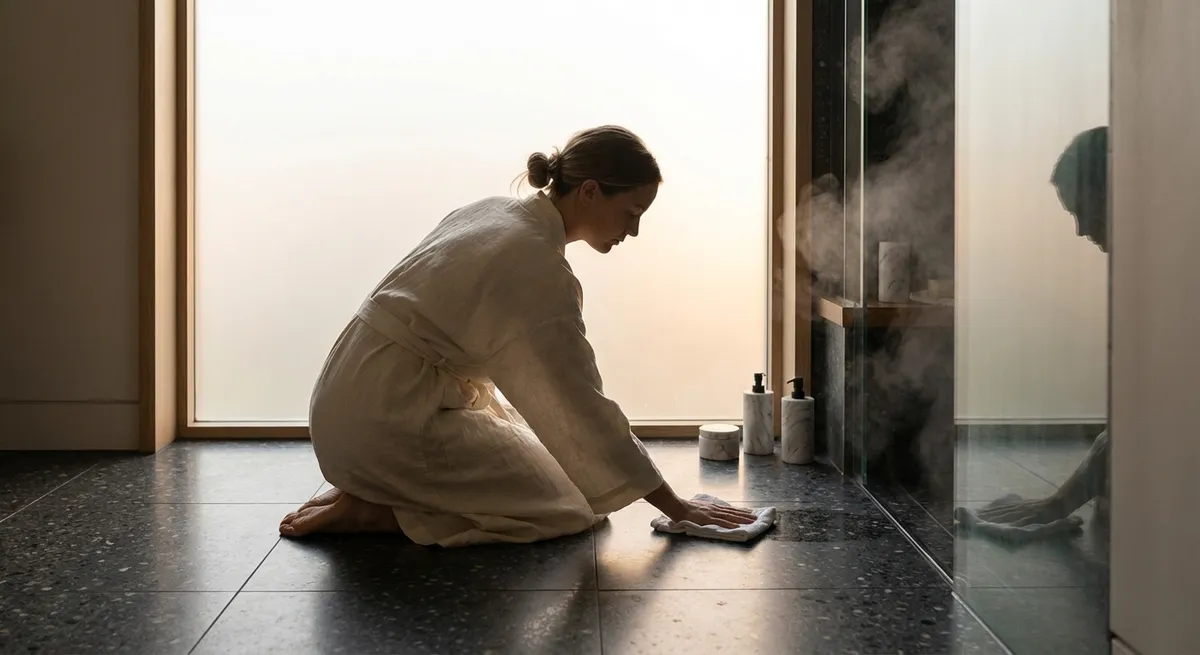
Below are five exclusive, detail-driven insights that elevate tile care from routine chore to considered ritual—designed for homeowners who expect their surfaces to perform and present at a truly elevated level.
1. Treat Grout as a Design Element, Not a Sacrificial Layer
In many homes, grout is unintentionally allowed to become the “wear layer”—absorbing stains, traffic, and cleaning abuse until it visually collapses. In a refined setting, grout deserves the same strategic thinking as the tile itself.
Begin with a penetrating, solvent- or fluoropolymer-based grout sealer appropriate for your specific product and color, applied according to manufacturer instructions. Rather than a one-time event, think of sealing as part of a cadence: high-traffic floors may benefit from light re-sealing every 12–18 months, while guest baths and low-use areas can follow a more extended timeline.
Adopt low-alkaline, pH-neutral cleaners as your day-to-day standard to avoid gradually etching grout or breaking down its sealant. Reserve stronger, alkaline or acidic products strictly for professional-level interventions, and always neutralize thoroughly afterward. For pale grout lines, introduce a “white glove” inspection once a quarter: discreet hand-detailing with a soft nylon brush along thresholds, around kitchen islands, and near showers prevents early discoloration from settling in, keeping grout lines crisp, intentional, and architecturally sharp.
2. Calibrate Cleaning to the Material, Not the Mess
Luxury tile maintenance is not about using the strongest product; it is about using the most appropriate one. Each tile material has its own chemistry, and aligning your care routine to that chemistry is the hallmark of a sophisticated home.
Porcelain and many ceramics are highly resistant to staining, yet harsh powders and scouring pads can still create micro-abrasions that catch grime and dull the finish over time. A concentrated, pH-neutral cleaner diluted with warm (not hot) water, applied with a soft microfiber mop, is usually all that’s required for daily or weekly maintenance.
Natural stone requires an even more tailored approach. Marble, limestone, and travertine are sensitive to acids, including those found in common household products and even food spills like citrus, vinegar, and wine. Opt for stone-specific cleaners clearly labeled as safe for the particular stone in your home, and wipe up acidic spills immediately rather than “later that day.” A single neglected etch can disrupt the visual calm of an otherwise pristine floor.
Finally, always test any new product in a discreet corner. Observing how a surface reacts over 24 hours is a simple, refined safeguard against unintended dulling, streaking, or discoloration.
3. Engineer a Dry Environment Where It Matters Most
In elevated interiors, water is managed, not tolerated. Bathrooms, showers, and kitchens may be designed for moisture, but they are not designed for standing water or perpetual dampness. Long-term elegance depends on actively reducing the window in which water can do damage.
In showers, a simple but luxurious habit is to squeegee or towel-dry walls and glass immediately after use. This practice dramatically reduces mineral deposits on tiles and grout, limits mildew growth in corners, and preserves the clarity of glossy and polished finishes. Finely honed stone or large-format porcelain panels benefit even more, as water spots become visually prominent on otherwise continuous surfaces.
In kitchens, invest in unobtrusive, absorbent mats at sink bases—not bulky kitchen rugs, but slimline mats in coherent colorways that keep splashes from repeatedly soaking grout joints. In laundry rooms with tile floors, position appliances so that any plumbing inspection, hose replacement, or leak checks are straightforward; an elegant tile floor is compromised less often by catastrophic events when you anticipate them.
Ventilation is the invisible guardian of tile longevity. Ensure bathroom fans are properly sized and run for 15–20 minutes after showers. This single step safeguards grout, adhesives, and backer materials as much as the visible tilework.
4. Respect the Micro-Scale: Joints, Transitions, and Thresholds
The most refined tile installations are often defined not by the central field, but by their transitions and terminations. These are also the zones where maintenance is most frequently neglected.
Pay particular attention to expansion joints and soft joints—those thin, flexible lines (often silicone or urethane) where tile meets other surfaces such as tubs, countertops, door thresholds, and exterior doorways. These joints absorb movement and prevent cracking in the rigid tile assembly. Over time, they can degrade, collect grime, or lose elasticity.
Make a habit of visually inspecting these transitions a few times a year. Look for hairline separations, mildew along tub edges, or hard, brittle caulk. Replacing compromised soft joints before they fail is far less intrusive—and far more elegant—than waiting for cracks, moisture intrusion, or subfloor damage to reveal themselves dramatically.
At doorways and thresholds, use gentle vacuuming with a soft brush head to remove grit from grout lines and metal trims. Small particles can behave like sandpaper underfoot, disproportionately wearing down these highly visible edges where materials meet and the eye naturally lingers.
5. Preserve Sheen and Texture, Don’t “Polish It Away”
A luxurious tile surface has an intentional interaction with light and touch. The wrong maintenance products, even if marketed as “restorative,” can gradually obscure that intention.
Avoid generic “all-in-one” floor polishes, waxes, or coatings on porcelain and ceramic tile unless the manufacturer has explicitly approved a specific product. These coatings can create a plasticky gloss that cheapens the appearance, traps dirt, and eventually demands laborious stripping. Instead, focus on preserving the factory finish: sweeping or vacuuming with a soft head to remove abrasive grit, followed by damp mopping with a residue-free cleaner.
For natural stone, rely on stone-specific sealers and, when needed, professional honing and polishing rather than DIY abrasive methods. Over-polishing marble with consumer-grade kits can create inconsistent sheen levels and “hot spots” that catch the eye in all the wrong ways. When stone begins to show wear in high-traffic zones, a professional refinishing service—done sparingly but expertly—is much more aligned with a premium maintenance philosophy than continual, aggressive home buffing.
For textured, matte, or anti-slip tiles, especially in exterior or pool-adjacent areas, the objective is cleanliness without flattening the texture. Use soft-bristled brushes and low-foam cleaners that rinse cleanly, so the tile retains its designed tactile profile instead of accumulating a filmy, slippery overlay.
Conclusion
Truly elevated tile maintenance is quiet, precise, and anticipatory. It is not about over-cleaning; it is about understanding how materials age and guiding that aging with intention. By treating grout as part of the design, calibrating cleaners to the surface, deliberately controlling moisture, honoring transitions, and preserving rather than altering factory finishes, homeowners can ensure their tilework remains composed and compelling decade after decade.
These are not dramatic interventions, but small, disciplined gestures—exactly the sort of rituals that distinguish a well-finished house from a genuinely cultivated home.
Sources
- U.S. Environmental Protection Agency – Safer Cleaning Products - Guidance on safer, less harsh household cleaners that help protect surfaces and indoor air quality
- Tile Council of North America (TCNA) – Cleaning Ceramic Tile - Industry recommendations on appropriate cleaning methods and products for tile and grout
- Natural Stone Institute – Stain Removal and Care - Authoritative information on proper maintenance, sealing, and cleaning of natural stone surfaces
- U.S. Department of Energy – Ventilation and Moisture Control - Explains the importance of proper ventilation in managing interior moisture, relevant for tile longevity in wet areas
- MAPEI – Guide to Grout and Sealant Maintenance - Technical guidance on grout care, sealing intervals, and soft joint considerations