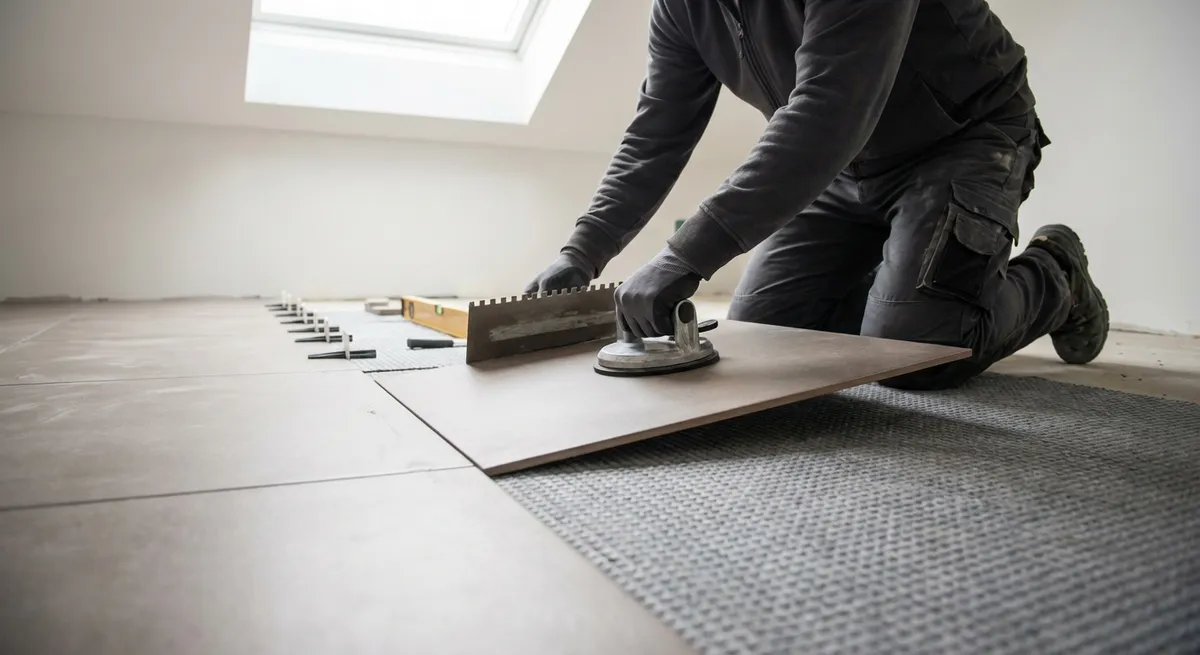
What follows are five exclusive, often-overlooked insights that separate ordinary tile work from truly elevated installations—insights that help you ask the right questions, recognize quality, and ensure your surfaces age with grace instead of frustration.
Beyond Flat: The Concept of “Plane” in Luxury Tile Work
Most people ask whether a floor is “level.” In high-end tile work, the more important question is whether it is in plane.
A level floor is perfectly horizontal. A floor that’s “in plane” is flawlessly smooth—no humps, no dips—whether it’s level or gently sloped (as in a shower floor). Large-format tiles, stone slabs, and ultra-thin porcelains demand this precision; even a 1/8" variation can telegraph through as lippage (edges you can feel underfoot or catch light along a seam).
Premium installers treat substrate preparation as its own discipline. They:
- Use long straightedges (6–10 feet) to map high and low spots, not just a 2-foot level.
- Employ self-leveling underlayments strategically, not as a cure-all.
- Feather transitions between rooms to keep surfaces aligned while respecting different finishes.
- Coordinate with other trades early so HVAC ducts, plumbing, and framing don’t create uncorrectable humps beneath tile.
As a homeowner, your most powerful request is simple: “Show me how you verify the floor is in plane for these tile dimensions.” The answer will tell you almost everything about the level of craftsmanship you’re about to receive.
Thinset Is Not Glue: The Architecture of a Bond
In refined installations, thinset mortar isn’t treated as adhesive—it’s treated as structural connection.
High-performance mortars are engineered for specific conditions: large and heavy tiles, exterior exposure, radiant heat, submerged installations, or marginal substrates. When these products are properly matched and mixed, they don’t just hold tile; they manage movement, distribute stress, and prolong the life of both tile and grout.
Key distinctions true professionals respect:
- Coverage standards: Critical areas (showers, exteriors, floors) often require 95% or more mortar coverage beneath each tile. This is not negotiable in premium work.
- Trowel technique: The trowel size, combing direction, and angle are chosen to achieve full coverage, not speed. Ridges must collapse completely when the tile is set.
- Back-buttering: Larger format tiles and natural stone frequently require mortar applied to the back of the tile to eliminate voids that can crack under point loads (like chair legs or stilettos).
- Pot life and slake times: Quality installers honor manufacturer instructions for mixing, resting, and using mortar within its working time; shortcuts here can quietly undermine bond strength.
When you’re reviewing bids, ask: “What mortar system are you specifying for this tile and substrate, and why?” A thoughtful, product-specific answer signals you’re dealing with a professional who sees your tile as part of a system, not a surface to be rushed.
The Hidden Geometry of Grids, Joints, and Transitions
Perfectly installed tile is a study in quiet geometry. The pattern you see on the surface is only the final expression of a much deeper alignment strategy—one that begins on paper or in software, not on the jobsite.
In high-caliber installations, layout is treated as design, not logistics:
- Centering with intention: Instead of simply starting in the middle of the room, a premium installer studies sightlines from entries, hallways, key seating areas, and focal walls. Cuts are balanced where the eye naturally rests.
- Managing pattern across thresholds: Patterns that flow gracefully from one room to the next feel more expansive and composed. Misaligned grids or awkward “reset” points at doorways visually cheapen even expensive tile.
- Respecting grout joint proportions: A 3 mm joint on a small mosaic reads differently than the same joint on a 48" tile. Sophisticated work tailors joint width to tile size, edge profile, and aesthetic, always within manufacturer tolerances.
- Accommodating movement joints elegantly: Thoughtful installers integrate required movement joints into grout lines or design breaks so they’re functionally essential yet visually discreet.
Invite your installer to walk you through the proposed layout, referencing major sightlines and thresholds. When layout is treated as a design conversation rather than a field guess, the finished space feels inherently more intentional.
Sound, Warmth, and the Invisible Comfort of Proper Underlayment
The true luxury of tile isn’t only in how it looks—it’s in how it feels and sounds underfoot.
High-quality underlayment systems act as the silent partners of any premium tile installation. They can dramatically improve daily experience without ever being seen:
- Acoustic refinement: In multi-story homes and condominiums, acoustic underlayments reduce footfall noise and echo, especially over concrete or wood-framed floors. The difference between a bare tile on slab and a properly isolated system is immediately noticeable in both sound and comfort.
- Thermal synergy with radiant heat: When paired correctly, underlayments can optimize the performance of in-floor heating, distributing warmth evenly and minimizing cold spots or temperature stratification.
- Crack isolation and decoupling: Modern membranes allow the tile surface to move slightly independently of the substrate, absorbing minor hairline cracks or seasonal movements in wood framing instead of transmitting them directly to the tile.
- Moisture management: In below-grade or moisture-prone areas, select underlayments can help limit vapor transmission and protect both the tile and the building structure.
Ask your installer not just if they’re using an underlayment, but which system and for what explicit purpose—acoustics, crack isolation, moisture, or all of the above. In sophisticated homes, this layer is rarely optional; it’s part of the comfort specification.
Detail as Luxury: Edges, Terminations, and the Art of the Last 2%
In tile work, luxury isn’t announced by a single dramatic gesture. It resides in the last 2% of decisions that most people never think to question—but instantly feel when they’re done correctly.
Consider a few areas where premium detail makes a quiet but unmistakable difference:
- Edge profiles and trim: Finishing edges with carefully selected metal profiles, stone thresholds, or mitred tile corners eliminates the raw or “builder-basic” look of exposed tile bodies. The transition between materials becomes a designed element, not an accident.
- Aligned penetrations: Outlets, switches, floor registers, and plumbing escutcheons can either interrupt a pattern or integrate into it. Precision cutting that centers fixtures within tiles (where possible) or aligns them with grout joints speaks to a higher level of care.
- Recessed elements: Properly waterproofed and tiled niches, linear shower drains set tight to walls, and flush transitions between wet and dry zones read as seamless architectural gestures rather than afterthoughts.
- Color-matched grout and sealants: Grout color profoundly influences the final aesthetic. Subtly coordinated sealant at changes of plane—corners, tub perimeters, countertop junctions—ensures functional flexibility without visual disruption.
When reviewing a proposal or walking a job in progress, let your questions focus on these edges and terminations. “How will you finish this edge?” or “What’s your plan for aligning these fixtures with the tile layout?” signals that you understand the importance of detail—and encourages your installer to elevate theirs.
Conclusion
Refined tile installation is equal parts engineering, choreography, and restraint. Behind every flawless surface lies a chain of decisions about plane, bond, geometry, underlayment, and detail—each one quietly compounding to create or undermine quality.
For homeowners who care about enduring elegance, fluency in these five insights is a strategic advantage. It allows you to select installers based on substance rather than speed, engage in richer conversations about design and performance, and ultimately inhabit spaces where tile doesn’t merely occupy a surface—it defines the character of the room from the ground up.
Sources
- Tile Council of North America (TCNA) Handbook – Industry reference for best practices on tile installation, substrates, and movement joints
- American National Standards Institute (ANSI) A108/A118/A136.1 – Standards governing installation materials and methods for ceramic, glass, and stone tile
- Schluter Systems Technical Articles – Detailed guidance on underlayments, decoupling membranes, waterproofing, and movement accommodation
- Custom Building Products: Mortar Selection Guide – Practical information on choosing the correct thinset mortar for specific tiles and substrates
- Flooring Acoustics – National Research Council of Canada – Research-based discussion of impact sound transmission and underlayment performance