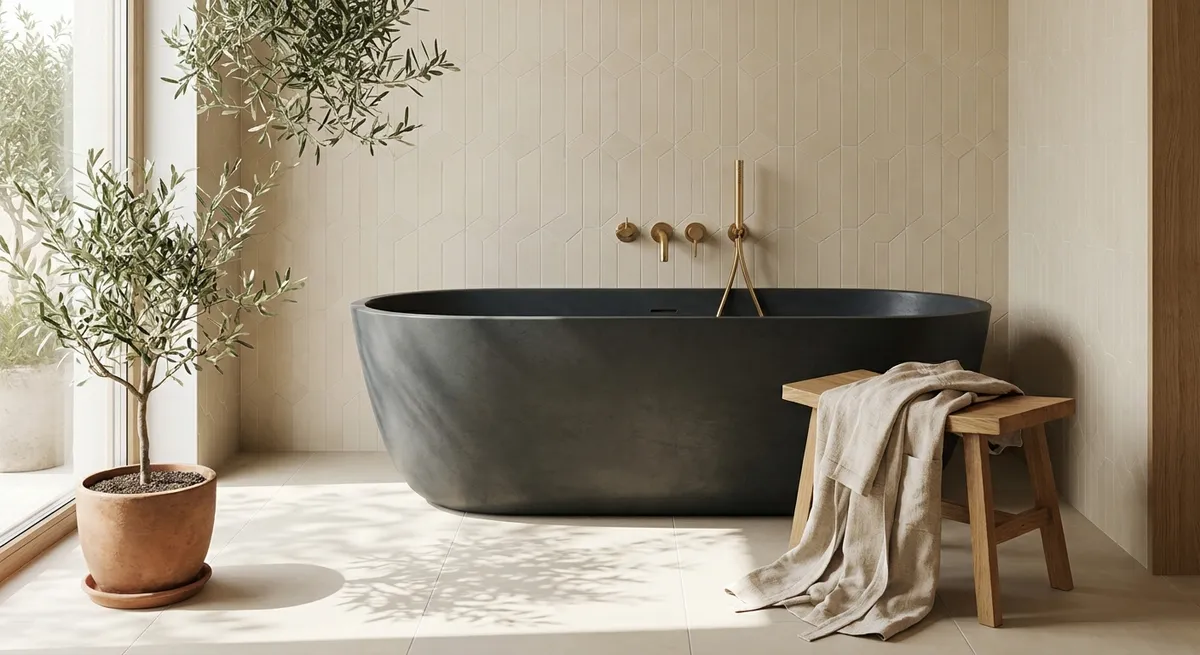
Below are five exclusive, design-forward insights for homeowners who want their tile work to feel bespoke, considered, and permanently relevant.
1. Compose with Light, Not Just Color
Most tile projects begin with a color palette. Elevated tile design, however, begins with light. The same tile will read entirely differently under cool daylight, warm LEDs, or grazing wall washers. Rather than choosing tile from a showroom wall alone, envision how it will behave throughout the day in your specific rooms.
In spaces with strong natural light, subtly variegated tiles—handmade-look ceramics, honed stones, or porcelain with delicate movement—allow the surface to shift character as the sun moves. In lower-light rooms, a soft satin or semi-polished finish can capture just enough reflection to keep the plane from feeling flat, without veering into high-gloss glare. Consider directional light: when a wall is lit from above or from one side, a structured or softly textured tile creates faint shadows that add depth and sophistication.
Refined projects often layer light intentionally around tile: under-cabinet lighting washing down a backsplash, linear LEDs grazing a shower wall, or concealed cove lighting amplifying a tiled fireplace. This transforms tile from background finish to luminous focal plane, while still maintaining an atmosphere of understated luxury.
2. Treat Grout as an Architectural Decision
In elevated tile work, grout is never an afterthought. Its color, width, and profile can either sharpen the geometry or dissolve it. Homeowners aiming for a premium, gallery-like aesthetic should think of grout as the “line weight” in a technical drawing.
For a seamless, monolithic effect, specify grout just a half tone off your tile (slightly lighter on dark tile, slightly darker on light tile). This minimizes visual fragmentation while still preserving enough joint definition to read as intentional craftsmanship rather than a plastic-like sheet. To celebrate pattern—such as a herringbone, basketweave, or artisanal subway—select a grout that contrasts delicately, not starkly. Think soft stone gray against white tile, or warm linen against muted terracotta, rather than harsh black-on-white.
Narrow joints (around 1/16"–1/8", depending on tile type and size) telegraph precision and feel more tailored, especially with rectified porcelain or well-calibrated stone. In statement areas like a feature wall or powder room, experimenting with slightly deeper grout joints and a carefully chosen color can create a subtle shadow grid that feels architectural, not busy. The objective is control: grout should guide the eye, not compete for attention.
3. Use Scale and Proportion to Shape Perception
Exceptional tile design manipulates scale to quietly alter how a room is perceived. The trick is to consider the proportions of the tile in relationship to the space, not in isolation. A tile that looks elegant on a sample board can feel either diminutive or overwhelming once multiplied across an entire wall or floor.
In small baths, large-format floor tiles with minimal grout can visually expand the footprint, especially when the color value is kept close to the wall tone. Conversely, in a generous foyer or great room, overlarge tiles that lack modulation can feel oddly vacant; a considered module—perhaps a 24x24 or 24x36 paired with a border or inset—adds deliberate structure. On walls, running a vertically oriented rectangular tile to full height elongates the room, particularly striking in showers, fireplaces, and kitchen feature walls.
For homes with classic architecture, integrate scale that respects existing elements: relate tile dimensions to door heights, window sills, and stair risers. In contemporary spaces, commit to bold proportion—an entire wall of slender, stacked tiles; an oversized stone-look porcelain slab behind a tub; or a continuous floor pattern that runs unbroken between rooms. When tile size and layout feel mathematically resolved, the space reads as quietly sophisticated, even if the materials are restrained.
4. Elevate Transitions into Deliberate Design Moments
Where tile begins and ends is as revealing as the tile itself. High-end spaces are defined not only by what you see in the center of a room, but by how thresholds, edges, and intersections are resolved. Thoughtful transitions turn these inevitable seams into discreet moments of refinement.
On floors, instead of an arbitrary straight line where tile meets hardwood or carpet, align the transition with architectural logic: a cased opening, a structural column, or a shift in ceiling plane. Consider metal profiles in brushed brass, black, or stainless steel as razor-thin, precise dividers that read as intentional jewelry rather than pragmatic constraint. In historic homes, a stone or porcelain border at room perimeters can reference traditional inlay patterns while capturing a sense of tailored formality.
For walls, resolve outside corners with mitered edges, bullnose, or perfectly matched trims that carry the tile’s tone or texture, rather than relying on mismatched plastic trims. In showers, step niches, benches, and thresholds into the design early so tile joints continue uninterrupted across these details. When every edge feels composed instead of improvised, the entire installation takes on the aura of custom millwork rather than commodity finish.
5. Curate a “Quiet Hero” Pattern for Each Home
The most confident tile designs often revolve around a concept of a “quiet hero”—a single recurring pattern, shape, or motif that appears selectively throughout the home in different expressions. Rather than filling each room with a new statement tile, this approach creates a cohesive narrative that feels tailored and enduring.
For example, a home might adopt a slender vertical rectangle as its hero element: stacked white tiles in the main shower, a muted green version in the powder room, and a stone-look iteration in a fireplace surround. Another home may favor a soft hexagon: honed marble hex on a bathroom floor, a scaled-down porcelain hex in a mudroom, and a subtly embossed hex pattern in a kitchen backsplash. The key is restraint—choose variations that share undertones, finish family, or geometry so the connection feels subliminal.
By curating a quiet hero pattern, homeowners achieve the sense of a custom collection rather than a catalog of unrelated choices. This strategy also future-proofs the home: as accents and furnishings evolve, the underlying tile language remains coherent, dignified, and adaptable.
Conclusion
Truly refined tile design is not about spectacle; it is about discipline—of light, of line, of proportion, and of detail. When grout is treated as architecture, scale is calibrated to the room, transitions are composed with intent, and a quiet hero pattern weaves through the home, tile stops being surface and becomes structure.
For homeowners who understand that luxury lies in what most people overlook, tile offers an unrivaled opportunity: to craft spaces that feel both immediate and timeless, visually serene yet technically exacting. The result is a home where every tiled plane, from the most visible foyer to the most private bath, speaks in the same language of quiet geometry and enduring elegance.
Sources
- [Porcelain Tile Certification Agency – Technical Information](https://www.pticert.org/technical) - Offers guidance on rectified tiles, grout joint recommendations, and technical aspects relevant to precision installations
- [Tile Council of North America (TCNA) Handbook](https://www.tcnatile.com/technical-services/hb-online.html) - Authoritative reference on tile design, installation methods, and best practices used by industry professionals
- [Ceramic Tilework: Illuminating Tile with Proper Lighting (U.S. Department of Energy)](https://www.energy.gov/energysaver/lighting-choices-save-you-money) - While focused on lighting efficiency, this resource informs how different light types and temperatures affect surfaces and finishes
- [National Kitchen & Bath Association (NKBA) Design Trends](https://nkba.org/insights/design-trends/) - Provides insight into current high-end kitchen and bath design directions, including tile usage and layout considerations
- [Clemson University – Home & Garden Information: Ceramic Tile](https://hgic.clemson.edu/factsheet/ceramic-tile/) - Educational overview of tile types, grout, and practical considerations for residential applications