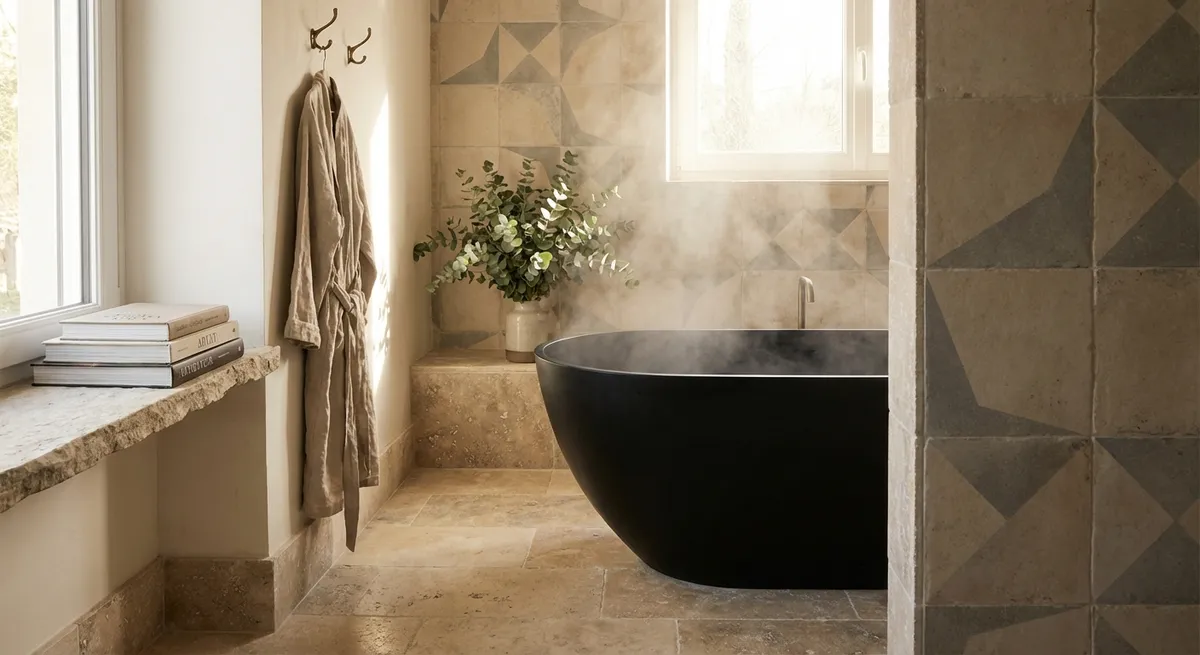
This is tile design at its most elevated: refined, restrained, and deeply intentional. Below are five exclusive insights that homeowners and designers can use to cultivate that rare combination of calm, depth, and quiet opulence.
1. Grout as Tailoring, Not Filler
In a sophisticated space, grout is to tile what fine tailoring is to a bespoke suit: invisible at first glance, indispensable upon inspection.
Most homeowners choose grout as an afterthought, chasing a “close enough” color. A more refined strategy is to treat grout as a tonal instrument:
- Near-invisible seams for serene expanses
Pair large-format tiles with grout just a half-shade lighter or darker than the tile body. This keeps the surface reading as a continuous plane, ideal for spa-like bathrooms or gallery-like living spaces.
- Shadow lines rather than outlines
Instead of stark contrast (e.g., white tile with charcoal grout), consider a softened relationship. A warm greige grout with off-white tile, or a deep espresso with charcoal tile, creates depth without visual agitation.
- Room-by-room grout strategy
Kitchens can handle slightly more contrast to delineate backsplash patterns, while primary bathrooms often benefit from nearly seamless grout to avoid visual clutter. Powder rooms sit in between—an ideal place to experiment with bolder, yet still polished, contrasts.
- Finish matters
Sanded vs. unsanded grout subtly changes how light interacts with the surface. In high-luxury settings, a fine, smooth grout joint can feel more tailored and easier to keep visually pristine.
The result is not a “grouted wall,” but a composed field of material where the joints gently guide the eye rather than shout for attention.
2. Playing with Scale: Micro, Human, Monumental
One of the most underused luxuries in tile design is scale choreography—curating how tile size shifts as you move through the home. Rather than using the same 12" x 24" tile everywhere, think in three registers: micro, human, monumental.
- Micro scale for intimacy
Mosaics or small-format tiles (1"–2") work beautifully in shower floors, niche interiors, or as a border detail. The fine grain reads as jewelry, especially in natural stone, handmade ceramic, or glass. Used sparingly, they create moments of closeness and intricacy.
- Human scale for daily life
Mid-sized tiles (3" x 12", 4" x 16", 6" x 6", etc.) feel innately approachable. They’re ideal for walls you interact with frequently—backsplashes, vanity walls, mudroom wainscoting—surfaces you see at arm’s length and touch daily.
- Monumental scale for calm drama
Oversized formats (24" x 48", 30" x 60", or slab-style porcelain) bring a sense of architectural gravitas. Used on floors and major wall planes, they reduce grout lines and lend a gallery-like quietness, especially in entryways, great rooms, and primary baths.
Most homes feel visually “busy” because everything is the same mid-size. A cultivated home allows tile scale to shift with function and emotion: intricate underfoot in a shower, calm and expansive in a main bath wall, comfortably scaled at the kitchen backsplash.
3. Edge Details: Where Luxury Quietly Reveals Itself
The edge of a tiled surface is where craftsmanship stops being theoretical and becomes visible. High-end spaces rarely end tile with a basic metal strip; instead, they invest in edges that feel resolved.
Consider a hierarchy of edge treatments:
- Mitered corners for uninterrupted flow
When large-format tiles wrap a niche, bench, or wall return, mitered corners keep the pattern or veining visually continuous. This is especially refined with marble-look porcelain or natural stone, where a clumsy edge immediately breaks the illusion of a monolithic block.
- Bullnose or finished edges as a subtle frame
Matching bullnose or finished edges create a gentle, rounded termination. This works beautifully at wainscot terminations, window openings, or the top of a shower wall.
- Shadow reveals instead of trims
In ultra-minimalist interiors, a small shadow gap (reveal) between tile and adjacent surfaces (such as drywall or cabinetry) can read more architectural than decorative trims. It creates a purposeful pause instead of an abrupt finish.
- Recessed transitions
Where tile meets wood or another flooring, a slight recess or inlay strip (often metal or stone) can make the transition feel intentional rather than incidental, protecting edges while signaling a threshold.
The true sign of a thoughtfully tiled space is not only what you see front and center, but how corners, cut edges, and terminations have been choreographed. These details move a bathroom from merely “updated” to convincingly custom.
4. Light Choreography: Designing for Reflection and Shadow
Tile is one of the few surfaces that can conduct, scatter, and soften light all at once. Elevated tile design consciously pairs tile finishes with natural and artificial light sources to shape mood throughout the day.
- Finish as a light modifier
Glossy and pearl finishes reflect; honed and matte finishes absorb; textured surfaces fracture and diffuse. A glossy tile behind a pendant in a dark bar niche adds subtle sparkle, while a honed limestone on a large bathroom wall prevents glare and keeps the space restful.
- Directional textures that respond to light
Ribbed, fluted, or beveled tiles create delicate shadows that change as the light moves. Placed opposite a window or near a soft wall washer, they introduce depth without relying on loud colors or patterns.
- Aligned lighting and tile joints
When possible, align linear lights (recessed strips, wall washers) with grout patterns or the edges of major tiled planes. This creates visual order and turns what might be a simple tile wall into a quietly architectural element.
- Nighttime personality
Consider how a tiled surface looks under warm, dim lighting—especially in powder rooms, ensuites, and kitchens. A slightly iridescent tile that feels understated in daylight can become gently luminous at night, adding a layer of evening glamour without feeling ostentatious.
By treating tile as a tool of illumination, not just decoration, you transform surfaces into active participants in the home’s atmosphere.
5. Composed Transitions: Allowing Rooms to “Speak” to Each Other
The most refined homes feel as though each room has its own voice, yet all share the same language. Tile is an ideal medium for that subtle continuity—particularly in open-plan spaces where abrupt changes can feel jarring.
Key strategies for composed transitions:
- Palette echo, not repetition
Instead of using the same tile throughout, repeat a tone or finish family. A warm limestone-look floor in the entry might transition to a coordinating porcelain in the kitchen and a honed stone mosaic in the powder room—each different, all related.
- Soft thresholds, not hard lines
Where two tile patterns or materials meet, consider a transitional zone: a band of mosaic between large-format tiles and hardwood, or a slim strip of the adjacent material inlaid as a border. This reads more couture than a simple straight cut line.
- Vertical and horizontal dialogue
A color that appears on the floor in one space might reappear vertically in an adjacent niche or backsplash. This creates a visual rhythm, so the eye recognizes a recurring motif without the space feeling repetitive.
- Wet-zone choreography
In bathrooms, shift texture and scale as you enter wet zones (showers, around tubs) while staying within the same tonal family. It signals function and safety underfoot, yet the space still feels like a single, coherent environment.
Thoughtful transitions ensure that your tile choices read not as a collection of isolated decisions, but as chapters in a single, well-edited narrative.
Conclusion
Elevated tile design is less about spectacle and more about control—of scale, edges, light, transitions, and the quiet lines of grout that hold everything together. When approached with this level of intention, tile stops behaving like “finish material” and starts acting like architecture: grounding, framing, and gently guiding every room it inhabits.
For homeowners who care about nuance, these five insights offer a roadmap to surfaces that don’t shout their luxury, but whisper it—confidently, persistently, and with enduring grace.
Sources
- Tile Council of North America (TCNA) Handbook - Industry standards and guidelines for tile installation, grout joints, and detailing
- Porcelanosa – Large Format Tile Design Ideas - Examples of scale, edge treatments, and refined applications of large tiles
- Daltiles Design Resources - Inspiration and technical discussion on finishes, lighting interactions, and pattern layout
- University of Minnesota – Lighting for Interior Environments - Background on how surfaces and finishes interact with light in interior spaces
- ArchDaily – The Beauty of Mitered Joints in Architecture - Exploration of mitered edges and architectural detailing relevant to high-end tile work