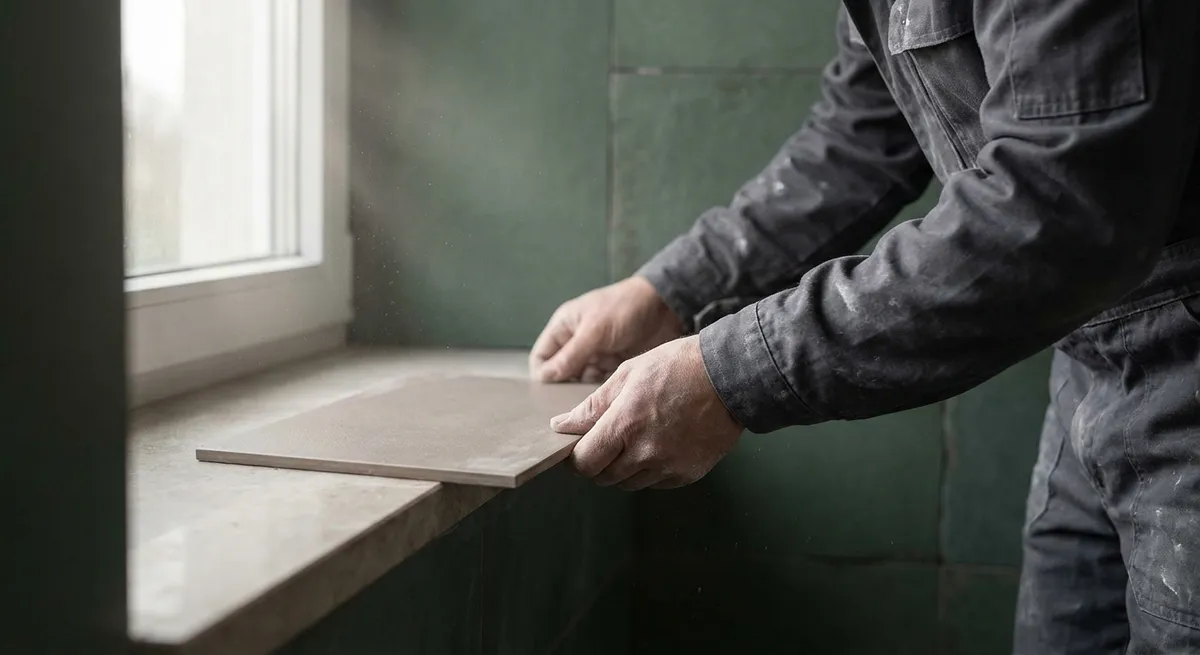
This guide explores refined repair solutions that maintain the integrity of your surfaces and your space’s overall narrative—plus five exclusive insights you will not hear from a typical contractor.
Seeing Beyond the Flaw: Diagnosing with Design in Mind
Tile repair should begin long before adhesive meets trowel. The first discipline is diagnostic: understanding why something failed, not only where it failed.
A hairline crack across several tiles may indicate subfloor movement, thermal expansion, or a structural detail that was never fully addressed. A single loose tile in an otherwise perfect field may point to inadequate coverage, an isolated impact, or moisture encroaching at the perimeter. The solution is rarely just “replace what’s broken.”
For a premium result, the diagnostic process must consider both technical and aesthetic implications. If one tile in a large, veined porcelain pattern fails, replacing it with a tile whose veining direction is misaligned can visually disrupt an entire wall. Similarly, repairing grout in only one isolated joint can create a patchwork effect when the rest of the field has gently patinated over time.
The refined approach: determine the structural cause, study the visual rhythm of the entire surface, and plan the repair as if you were directing a small restoration—because, in a well-appointed home, that is precisely what you are doing.
Material Intelligence: Matching More Than Just Color
For sophisticated tile work, “close enough” is never enough. Matching a repair to an existing installation requires sensitivity to color, sheen, texture, and even how the material interacts with light throughout the day.
Porcelain and ceramic tiles from the same collection can vary subtly across production runs. Natural stone has even greater nuance—veining direction, crystal structure, and mineral tonality all shift from tile to tile. Grout, meanwhile, evolves over time, mellowing with cleaning, traffic, and exposure to light.
A premium repair strategy prioritizes material intelligence:
- Confirm shade and caliber from leftover boxes if available; these details are often printed on the carton.
- For grout, consider the current, aged color, not the original. A slight custom tinting of grout or colorant may be required to harmonize old and new.
- Evaluate surface reflectivity. A matte patch in a field of soft satin tiles, or a glossy repair on honed stone, draws the eye immediately.
- Consider line and movement. In marble or marble-look tiles, vein direction is as critical as color; one incorrectly oriented tile can unbalance an entire composition.
This level of attention transforms a repair from a fix into a continuation of the original design philosophy.
Five Exclusive Insights for Discreet, High-End Tile Repairs
These are the quiet, behind-the-scenes practices that discerning homeowners and top-tier installers rely on to keep refined spaces looking genuinely untouched.
1. Micro-Resurfacing Before Full-Tile Replacement
Not every chip, corner bruise, or surface abrasion requires tile replacement. In some cases—particularly with high-end porcelain and dense natural stone—a skilled professional can perform micro-resurfacing or micro-filling.
Using ultra-fine abrasives, high-grade epoxies, and color-stable pigments, minute defects can be blended into the surrounding surface. On solid-color, matte porcelain, this is sometimes more visually seamless than replacement, especially if matching the exact production batch is impossible. On natural stone, a properly executed fill that respects vein direction and translucency can preserve original slabs you may never be able to source again.
The key is restraint: the goal is not to create a high-gloss “patch,” but to sympathetically echo the existing surface, working within its character rather than overwriting it.
2. Grout Rejuvenation as a Strategic “Soft Repair”
Often, what appears to be tile failure is actually grout fatigue: fine cracks, discoloration, or erosion that visually ages an otherwise robust tile field. In these instances, a strategic grout rejuvenation can revive the installation without the disruption of full tile replacement.
This may involve:
- Carefully removing compromised grout to a consistent depth
- Regrouting with a premium, stain-resistant formulation, such as epoxy or high-performance cementitious grout
- In some cases, applying a grout colorant across the entire field to achieve a uniform, curated tone
By treating grout as a design element rather than an afterthought, you can subtly correct visual imbalances—narrow joints that read too harshly, or overly bright grout that competes with the tile. The surface looks “new,” but more importantly, it looks intentional.
3. Acoustic Testing as a Non-Invasive Checkup
Sophisticated tile care includes preventive listening. Before visible failure appears, hollow-sounding tiles can betray a lack of proper bond or emerging substrate issues. A simple acoustic survey—tapping the tile surface with a non-marring tool and listening for changes in pitch—can reveal pockets of concern that may not yet be visible.
For high-value floors or large-format installations, this quiet, non-destructive testing is invaluable:
- It allows localized repairs before a larger section debonds.
- It helps distinguish between purely cosmetic concerns and issues that may eventually affect structural integrity or safety.
- It informs where expansion joints or movement accommodation should be revisited.
This is not a dramatic intervention. It is a periodic, thoughtful audit, much like having a fine watch inspected before it stops keeping perfect time.
4. Controlled Demolition to Protect Adjacent Tiles
The most underrated luxury in tile repair is what doesn’t get disturbed. Removing a single failed tile from a tightly set, premium installation requires a surgeon’s mindset. The goal: isolate the defect while preserving every neighboring piece.
Controlled demolition may include:
- Precision scoring of grout joints to decouple the target tile from its neighbors
- Incremental removal of the tile center first, working outward to reduce stress on edges
- Use of specialized tools (oscillating multi-tools, low-vibration chisels, or, in some cases, core drills) to limit shock transfer
- Dust management strategies to protect finishes, furnishings, and indoor air quality
An elegant repair is as much about respect for what remains as it is about changing what has failed. When executed correctly, the only hint of intervention is the quiet return to visual harmony.
5. Planning Repairs Around Movement and Moisture, Not Just Damage
The most enduring repairs address the two forces that most often undermine tile work: movement and moisture. Simply re-adhering a loose tile without considering either is an invitation to repeat the work.
A refined repair plan evaluates:
- Whether movement joints (in large floors, long corridors, or transitions between materials) are properly placed and functioning
- The presence and integrity of waterproofing or crack-isolation membranes in wet areas and over substrates prone to hairline cracking
- Changes in building use or environment since the original installation—new underfloor heating, altered HVAC behavior, or increased sun exposure through expanded glazing
A single shower leak or unaccommodated expansion can eventually express itself as cracked grout, tented tiles, or recurring failure in the same location. The sophisticated solution is to repair not just the surface, but the underlying conditions—even when they are invisible to the casual eye.
Collaborating with Craftspeople: What to Ask Before Any Repair
Homeowners who value refined spaces benefit from working with professionals who see tile repair as craft, not simply construction. Before commissioning work, consider asking:
- How will you diagnose the cause of failure, not just address the symptom?
- What is your plan to match tile, grout, and finish as closely as possible?
- How will you protect adjacent tiles and finishes during removal and installation?
- Can you walk me through your dust, noise, and cleanliness protocols?
- How do you ensure compatibility with existing waterproofing, membranes, or heated floors?
The right craftsperson will welcome these questions. Their responses should reference industry standards, manufacturer guidelines, and past experience with similar materials—porcelain slabs, encaustic tiles, natural stone, or handmade ceramics.
In high-end homes, the relationship with a tile specialist can become much like that with a trusted art restorer: someone you call not only when something fails, but when you wish to preserve, refine, and future-proof what you already love.
Conclusion
Elegant tile repair lives in the space between architecture and restoration. It is as much about honoring the original vision as it is about correcting what time, movement, or moisture have disturbed. When approached with material intelligence, technical discipline, and aesthetic sensitivity, repairs can be nearly invisible—yet profoundly reassuring.
For the modern home, the measure of luxury is not the absence of wear, but the grace with which surfaces are maintained, renewed, and quietly rescued when needed. With the right insights and collaborators, your tiled spaces can age not just beautifully, but confidently.
Sources
- Tile Council of North America (TCNA) Handbook – Industry-recognized guidelines for tile installation and repair best practices
- ANSI A108 / A118 / A136.1 Standards Overview – Tile Council of North America – Technical standards governing tile installation materials and methods
- LATICRETE – Tile & Stone Installation and Care Guides – Manufacturer guidance on adhesives, grouts, membranes, and repair approaches
- Mapei Technical Articles – Tile & Stone Installation Systems – Detailed product and system information relevant to professional tile repair
- U.S. General Services Administration – Historic Building Stone and Tile Preservation Briefs – Conservation-oriented perspectives on repairing and preserving stone and tile surfaces in significant buildings