Reading the Tile: Diagnosing Without Disturbing
Sophisticated repair begins long before any tool touches the surface. The first task is diagnosis—performed with the same restraint and discernment you would bring to fine furniture restoration.
A simple “sound test” with a knuckle or a wooden dowel reveals hollow spots, indicating poor bond or voids beneath the tile. A dull, thudding note contrasts with the crisp, solid tone of fully adhered tile. Subtle variations in grout color can hint at moisture migration, while a fine crack tracing a doorway or structural joint may say more about movement than material failure.
Lighting matters as much as listening. Grazing light—natural or from a handheld source angled across the floor or wall—exposes hairline fractures, lippage (uneven edges), or micro-chips along polished porcelain and stone. In bathrooms and wet areas, inspect caulk transitions and grout intersections; localized discoloration or efflorescence (a powdery white residue) can flag hidden moisture long before tiles loosen.
This calm, observational phase is where premium repair work is defined: the goal is to understand the problem so precisely that the eventual remedy is minimal, targeted, and virtually invisible.
Invisible Mending: Precision Over Patchwork
The distinction between a patch and a repair is immediately visible in refined interiors. Patching merely fills a void; true repair restores continuity—of texture, color, sheen, and line.
For hairline cracks in stable substrates, ultra-thin, clear or color-matched epoxy systems can bridge the fracture without resorting to replacement. When applied with a fine artist’s brush and lightly polished once cured, the crack becomes an almost imperceptible trace, rather than a visual interruption. On patterned porcelain, a subtle touch of pigment, feathered into the design, can complete the illusion.
Edge damage on stone thresholds, steps, and shower entrances demands jeweler-level care. Instead of swapping an entire piece, expert technicians may rebuild a chipped corner or softened edge using high-quality stone repair resins, then re-profile and polish to match the original radius. This avoids disrupting veining or pattern alignment while maintaining the bespoke feel of the original installation.
Even grout can be “invisibly mended.” Rather than regrouting entire walls or floors, selective removal and replacement, followed by professional color sealing, can harmonize old and new joints, preserving patina while eliminating visual noise. The best tile repairs don’t announce themselves; they quietly restore the room’s composure.
Five Exclusive Insights for Discerning Tile Owners
In elevated interiors, the difference between acceptable and exceptional repair lies in nuance. These five insights are particularly valuable for homeowners who view their tilework as an investment, not simply a finish.
1. Movement, Not Material, Is Often the Culprit
Cracked grout or isolated cracked tiles frequently reflect building movement, thermal expansion, or improperly placed control joints—not defective tile. Before replacing surfaces, insist on evaluating expansion gaps at perimeters, transitions between rooms, and changes in substrate (for instance, where concrete meets wood framing). Correcting movement issues—adding or reestablishing soft joints, adjusting thresholds, or upgrading underlayments—prevents repeat failures that would otherwise reappear, no matter how beautiful the initial repair.
2. Color Matching Is a Specialty, Not an Afterthought
True luxury repairs treat color as a craft in its own right. Grout that is “close enough” or caulk that’s merely white undermines the coherence of a high-end room. Advanced color-matched grouts, custom-tinted sealers, and silicone sealants are now available in hundreds of shades; some installers even mix micro-batches on site to reconcile aging grout with new material. For natural stone, repair professionals can layer transparent and opaque pigments within resins to mirror veining and undertones, rather than simply filling chips with a flat, mismatched tone.
3. Replacement Tiles Are Only as Good as Their Batch Lineage
When you planned ahead and stored spare tiles, their value depends on more than the manufacturer’s name. Box labels with batch, shade, and caliber codes are invaluable. Even within the same collection, slight variations in size, tone, and surface finish can become glaring under refined lighting. Before installing a replacement, lay it dry next to existing tiles under the same light conditions—day and evening. If you lack spare tiles from the original batch, a skilled pro can often “steal” a perfectly matched tile from a discreet location (inside a closet, under a removable vanity toe-kick, or deep in a pantry) and replace that hidden area with a close but imperfect match.
4. Polished Surfaces Require a Restoration Mindset
Polished porcelain and natural stone do not forgive aggressive repair techniques. Spot-grinding a lippage issue or sanding out an etch mark with coarse abrasives creates dull halos that are nearly impossible to blend by hand. For premium finishes, insist on a restoration-based approach: progressive diamond polishing with increasingly fine grits, followed by polishing powders or compounds calibrated to the stone or porcelain type. When done correctly, the repaired area doesn’t just look smooth—it reflects light with the same crisp, controlled sheen as the surrounding field.
5. Controlled Disassembly Is an Art Worth Paying For
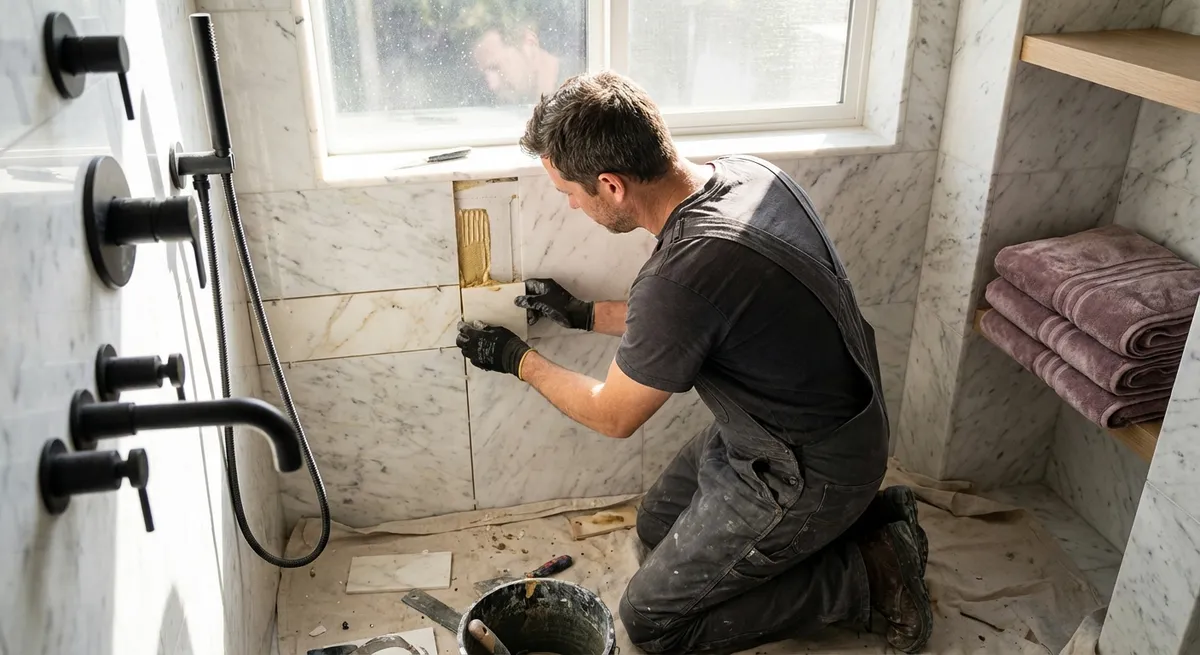
Sometimes, true repair means selectively removing and reinstalling tile instead of attempting surface-level fixes. In heated floors, curbless showers, or large-format installations, this is delicate work. The objective: remove only what is absolutely necessary, without disturbing adjacent layout, in-floor heating elements, or waterproofing membranes. Heat guns, oscillating multi-tools, vacuum-equipped chisels, and specialized scraping blades allow careful “surgical” extraction. An expert will document each stage—photographing underlayments, mapping heating wires, and testing waterproofing—to ensure the rebuilt assembly is not just structurally sound but quietly superior to the original.
Working With Experts: What Elevated Repair Looks Like
Premium tile repair has a distinctive rhythm and methodology. It begins with a consultation that feels more like a design review than a service call. A serious professional will ask about the history of the installation, the age of the building, prior repairs, and your long-term plans for the space. They should be as interested in how you live with the room—barefoot traffic, pets, frequent entertaining—as in the tiles themselves.
Expect them to probe beyond the visible symptoms: moisture readings in wet rooms, assessment of subfloor deflection on upper stories, inspection of grout movement joints, and review of transitions to adjacent materials. Rather than promising a quick fix, they will outline options—stabilization, localized repair, partial restoration—along with their implications for longevity and appearance.
Materials selection is equally meticulous. High-performance mortars and grouts, appropriate for the tile type and setting, are fundamental. In wet zones, ANSI- or ASTM-compliant waterproofing systems and compatible sealants should be non-negotiable. A refined professional will also consider acoustics (for example, underlayments that reduce sound transfer in multi-story homes) and maintenance compatibility, ensuring that repaired areas respond predictably to your preferred cleaning regimen.
Finally, elevated repair respects your home as much as your tile. Dust control, clean edges to temporary protection, careful removal of fixtures, and thorough post-repair polishing all signal a level of craft that aligns with sophisticated interiors.
Conclusion
Impeccable tilework is not defined by an absence of flaws, but by the elegance with which it withstands time, movement, and daily life. When approached with discernment, tile repairs become a form of quiet guardianship—preserving layout, proportion, and material integrity while discreetly addressing the inevitable stresses of use.
By diagnosing with precision, favoring invisible mending over broad patching, and partnering with professionals who understand both the technical and aesthetic dimensions of tile, homeowners can ensure that each intervention reinforces the original design intent. The result is not merely a “fixed” floor or wall, but a surface that continues to serve as a calm, composed foundation for everything else in the room to shine.
Sources
- Tile Council of North America (TCNA) – Handbook for Ceramic, Glass, and Stone Tile Installation - Authoritative industry guidelines on proper installation and repair practices.
- ANSI A108 / A118 / A136.1 Installation Standards (via American National Standards Institute) - Technical standards for tile setting materials and methods referenced by professionals.
- Schluter Systems – Movement Joints and Crack Isolation - Detailed information on managing movement and preventing tile and grout cracking.
- Laticrete – Tiling Over Cracks and Control Joints - Technical guides on addressing cracks and structural movement in tile assemblies.
- University of Florida IFAS Extension – Efflorescence and Masonry - Explanation of efflorescence causes and implications for moisture and substrate conditions.