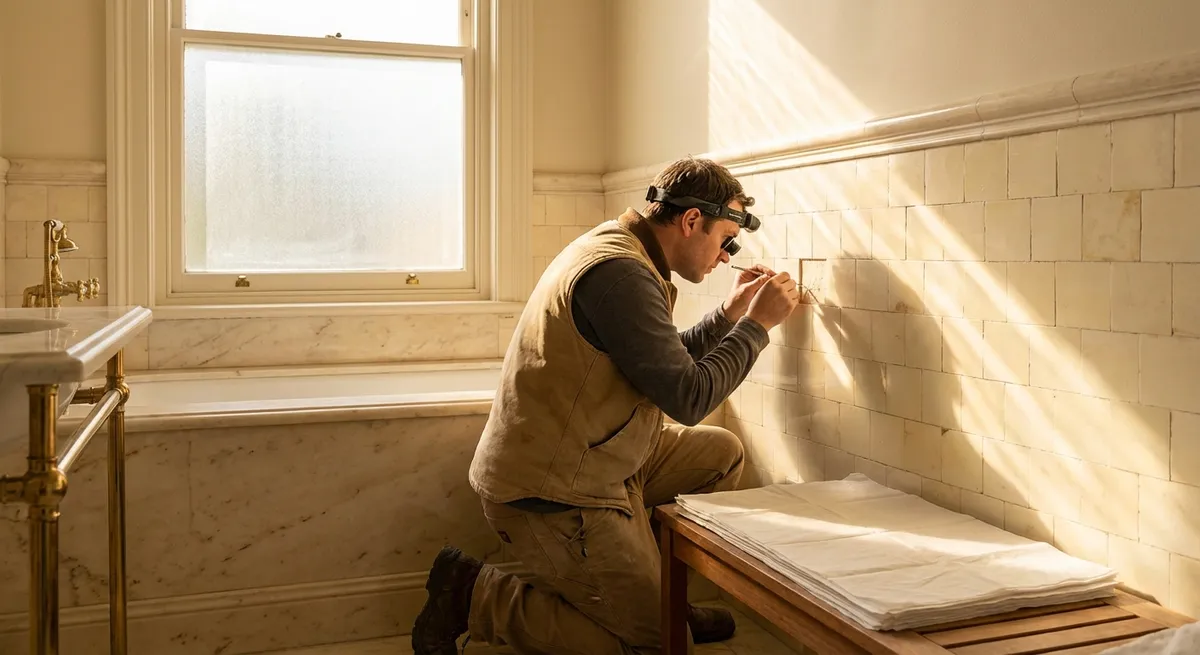
This guide explores repair solutions that begin before damage is obvious, with five exclusive insights that discerning homeowners can use to protect their investment and sustain beautifully finished spaces.
Reading the Room: Subtle Signals Before a Tile Fails
By the time a tile cracks, the underlying problem has often been developing for months—or longer. The hallmark of a refined approach is the ability to recognize early signals that most people overlook.
Micro-shifts in grout lines, hairline changes at thresholds, or the faintest hollow sound when tapped with a knuckle can all indicate stress beneath the surface. Slight darkening along grout in showers may point to moisture intrusion rather than simple discoloration. A minuscule lip between flush tiles can reveal uneven substrate movement, especially near structural transitions or under heavy furniture.
Mapping these clues—literally walking the room in a quiet, systematic pattern—turns the space into a readable surface. Subtle anomalies can be noted, photographed, and rechecked over time. This gentle surveillance allows corrective action before visible damage appears, turning repairs into discreet adjustments rather than disruptive projects.
Exclusive Insight #1:
Treat your tiled rooms like a tailored garment: schedule a “fitting” once or twice a year. Slowly walk each tiled area barefoot, eyes and ears tuned for temperature differences, hollow spots, and small height changes. Early detection preserves both aesthetics and structure.
Intelligent Grout Repair: Precision Without Patchwork
Grout often telegraphs problems before the tile does, yet many repairs are done hastily, leaving visible patchwork that diminishes the overall composition. A more elevated approach considers grout repairs as micro-restorations, with attention to color, texture, and long-term performance.
Rather than simply scraping and refilling cracked joints, a careful assessment identifies why the grout is failing: movement in the substrate, cleaning with harsh chemicals, inadequate original coverage, or moisture migration. Where possible, isolated stress points (such as inside corners or perimeter joints) are upgraded to flexible sealant that matches the grout, subtly allowing movement where rigid grout will always fail.
Color matching should go beyond the label on a bag. Aging, UV exposure, and cleaning patterns alter grout appearance over time. A sophisticated repair uses test swatches, careful blending, and sometimes deliberate micro-variation along existing joints so the repair dissolves into the original field rather than reading as a new insertion.
Exclusive Insight #2:
When planning grout repairs, request a small “blend sample” board: your existing grout, cleaned, photographed, and matched against multiple manufacturer tones under both natural and artificial light. Approving the blend—not just the product name—prevents jarring, mismatched joints.
Moisture as the Hidden Architect: Repairing the Invisible
Water is the quiet author of many tile failures, particularly in baths, showers, kitchens, and outdoor spaces. A refined repair strategy treats tile not as a waterproof layer, but as the visible expression of a deeper waterproofing system that must be evaluated and, when necessary, discreetly renewed.
Before addressing visible damage such as efflorescence, darkened grout, or loose tiles, an elevated repair workflow often includes moisture mapping with professional meters, infrared imaging, or controlled test cuts in inconspicuous locations. The goal is not simply to remove the symptom, but to understand the path of water and correct it at its source.
This may involve upgrading shower membranes, reinforcing critical transitions (niche corners, benches, curb-to-wall intersections), or adding proper slope to exterior tiled areas. When handled with care, these deeper corrections can be localized and strategic, preserving most of the existing installation while significantly extending its lifespan.
Exclusive Insight #3:
For any recurring grout discoloration, warped baseboards near tile, or persistent “musty” odor, insist on a moisture assessment before cosmetic repair. A short, targeted investigation can prevent far more invasive—and expensive—work later.
Structural Respect: Aligning Repairs With the Building’s Behavior
Tile is unforgiving; it does not flex gracefully with a moving building. The most enduring repairs emerge from understanding the structure beneath and allowing the tile to coexist with it, rather than resist it.
In older homes, seasonal movement is inevitable. Joists expand and contract, substrates respond to humidity, and multi-story buildings experience subtle deflection. When a tile repair ignores this, even a beautifully executed patch can fail again in the same location.
Sophisticated tile professionals intentionally weave flexibility into the repair: decoupling membranes, expansion joints placed with architectural sensitivity, movement accommodations at perimeters, and reinforcement at known stress zones (over beams, transitions between materials, or near large spans of glazing). These measures can be structured so they are effectively invisible, maintaining visual continuity while dramatically improving resilience.
Exclusive Insight #4:
Where a single tile or small cluster repeatedly cracks or loosens, ask your professional not just to “replace the tile,” but to identify why that exact area is stressed—over a joist, near a threshold, under heavy appliances, or along a structural joint. Targeted structural respect in that zone often eliminates chronic recurrence.
Curated Materials for Future Repairs: Building a Private Archive
One of the simplest yet most overlooked luxuries in tile ownership is having a private archive: a carefully curated set of surplus materials and documentation reserved for future repairs. When this archive exists, a damaged tile can often be replaced with museum-like precision. Without it, even minor repair work can devolve into compromise.
Beyond keeping a few extra tiles, a sophisticated archive includes: batch and shade numbers, grout brand and color codes, setting materials used, layout drawings or photos of the pattern before grout, and records of underlayment or waterproofing systems. For patterned, handmade, or large-format tiles, a more generous surplus is essential; manufacturing runs change, even when products carry the same name.
This archive transforms future repairs. Instead of approximate substitutions or visible patchwork, the repair becomes a restoration—integrating authentically with the original installation and preserving the home’s visual narrative.
Exclusive Insight #5:
Store surplus tile and documentation as you would a fine textile: labeled, climate-stable, and photographically cataloged. Keep a digital folder with invoices, photos of packaging labels, and images taken during installation (especially before grout). This quiet record-keeping is one of the most valuable “repair tools” you can own.
Conclusion
Elevated tile repair is not defined by dramatic before-and-after photographs, but by what remains beautifully unchanged. It is the art of preserving alignment, depth, and finish so that the home continues to feel composed—never compromised. By reading early signals in your surfaces, treating grout with precision, respecting moisture and structure, and maintaining a curated archive of materials, you transform tile repair from an emergency response into an ongoing act of stewardship.
In refined homes, the most successful repair is the one guests never notice—only the quiet confidence of surfaces that feel effortlessly right, year after year.
Sources
- U.S. Department of Housing and Urban Development – Residential Rehabilitation Inspection Guide - Offers technical background on building movement, moisture issues, and substrate conditions that impact tile performance and repair.
- Tile Council of North America (TCNA) – Handbook for Ceramic, Glass, and Stone Tile Installation - Authoritative industry standards for proper tile installation, movement joints, and repair considerations.
- Schluter Systems – Waterproofing and Uncoupling Membrane Information - Technical resources on membranes and movement accommodation relevant to long-term tile durability and repairs.
- Laticrete Technical Data Sheets - Detailed documentation on grout, setting materials, and repair products, including performance considerations for different environments.
- University of Florida IFAS Extension – Moisture Problems in Homes - Explains causes and detection of moisture issues that often manifest as tile and grout failures.