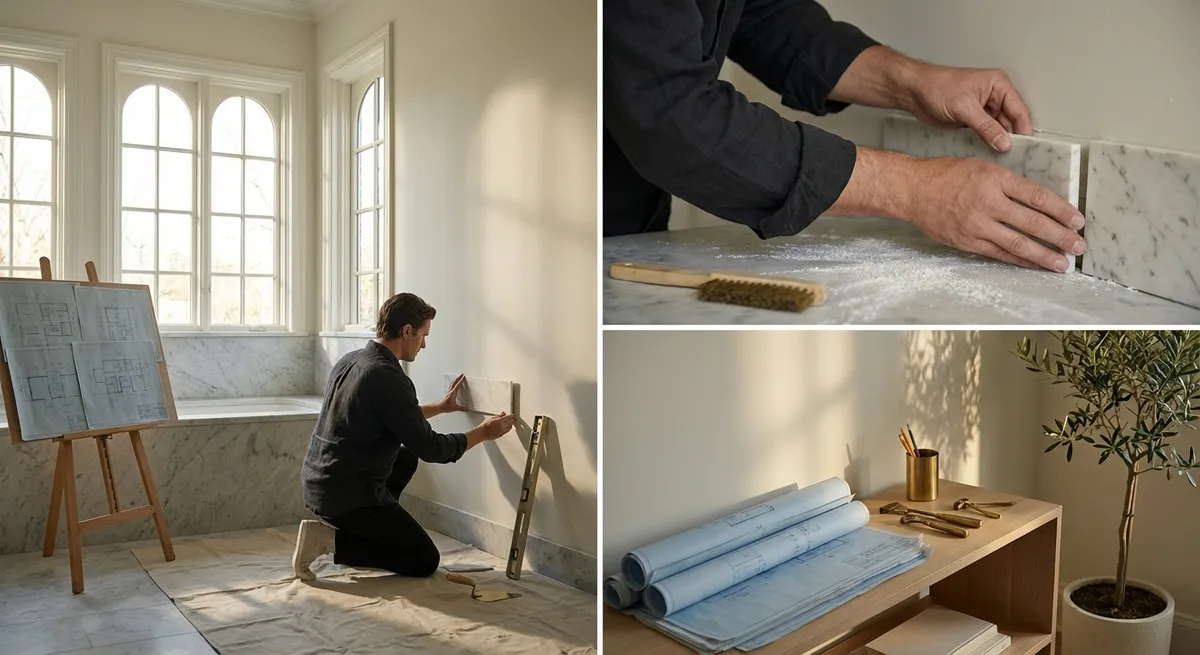
Below are five exclusive, practitioner-level insights that sophisticated homeowners and design professionals rely on when addressing tile repairs without sacrificing a millimeter of elegance.
Reading the Floor: Diagnosing Before You Touch a Tile
Refined repair begins with restraint. Pulling a single tile prematurely can create more damage than the original issue. Instead, start with a quiet, methodical assessment.
First, listen. A light tap with a wooden dowel or the plastic end of a tool can reveal hollow spots where thinset has detached from the substrate. Hollow does not always mean failure—especially in larger format tiles—but hollowness combined with movement underfoot is a red flag. Next, observe transitions: thresholds between rooms, around kitchen islands, and near entry doors often tell the story of underlying structural or substrate issues.
Pay particular attention to patterns of cracking. A diagonal crack that runs across multiple tiles often speaks to movement in the subfloor or slab. An isolated hairline crack in the center of a single tile may result from an impact, such as a dropped pan. Subtle lippage (one edge of a tile slightly higher than its neighbor) can also indicate that a tile has started to release from its bond. Approaching the floor as a system, rather than as a collection of individual pieces, allows you to repair the specific failure without disturbing the entire composition.
Invisible Mends: Mastering Color, Finish, and Pattern in Repairs
In a premium interior, the success of a tile repair is measured by its invisibility. That demands an elevated approach to color, finish, and pattern matching—especially with natural stone, artisanal ceramics, and high-end porcelain.
For natural stone, it is rarely sufficient to order “more of the same” from the original vendor. Quarries evolve, and so do lots. An experienced stone supplier or fabricator can help you source material from the same or a compatible lot, or, where that is impossible, selectively choose pieces with veining and undertones that complement the existing installation. Often, it is wiser to pull and replace a small, strategically bounded section than to insert a single tile that visually shouts.
With porcelain and ceramic, sheens and micro-textures are critical. Even a slight difference in gloss level can catch morning light and reveal a repair from across the room. Before committing, request samples from current production runs and place them in situ at different times of day to evaluate sheen, color shift, and reflection. Where patterns or printed graphics are involved—think marble-look porcelain or hand-painted cement-look tiles—confirm exact pattern repeats and orientation so that the repaired area continues the visual rhythm rather than interrupting it.
Finally, grout color is not an afterthought. Original grout may have matured, softened, or slightly discolored over time. A refined repair specialist will custom-tint or blend grouts to harmonize with the aged tone rather than matching the original “new” color perfectly, which can inadvertently spotlight the repair.
Stabilizing What You Keep: Micro-Interventions That Preserve Existing Tile
Sophisticated homeowners know that the most elegant repair is often the smallest effective intervention. Not every hollow sound or minor crack warrants full tile removal. In some cases, targeted stabilization can extend the life of the installation without disturbing the aesthetic.
For non-structural hollow tiles that remain stable underfoot, low-pressure injection of specialized repair epoxy or adhesive beneath the tile can rebond it to the substrate. This must be done with precision—choosing the correct product compatible with both tile and substrate, drilling pinpoint holes through grout joints or inconspicuous areas, and carefully clamping or weighting the tile while the adhesive cures. When executed correctly, this approach avoids re-cutting or re-fabricating tiles that are otherwise in perfect visual condition.
Hairline cracks in natural stone can sometimes be cosmetically disguised and structurally improved with color-matched epoxy or polyester resins, then honed and polished to blend with the original finish. This is a common technique in luxury hotels and boutiques, where pulling large-format slabs would be disruptive and expensive. The result is not a “new” tile, but a surface that reads as quietly intact to the eye, preserving the sense of continuity in the space.
Knowing when to stabilize and when to replace requires an honest evaluation of traffic levels, moisture exposure, and your tolerance for subtle imperfection. In a primary bath wet area or entry exposed to outdoor grit, replacement remains the gold standard. In a seldom-used dressing room or gallery corridor, a finely executed micro-intervention may be entirely appropriate.
Respecting Movement: Elegant Solutions to Prevent Recurring Failures
Many tile failures are not about the tile itself, but about a lack of respect for movement—both in the building and within the tile assembly. A sophisticated repair strategy doesn’t merely fix the symptom; it discreetly corrects the underlying oversight.
Movement joints, often considered a visual intrusion, are actually a mark of intelligent design. Along long runs of tile, at perimeters, and across transitions between different substrates (for example, where a heated bathroom floor meets an adjacent hallway), flexible joints absorb expansion, contraction, and slight deflection. If your existing installation has no soft joints and you are repairing a recurring crack along a particular line, integrating an elegant, color-matched silicone joint in that location can prevent the issue from returning.
Underlayment failures are another common culprit. In upper-level installations, movement in wood subfloors can telegraph through rigid tile. Where you see repeated cracking along joist lines, an expert may recommend carefully removing a controlled section of tile, reinforcing or re-structuring the subfloor, and reinstalling tile over an appropriate uncoupling membrane or cement backer board. Done thoughtfully, this intervention is largely invisible when complete but profoundly improves the longevity of the entire field.
Even in slab-on-grade homes, moisture vapor and minor slab movement can undermine tile bonds over time. Correcting this might mean integrating a more advanced membrane system or patching and leveling compounds beneath the repaired area. The refinement lies in executing these improvements without disturbing the architectural quiet of the space.
Curating the Professional: How to Select an Expert for High-End Tile Repairs
In a luxury context, tile repair is closer to conservation than simple replacement. Choosing the right professional is therefore as critical as selecting the tile itself.
Start by seeking specialists who can speak fluently about standards and methods, not just aesthetics. References to industry guidelines, such as those from the Tile Council of North America (TCNA) or manufacturer-specific installation manuals, are markers of a craftsperson who understands the technical foundations of their work. Ask to see before-and-after photographs of repairs—not full installations—and look closely at how seamlessly the repaired zones integrate into existing surfaces.
For natural stone or specialty materials, consider professionals with a background in stone restoration or historic preservation. Their skillset—honing, polishing, blending repairs, and working with resins—is invaluable when the priority is to maintain original material wherever possible. Discuss mock-ups in inconspicuous areas before authorizing work in focal zones; a refined professional will welcome the opportunity to demonstrate their approach on a small scale.
Finally, align on philosophy, not just price. The right partner will suggest conservative, minimally invasive strategies where appropriate, and full replacement only when necessary. They will prioritize dust control, protection of adjacent finishes, and respectful work habits that suit an elevated home. In other words, they will treat your tile not as a commodity, but as part of your home’s architectural language.
Conclusion
Tile repair in a refined home is not a matter of patching flaws; it is an exercise in preserving coherence—structural, visual, and experiential. By diagnosing issues with patience, pursuing invisible mends, stabilizing what can be preserved, honoring the movement of the building, and curating the right professional, you transform repair from an interruption into a quiet continuation of your original design intent.
When approached with this level of care, even a once-troublesome tile field can emerge more resilient and more composed, allowing your surfaces to recede gracefully into the background—exactly where truly considered design belongs.
Sources
- Tile Council of North America (TCNA) – Handbook for Ceramic, Glass, and Stone Tile Installation - Authoritative industry guidelines on proper installation and repair practices
- American National Standards Institute (ANSI) – Specifications for the Installation of Ceramic Tile - Technical standards referenced by high-level tile professionals
- Custom Building Products – Technical Articles on Tile Repair and Installation - Detailed discussions on hollow tiles, crack isolation, and repair materials
- Laticrete – Tile & Stone Installation and Care Resources - Education and training materials on advanced substrates, membranes, and repair systems
- National Institute of Building Sciences – Whole Building Design Guide: Ceramic and Stone Tile Flooring - Comprehensive overview of design, installation, and performance considerations for tile assemblies