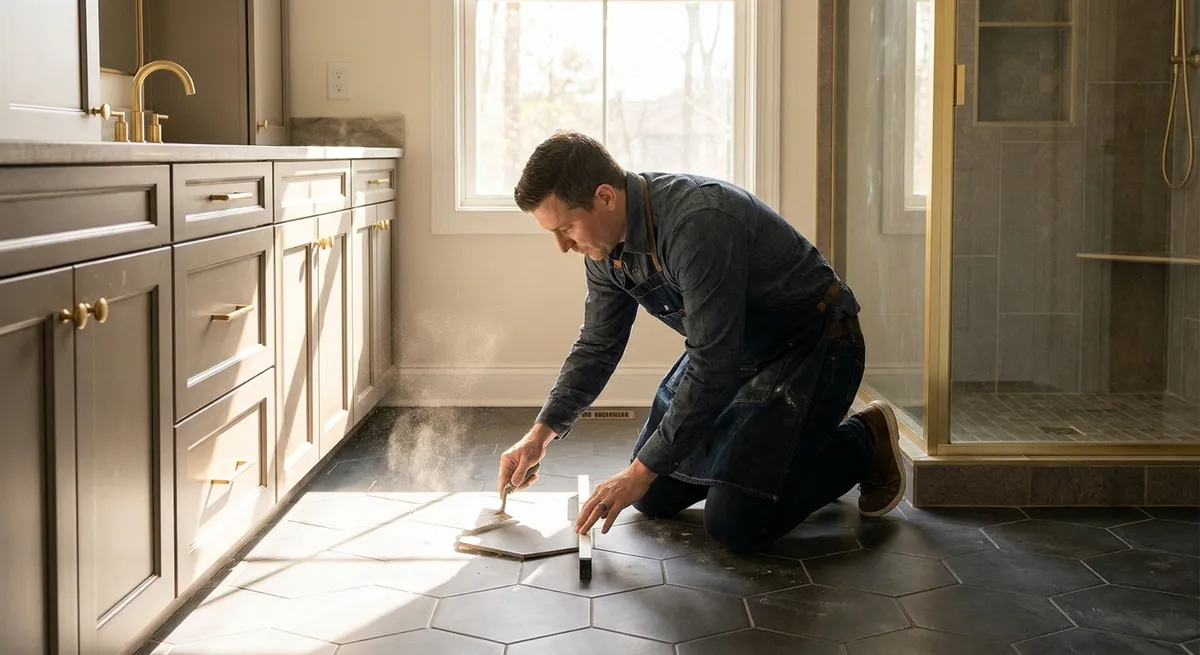
Reading the Surface: Repair as Architectural Context, Not a Patch
Sophisticated repair begins with understanding the tile as part of an architecture, not as an isolated product. A chipped edge in a kitchen backsplash is not just a localized flaw—it intersects with under-cabinet lighting, counter material, wall color, and even the viewer’s typical sightlines.
Instead of asking “How do I hide this chip?” a more refined question is: “How does this surface behave in this room?” Observe the area across different times of day. Does grazing light from a window exaggerate unevenness? Does task lighting highlight one section of grout more than another? These observations guide whether a repair should prioritize surface flatness, color accuracy, edge definition, or reflection control.
For instance, a highly polished porcelain in a sunlit entry will reveal even the slightest lippage in a replacement tile. In such a case, you may prioritize perfect plane alignment over minor color variation, sourcing a tile from a later batch that is close—but not identical—in tone. In a dimly lit shower niche, however, micro-variations in shade matter less than precise silicone and grout terminations, which the eye reads as “finished” or “unfinished.” The most successful tile repairs are not merely invisible; they are contextually appropriate.
Intelligent Matching: Beyond Color Chips and Leftover Boxes
Homeowners often assume that a spare box from the original installation guarantees a perfect match. In practice, it is more nuanced. Tile shade, texture, and even dimensions can shift subtly between production runs, and existing installations will have aged—exposed to UV light, cleaning agents, and wear. A sophisticated repair acknowledges time as a factor.
Start by evaluating four axes of compatibility, rather than color alone:
- Shade and undertone – Two whites can differ dramatically: one may lean blue, another cream. Compare tiles in natural daylight and under the actual room lighting.
- Surface texture and sheen – The eye is acutely sensitive to differences in gloss level. A semi-polished surface next to a full gloss tile will read as a “repair,” even if the color is close.
- Micro-geometry – Bevel depth, rectified edges, pillowed corners, and micro-chips in existing tiles all influence how the joint lines catch light. A tile with a slightly different edge will betray itself in raking light.
- Batch tolerance and sizing – Two nominally identical 24x24 tiles from different lots can vary just enough to break the rhythm of a tight grout joint.
Martini-level precision means testing potential replacements dry-fit in the actual installation—side by side under operational lighting—before committing. When an exact match is impossible, a skilled approach is to “redistribute” new tiles to visually quieter zones (behind a freestanding tub, under vanity overhangs, inside a cabinet base) and move original tiles into the main visual field. The result is a cohesive composition rather than a single conspicuous “new” tile in the middle of a main wall.
Adhesives and Grouts as Design Tools, Not Commodities
In elevated tile work, thinset and grout are not mere consumables—they are design instruments that influence both performance and perception. An experienced installer selects these products with the same discrimination a sommelier brings to a wine list: pairing, contrast, and longevity all matter.
For repairs, two considerations rise to the top:
- Compatibility, not just adhesion: The original assembly may have used a standard thinset on a concrete slab, while your repair area is now slightly more flexible due to past moisture or structural settlement. A premium, deformable (often labeled “flexible”) mortar may be necessary to prevent the new tile from cracking where the original has survived. Similarly, if the installation is over a heated floor, you should treat thermal movement as a central design parameter, not an afterthought.
- Grout as a visual narrative: Aged grout rarely matches the color in the original bag. Sunlight, cleaning agents, and soap residues all dial the tone up or down. This opens two refined paths:
- Tone-in: Custom-tinting a grout or using a grout colorant to bring the entire field into a harmonized, slightly adjusted color. This is exceptionally effective when replacing just a few tiles in a large installation.
- Intentional shift: When a perfect match is impossible, deliberately adjusting grout to a subtly contrasting tone can transform a small repair into a perceived design decision, especially in spaces where graphic grout lines complement the architecture.
Savvy homeowners understand that the “invisible” success of a repair often lies in invisible materials—those inside the assembly and between the tiles—that have been chosen with precision.
Managing Transitions: Where Most Repairs Betray Themselves
Luxury tile work is often judged not by its center field, but by its edges—door thresholds, shower transitions, inside corners, and where tile meets other materials. Repair projects, especially partial ones, tend to compromise these moments. An elevated approach treats transitions as architectural joints, not casual terminations.
Subtle yet powerful strategies include:
- Re-evaluating movement joints: Rather than simply grout-filling a cracked corner again, consider whether it should have been a soft joint (with silicone or a suitable sealant) from the start. Introducing a properly detailed flexible joint at a recurring crack is a mark of understanding, not a visible concession.
- Unifying profiles: If a repair forces you to touch a threshold, it may be worth upgrading to a high-quality metal or stone profile that ties both old and new materials together. A slim, well-chosen profile can recalibrate the entire perimeter, making the original and repaired sections read as one intentional layer.
- Controlling height and plane changes: Partial repairs over layered substrates (old tile, leveling compound, radiant mats) often create micro-steps. Instead of tolerating a subtle but perceptible ridge, a more refined solution might include feathering the underlayment beyond the repair area, distributing any transition over a broader span so it becomes imperceptible underfoot and to the eye.
The result is a space where your gaze can glide from surface to surface without catching on a poorly handled edge. In high-end interiors, this uninterrupted flow of sightlines and transitions is one of the quietest yet clearest markers of quality.
Subtle Future-Proofing: Designing Repairs That Age Gracefully
The most discerning homeowners think beyond today’s fix. A repair that looks impeccable now but ages inconsistently will ultimately feel like an intrusion. Future-proofing involves multiple layers of foresight—technical, aesthetic, and practical.
Consider these refined practices:
- Calibrated sealing strategies: If you introduce a new natural stone tile into an older installation, sealing only the new tile can cause uneven patina and differential staining. Instead, use the repair as an opportunity to bring the entire field to a consistent level of protection. The goal is for all tiles to age at the same rate, developing a unified character over time.
- Moisture and movement diagnostics: A cracked tile or recurring grout fracture is often a symptom, not the disease. Before replacing, investigate substrate movement, moisture levels, and, in wet areas, the integrity of waterproofing. A small investment in diagnostics (humidity probes, infrared imaging, or professional moisture assessment) can prevent a future cascade of failures and preserve the surrounding finishes.
- Creating an archival reserve: Whenever feasible, use the repair project to build a small, curated stock of properly labeled replacement tiles, stored flat in a temperate, dry location. Homeowners who inherit a thoughtful “tile archive,” complete with batch numbers and product data, gain an insurance policy for any future incidents. This is especially valuable for large-format, specialty, or discontinued lines.
- Documenting systems and sequences: Photograph each repair layer—substrate, membrane, mortar, and finished surface—and store this with product documentation. In sophisticated properties, this “material dossier” becomes a reference for any future work, ensuring continuity of methods and materials even if personnel change.
When repairs are approached as part of a long-term stewardship strategy rather than a short-term correction, your tiled spaces not only retain their composure, they acquire a quiet, enduring gravitas.
Five Exclusive Insights for the Discerning Tile Homeowner
- Lighting is your most honest inspector: Before approving any repair, observe the area under grazing light—early morning, late afternoon, and with all artificial lighting modes. Raking light will reveal lippage, grout haze, and edge misalignment that remain invisible in diffuse light.
- Micro-adjustments in grout can outperform a perfect tile match: When you cannot perfectly match an existing tile, prioritizing a cohesive grout tone across the entire field often does more for visual unity than obsessing over tile color alone.
- One precisely placed movement joint can save an entire room: Accepting a discreet, well-detailed flexible joint in a strategic location (often at a structural break or where materials change) can resolve recurring cracks that no amount of re-grouting will fix.
- Substrates age too: A tile that suddenly “fails” after years of service may be the visible expression of a changing substrate—settling structure, shifting screed, or moisture migration. Elegant repair work respects the assembly beneath the surface and never treats tiles as isolated components.
- Consider the patina you want in ten years, not just tomorrow’s perfection: Particularly with stone and high-end ceramics, a subtly lived-in patina can be more luxurious than a relentlessly pristine surface. Schedule repairs, sealing, and cleaning strategies around the kind of aging you wish the room to express—museum-perfect, quietly softened, or intentionally timeworn.
Conclusion
Refined tile repair is ultimately an exercise in restraint and discernment. It asks you to see beyond the damaged square and into the broader choreography of the room: how light moves, how joints align, how surfaces will evolve with use and time. By reading the context, choosing materials intelligently, honoring transitions, and planning for the future, homeowners can turn necessary repairs into an opportunity to elevate their spaces.
In the most considered homes, you never notice a repair as an event. You notice, instead, a calm continuity of surface—a sense that the architecture has been thoughtfully looked after, tile by tile, joint by joint, with the kind of quiet care that defines true luxury.
Sources
- [U.S. Department of Housing and Urban Development – Residential Rehabilitation Inspection Guide (Ceramic Tile)](https://www.hud.gov/sites/documents/DOC_9835.PDF) - Offers technical guidance on assessing and correcting tile issues in residential settings
- [Schluter Systems – Movement Joint Placement](https://www.schluter.com/schluter-us/en_US/MR-FAQ/Where-do-I-need-to-install-movement-joints%3F/c/FI-FAQ-MovJoints) - Explains best practices for movement joints, crucial for crack prevention and durable repairs
- [Custom Building Products – Understanding Mortar and Grout Selection](https://www.custombuildingproducts.com/reference-library/understanding-mortar-and-grout/) - Details how to choose appropriate mortars and grouts for different tile repair conditions
- [LATICRETE – Tiling Over Existing Tile and Substrate Considerations](https://laticrete.com/en/support-and-downloads/technical-design-manuals/tiling-over-tile) - Discusses substrate behavior, movement, and strategies when repairing or installing over existing tile
- [TCNA (Tile Council of North America) – Handbook for Ceramic, Glass, and Stone Tile Installation (Overview)](https://www.tcnatile.com/handbook.html) - Authoritative reference on industry-accepted methods and standards that underpin sophisticated tile repair strategies