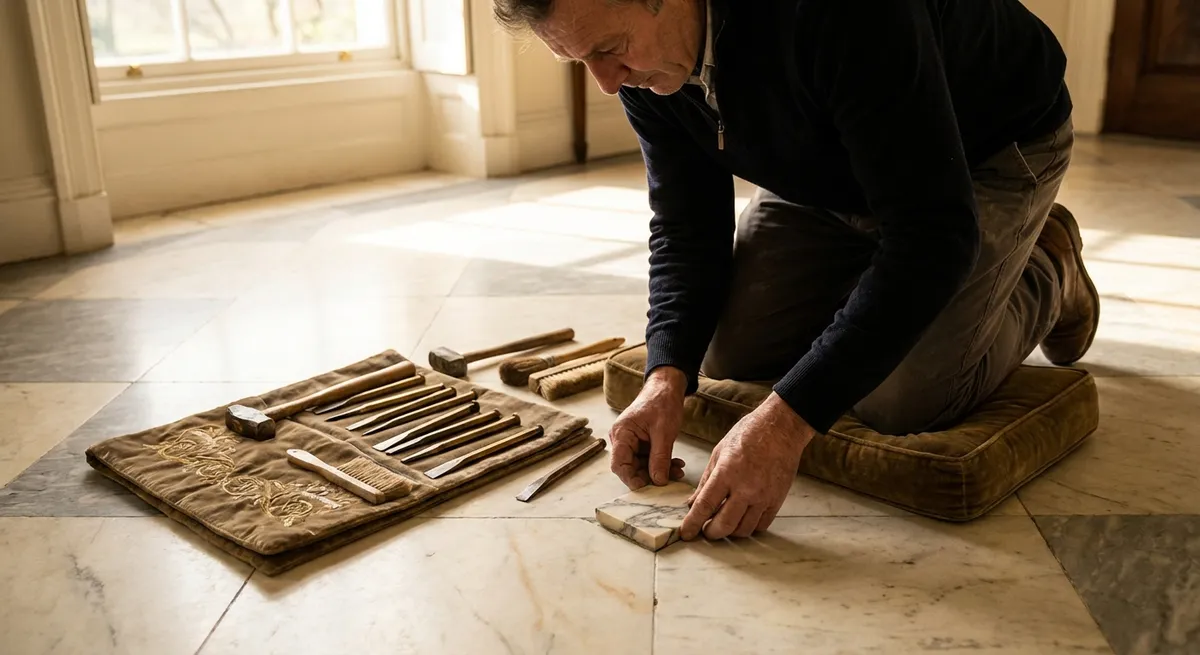
Below are five exclusive, detail-driven insights for homeowners who expect their tile to age with grace, not merely endure.
Treat Every Repair as Conservation, Not Construction
The most refined tile repairs begin with a conservation mindset: the goal is to protect and extend the original installation’s integrity, not simply “patch the problem.”
This means documenting the existing tile before any work begins—lighting, grout tone, layout patterns, and even how the tile reads at different times of day. A high-resolution photo record ensures that any replacement tile, grout, or finish can be blended back seamlessly. It also helps guide small, targeted interventions instead of disruptive overhauls.
Conservation-grade thinking also discourages invasive methods. Rather than cutting aggressively into surrounding tile, a skilled professional will work surgically, isolating compromised sections while preserving adjacent materials and substrates. When this mindset is honored, a repair doesn’t announce itself; it disappears into the original design language.
Grout Is Not a Filler—It’s a Design Material
In luxury environments, grout is not an afterthought. During repairs, it becomes one of the most visible indicators of whether a surface is truly cohesive or quietly compromised.
Color-matching is only the starting point. You must consider grout sheen, joint profile (slightly concave, flush, or subtly proud of the tile), and texture. Modern high-performance grouts—such as premium cementitious or epoxy formulations—offer enhanced stain resistance and color stability, but if they’re used to repair an older installation, they must be selected and finished with intent. A grout that’s technically superior yet visually mismatched diminishes the overall impression of quality.
In discreet repairs, professionals sometimes custom-tint grout by mixing two shades or lightly misting joints after curing with compatible colorant to soften any harshness. The objective: when someone views the floor or wall from a natural distance, the grout rhythm should feel uninterrupted—no new joints catching the eye.
Invisible Tile Replacement Starts with Controlled Demolition
Replacing a single cracked tile in a high-end installation can be riskier than it appears. Done poorly, it can loosen neighbors, fracture underlayment, or telegraph micro-movements that later appear as fresh cracks.
The most sophisticated approach begins with a controlled demolition plan. Rather than prying from the edges and stressing grout lines, an expert will typically:
- Score the damaged tile into smaller segments with a precision diamond blade.
- Remove the center sections first, releasing tension from the middle instead of the perimeter.
- Work gradually toward the edges with carbide or oscillating tools, preserving the substrate and neighboring tiles.
Once the cavity is cleared, the substrate is evaluated—not assumed sound. Any hollow spots, moisture intrusion, or decoupling membrane damage is addressed before a new tile is bonded. This layered approach ensures the replacement piece doesn’t simply mask a structural issue waiting to resurface.
For homeowners, the key is to insist on this methodology: no prying at intact tile edges, no shortcuts on substrate inspection. True luxury shows up in what you can’t see after the repair is done.
Hairline Cracks and Lippage Reveal the Story Beneath
Not all damage demands immediate replacement. The most discerning repair strategies distinguish between cosmetic flaws and structural warnings.
Hairline cracks that remain stable over time, especially in glazed surfaces, can sometimes be treated with clear sealants or surface refinishing techniques to prevent staining and moisture ingress. Conversely, cracks that widen, span across multiple tiles, or align with transitions (doorways, between rooms) may indicate substrate movement, inadequate expansion joints, or structural shifts.
Similarly, subtle lippage—where one tile edge sits slightly higher than the next—can occasionally be corrected or minimized through strategic re-bonding or feathered grout techniques. But when lippage appears in broad areas, or worsens over seasons, it can point to deflection or improper installation layers.
The refined strategy is diagnostic first, then corrective. A homeowner invested in longevity should request a movement and moisture assessment when recurring cracks or lippage appear. Intelligent repair doesn’t just fix what is visible; it stabilizes what caused the irregularity in the first place.
Refinishing and Re-Sealing: The Subtle Art of Surface Continuity
In many sophisticated homes, the most valuable “repairs” do not involve fresh tile at all—they involve restoring the surface finish to a unified, quietly luxurious state.
For natural stone and certain high-end porcelain, professional honing and polishing can soften scratches, etching, and minor wear, particularly in transition zones (entryways, around kitchen islands, near showers). When done across a broad area rather than only over a patch, these refinishing techniques erase evidence of localized intervention and bring the entire plane back into harmony.
Equally important is the choice and timing of sealers. High-quality penetrating sealers protect stone and grout against staining without imposing a plastic sheen. In a repair context, the goal is continuity: new grout or replaced tiles should be sealed and then “feathered” into the existing area so that reflectivity and water behavior feel consistent—no zones that darken more quickly, bead differently, or clean unevenly.
Sophisticated homeowners treat re-sealing as part of the repair protocol, not an optional add-on. The result is a surface that not only looks whole but behaves as a singular, well-managed system.
Conclusion
Exquisite tile work is one of the clearest indicators of a thoughtfully curated home. When damage inevitably occurs, the difference between a visible patch and a discreet restoration lies in the nuance of the repair strategy: conservation-first thinking, meticulous grout handling, surgical tile replacement, intelligent diagnostics, and holistic refinishing.
When you engage with tile professionals, frame the conversation not around “fixing a crack” but around preserving the architectural calm and continuity of your surfaces. In the finest homes, impeccable tile isn’t accident-free—it’s simply repaired with such quiet precision that its history never becomes the focal point.
Sources
- U.S. Tile Council – Tile Installation & Maintenance Resources – Technical guidance on tile installation, substrates, and performance considerations
- National Tile Contractors Association (NTCA) – Reference Manual – Industry-recognized best practices for tile repair, troubleshooting, and detailing
- Laticrete Technical Data Sheets – Detailed information on modern grouts, adhesives, and sealers used in premium tile work
- Mapei Technical Library – Professional documentation on tile setting materials, crack isolation, and substrate preparation
- American National Standards Institute – ANSI A108/A118/A136.1 – Standards that define acceptable methods and materials for tile installation and related repairs