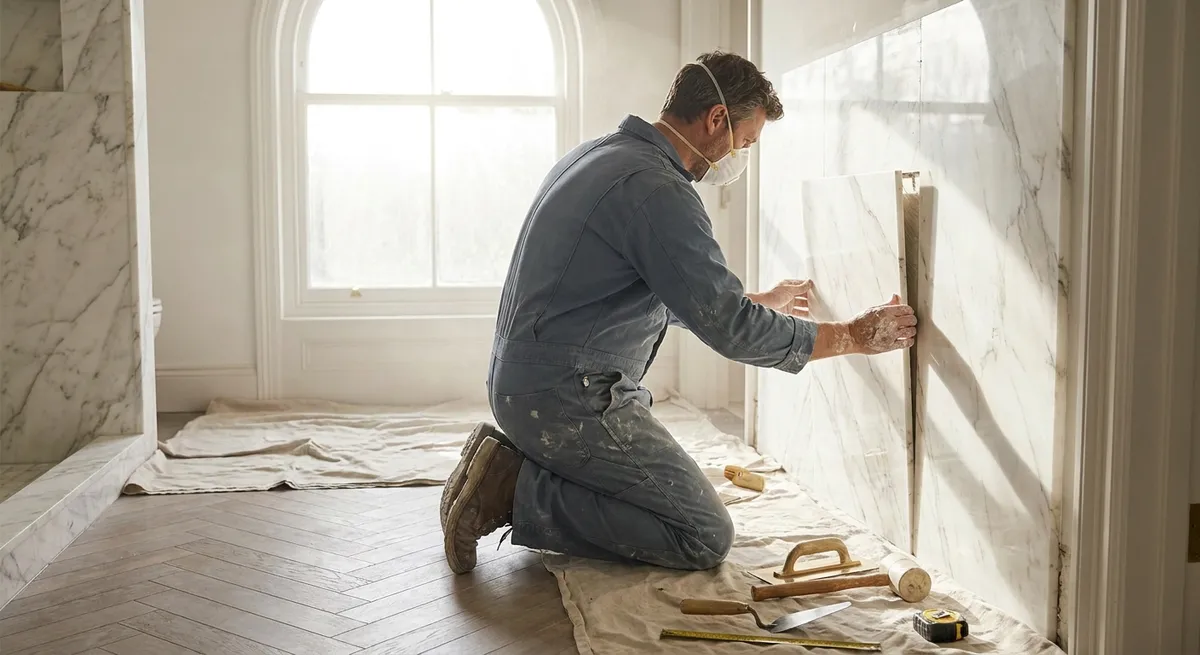
This guide explores repair solutions that prioritize refinement over quick fixes, with five exclusive insights that help homeowners protect both the performance and the quiet sophistication of their tile surfaces.
Reading the Room: Diagnosing Damage Like a Conservator
Before any repair begins, an elevated approach starts with observing the tile as a complete composition, not as a series of isolated flaws. Instead of rushing to replace a cracked piece or regrout a gap, step back and read the room:
- Note where stress gathers: doorways, transitions, beneath heavy furniture, or along poorly supported subfloors.
- Identify patterns of wear—are hairline cracks aligning in a grid, or is there a single, localized impact?
- Compare grout tone across the space; subtle discoloration can signal moisture intrusion long before tiles loosen.
- Examine lighting conditions; a repair that looks “perfect” under overhead fixtures may appear obvious in daylight washing across the surface.
By treating diagnosis as an exercise in visual literacy, you avoid cosmetic “patches” that ignore structural issues. You also gain the opportunity to plan repairs that preserve continuity of tone, sheen, and joint alignment—hallmarks of an elevated finish.
Insight 1: Color-Matched Repair is a Craft, Not a Product
Most tile repairs fail the elegance test at the color level. The human eye is exquisitely sensitive to subtle variations, particularly in grout and natural stone.
Instead of relying on a single off-the-shelf “close enough” grout or filler, think in terms of a palette:
- Micro-blending grout: Professionals often blend two or three grout colors to achieve a custom tone that matches your aged joints, not just the manufacturer’s original color chart.
- Accounting for grout patina: New grout is almost always slightly brighter and cooler than what’s already in place. A refined repair anticipates how the new section will cure, dry, and collect minimal patina over time, then adjusts the mix accordingly.
- Stone and porcelain touchups: For chips on glazed porcelain or natural stone, a layered approach with tinted epoxy or urethane fillers can mimic veining, speckling, and variation—as opposed to a single flat patch of color.
- Sheen alignment: Matte tiles repaired with glossy fillers (or vice versa) are a common visual giveaway. Select or adjust repair materials to reflect light identically to the surrounding tile.
The result isn’t perfection under magnification—it’s a repair that disappears at the distances you actually inhabit your space.
Insight 2: Structural Stability is the Ultimate Luxury
A truly premium repair addresses the unseen layers below the tile. Many surface problems—cracked grout, hollow sounds, tenting tiles—are symptoms of deeper issues with movement, support, or moisture.
Refined solutions begin with structure:
- Subfloor and underlayment evaluation: Movement in the substrate telegraphs upward as fractures. A serious repair may involve reinforcing joists, adding or upgrading underlayment, or improving decoupling membranes before a single tile is reset.
- Expansion and movement planning: Large-format tiles and heated floors are particularly sensitive to expansion. Incorporating or upgrading movement joints at perimeters and transitions prevents dramatic failures that no surface fix can truly disguise.
- Moisture diagnostics, not just drying: In showers and wet areas, efflorescence, loose tiles, and recurring grout failures often point to waterproofing breakdowns. A premium repair may mean selectively opening the system, correcting membranes and slopes, then retiling with surgical precision.
- Targeted removal instead of domino demolition: When the structure is sound, careful removal of individual tiles—using oscillating tools, diamond blades, and dust control—protects the integrity of the surrounding field, minimizing disruption to the room.
Investing in structure is an invisible luxury that expresses itself in the way your tile remains calm and silent over years, not just weeks after the repair.
Insight 3: Invisible Transitions Are the Mark of Mastery
Most tile repairs reveal themselves at their edges. Where old meets new, a subtle break in continuity can undermine an otherwise well-executed intervention. Elegant solutions rely on transitions so refined they feel intentional rather than improvised.
Consider:
- Soft joints as design details: In high-movement areas, a color-matched elastomeric joint can be placed in a grout line, aligned with the tile grid. When properly matched in tone and texture, it quietly absorbs movement while maintaining the overall rhythm.
- Feathered blending instead of hard cutoffs: When replacing a section of a tiled floor or wall, extending the repair slightly beyond the damaged area—then regrouting or refinishing a broader zone—creates a subtle gradient where the eye doesn’t lock onto a single boundary.
- Thresholds and borders: If an area demands extensive replacement, introducing a deliberate border or threshold detail creates a visual “frame” that makes the new section feel composed rather than patched.
- Edge refinement: Paying attention to micro-chamfers, eased corners, and consistent joint width around repaired tiles prevents shadow lines and micro-gaps that betray the work.
In well-considered repairs, the transition itself becomes a design asset, not a scar.
Insight 4: Smart Repairs Respect Material Personality
Every tile material has its own “personality”—how it ages, responds to stress, and reflects use. The most sophisticated repairs acknowledge and even protect that character instead of forcing unnaturally uniform results.
Examples include:
- Natural stone: Tiny chips and softened edges can be part of its charm. Over-polishing a small repair spot to a mirror finish in an otherwise honed or gently worn floor can look more jarring than the original blemish. Aim to restore the surface to the room’s overall mood, not a showroom sample.
- Handmade or artisanal tile: Slight irregularities in size, glaze pooling, and variation are intrinsic to their appeal. When replacing pieces, it’s often better to source slightly varied tiles and “scatter” replacements across a larger field than to concentrate obvious newness in one area.
- High-gloss porcelain: These tiles demand impeccable substrate flatness; any lippage introduced during repair will be emphasized by raking light. A careful reset may require re-leveling adjacent tiles, not only the visibly damaged one.
- Textured and three-dimensional tiles: Repairs should maintain the tactile story of the wall. Sanded fillers, micro-resurfacing, or piece-by-piece replacement is preferable to over-smoothing an area that should feel sculpted.
Rather than erasing time, elevated tile repair harmonizes with the way your materials gracefully evolve.
Insight 5: Planning Repairs as Part of a Long-Term Care Strategy
The most exclusive insight is also the most practical: refined tile repair is not a one-off event but part of an ongoing stewardship plan for your surfaces.
A thoughtful strategy includes:
- Documenting your installation: Keep detailed records—tile brand, series, color, lot numbers, grout type and color, adhesive and membrane systems. This transforms future repairs from guesswork into precision.
- Curating a “tile reserve”: Store extra field tile, trim, and mosaics from the original installation in a climate-stable, labeled location. This “reserve collection” allows repairs years later that are materially and visually coherent.
- Scheduling periodic inspections: Every year or two, have a professional evaluate grout integrity, movement joints, caulking in wet areas, and early signs of moisture or debonding. Addressing minute issues early preserves the calm, finished look of your rooms.
- Aligning repairs with subtle upgrades: When a repair is necessary, consider whether it’s an opportunity for subtle enhancement—upgrading to stain-resistant grout in a high-use zone, refining a slope in a shower floor, or improving isolation under a frequently used entrance.
- Educating household and staff: Proper cleaning agents, tools, and routines prevent avoidable damage. A short briefing for housekeepers or maintenance staff can protect delicate sealers, polished finishes, and specialty grout from harsh chemicals and abrasives.
This long-view approach ensures that each repair is not a compromise, but a precise, considered gesture in the life of your home.
Conclusion
Elegant tile repair is as much about restraint and intention as it is about technique. When you prioritize structural stability, nuanced color matching, invisible transitions, material authenticity, and long-term strategy, every intervention becomes nearly indistinguishable from the original craft.
In a refined home, your tile doesn’t need to announce that it has been repaired. It only needs to continue doing what it does best: quietly framing your life with composure, continuity, and understated luxury.
Sources
- [The Tile Council of North America (TCNA) – Handbook & Resources](https://www.tcnatile.com) - Industry standards and best practices for tile installation and repair, including substrate, grout, and movement joint guidance.
- [Schluter Systems – Technical Resources](https://www.schluter.com/schluter-us/en_US/technical-center) - Detailed information on underlayments, uncoupling membranes, waterproofing, and movement joints relevant to long-lasting tile repairs.
- [Custom Building Products – Grout & Repair Technical Data](https://www.custombuildingproducts.com/how-to/) - Professional guidance on grout selection, color matching, and repair materials for different tile types.
- [University of Florida IFAS – Home Moisture Problems](https://edis.ifas.ufl.edu/publication/AE120) - Explains moisture diagnostics and control in residential buildings, crucial for understanding tile failures in wet areas.
- [U.S. Department of Energy – Floors and Foundations](https://www.energy.gov/energysaver/floors-and-foundations) - Background on subfloor and structural considerations that impact tile stability and long-term performance.