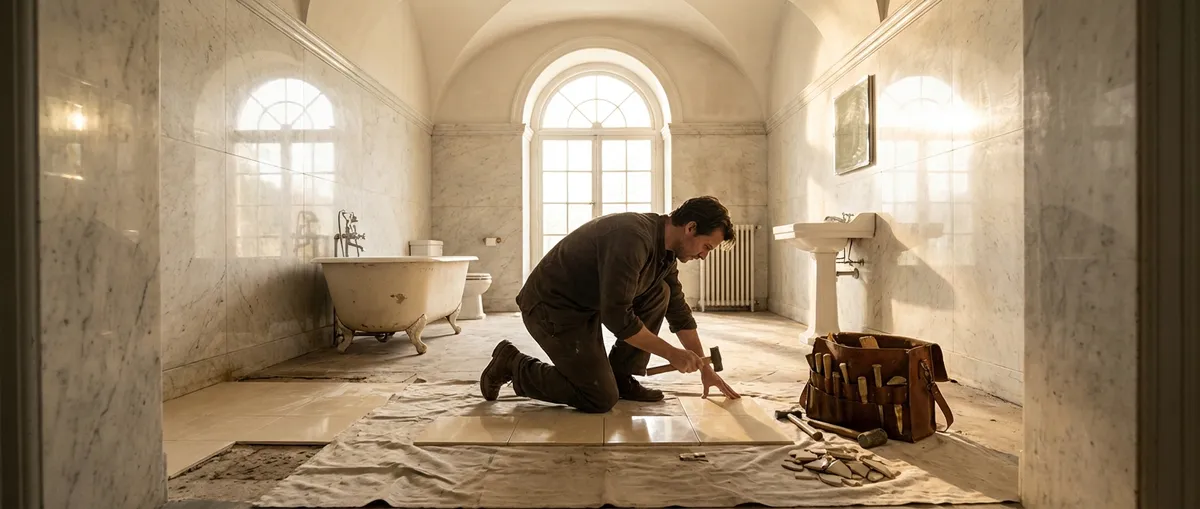
Below, we explore a refined approach to tile repair—one that assumes your goal is not just to make damage disappear, but to ensure your surfaces continue to feel quietly luxurious for years to come. Embedded within are five exclusive insights that homeowners who care deeply about detail will genuinely appreciate.
Reading the Surface: Diagnosis as a Design Decision
Before any repair material is opened, a thoughtful assessment separates sophisticated restoration from hurried patchwork. Cracks, chips, hollow spots, and grout failure each convey different stories about the installation beneath the surface.
A hairline crack running cleanly across multiple tiles may suggest movement in the substrate or structure, not simply “bad tile.” An isolated chipped corner, by contrast, usually reflects impact damage and may not call for invasive structural work. Hollow-sounding tiles—identified with the gentle tap of a wooden tool—often indicate poor bonding or voids in the thin-set, and their presence can influence whether you repair locally or plan a broader intervention over time.
A truly premium repair starts with the humility to ask: Is this problem purely aesthetic, or is it symptomatic? The answer dictates everything that follows—from the techniques you choose to the timeline you set for more comprehensive work.
Exclusive Insight #1: Color Is Not Enough—Match Sheen, Depth, and Age
Many homeowners (and, candidly, some professionals) stop at color matching. For refined interiors, that’s only the beginning. Surfaces that read as “perfect” from a distance often succeed because of subtler alignments: sheen level, depth of tone, and how the material catches natural light throughout the day.
For tile repairs, your reference isn’t the tile in your hand—it’s the tile in your room, under your lighting, at your time of day. A polished marble with micro-scratches from years of gentle cleaning will never visually align with a fresh factory-finished replacement unless you manage that transition intentionally. Similarly, stone tiles with veining or movement require you to orient replacements so that the visual “flow” continues, not abruptly stops.
This is especially crucial in grout repairs. A grout shade that’s correct in theory can look wrong in practice once it dries and patinas. Savvy homeowners request a cured sample board or a discreet, test patch in an inconspicuous area. Ideal grout matching respects three qualities at once: hue, saturation, and gloss. Sheen that is even slightly off will reveal a repair every time the light shifts.
Precision at the Edges: Grout, Transitions, and Movement
Most tile repairs fail visually at the edges—not in the center of the tile. Luxury projects treat every boundary as a design decision: where tile meets tile, tile meets metal, or tile meets another material like wood or stone.
Movement joints, for example, are often seen as utilitarian, yet in premium work they are quietly integrated into the rhythm of the layout. When you repair a crack that aligns with a long span and simply “fill and hope,” you miss the chance to introduce a properly sized, color-matched movement joint that can prevent future stress. Today’s refined silicones and flexible sealants can be carefully tooled to mimic the crisp line of grout while providing the elasticity the assembly needs.
Transition profiles (such as metal trims between tile and wood) also demand careful attention during repair. If you’re replacing tile near an existing profile, the depth, alignment, and reveal of that profile must be honored. Even a millimeter of misalignment at a doorway or threshold can feel jarring in a space where everything else is composed.
Exclusive Insight #2: Elevating “Spot Repairs” into Micro-Restorations
In luxury environments, the term “spot repair” undersells what’s actually required. A more accurate mindset is micro-restoration: small, contained interventions that respect the full context of the floor or wall.
This might mean removing and resetting several additional tiles to preserve a perfect pattern, instead of forcing a single replacement into a tight opening and chipping edges. It may involve feathering new grout into existing joints in a deliberate radius, rather than stopping abruptly around one tile and leaving a visible “halo.”
Micro-restorations also take the time to realign patterns. If you have a herringbone, chevron, or intricate mosaic, it is often better to expand the repair area slightly so that the geometry resolves gracefully. What reads as “a bit more work” to the installer reads as uninterrupted elegance to the homeowner every single day.
Subtle Structural Clues: When a Crack Is Not Just a Crack
Some damage whispers softly about larger issues beneath: substrate deflection, moisture intrusion, or thermal movement. In a premium home, ignoring these whispers is far more costly than listening carefully.
Tile over wood subfloors, for instance, demands adequate stiffness and underlayment. If repeated cracking appears along joist lines, you may be looking at movement that no cosmetic repair can sustainably hide. Similarly, tiles lifting or doming (often called “tenting”) can signal restricted movement or lack of perimeter gaps—an issue that calls for expert evaluation, not simply tile replacement.
Water-sensitive areas—showers, steam rooms, and spa-like bathrooms—are especially unforgiving. A missing or cracked grout line in a shower niche might seem trivial, but it can allow water migration behind the assembly, compromising waterproofing and leading to mold or structural damage. In such spaces, a premium repair approach includes testing for moisture, confirming waterproofing integrity, and potentially opening small, strategic areas to verify the condition behind the tile before proceeding.
Exclusive Insight #3: Invisible Support—Strengthening Without Replacing Everything
Sometimes the most elegant repairs are the ones you never see because they reinforce, rather than replace, what’s already there. While full tear-out is sometimes necessary, there are nuanced strategies to extend the life of existing tile surfaces.
In select cases, specialty adhesives or epoxy injections can stabilize localized hollow tiles when full removal would risk damaging neighboring pieces or disrupting rare or discontinued tile. On stone, micro-etching and honing can “erase” shallow scratches or minor lippage without a total refinish, restoring the original feel underfoot.
On large-format porcelain, subtle levelling and re-bonding of individual tiles can address slight rocking or voids. The key is restraint: employing structural reinforcement only where it is both technically sound and visually respectful, sparing you the disruption of a full renovation while still protecting your investment.
Light, Shadow, and the Art of Camouflage
In high-end spaces, tile interacts with light as much as with touch. Repairs that are technically competent can still look wrong if they ignore how light moves across the surface.
On walls, especially in bathrooms and kitchens, under-cabinet lighting and grazing fixtures accentuate even minor surface irregularities. A single replacement tile that sits a fraction of a millimeter proud—or recessed—can cast a shadow line that reads as “flaw” every time the lights turn on. Careful dry-fitting, using straightedges, and checking from multiple viewing angles under the actual room lighting is essential.
Sheen control is equally critical on floors. A repaired or re-polished area that is too perfect can be as conspicuous as damage—especially on aged limestone, travertine, or marble. Sometimes the goal is not high gloss, but a beautifully consistent soft reflection, achieved by deliberately stopping short of full polish to match the surrounding patina.
Exclusive Insight #4: The Power of Controlled Patina in Repairs
Homeowners who value refinement often also value authenticity. A perfectly new-looking patch in an elegantly aged floor can feel like a false note. The answer is controlled patina—a deliberate softening of the repair to harmonize with the room’s existing story.
On natural stone, this may involve final passes with slightly less aggressive polishing pads, or hand-finishing edges so they do not read as factory-sharp. On grout, gentle, selective cleaning of the surrounding area—rather than aggressively whitening only the new work—can avoid creating obvious “fresh lines” in a subtly lived-in room.
In some instances, a professional may gently distress or tone-seal a replacement tile to better echo the neighboring surfaces. This is not about faking age; it’s about refusing to let one new element visually dominate in a composition that has matured gracefully over time.
Choosing Expertise: When the Right Professional Is the Real Repair
For high-caliber tile work, the most consequential decision is often not what to repair, but who is trusted to do it. Repair, especially in premium homes, is a specialized discipline—not simply installation in miniature.
When evaluating professionals, look beyond basic licensing and insurance. Ask to see before-and-after examples specifically of repairs, not just new installations. Inquire about their familiarity with movement joints, waterproofing systems, and manufacturer installation standards. A thoughtful contractor will be as interested in the underlying cause as in the visible symptom.
Equally revealing is how they speak about disruption. High-end repair work often includes meticulous dust control, protection of adjacent finishes, and sequencing that respects your lifestyle. This level of consideration is not an indulgence; it’s part of what differentiates a repair that feels chaotic from one that feels discretely handled and quietly complete.
Exclusive Insight #5: Future-Proofing—Design Your Repairs With Tomorrow in Mind
Sophisticated homeowners know that every intervention today shapes tomorrow’s options. Smart tile repairs are not only about restoring the present; they are about protecting future flexibility.
Whenever possible, retain extra tiles, bullnose pieces, and trim profiles from your original installation and clearly label them with manufacturer, series, color, lot number, and date. If you are undertaking repairs now, consider ordering additional stock—especially if the tile line is at risk of being discontinued. Those extra pieces can turn a future “crisis” into a simple, seamless follow-up.
Thoughtful repairs can also pre-empt future stress points by introducing discreet movement joints, correcting marginal slopes in wet areas, or slightly enlarging an access panel behind vital plumbing. The luxury here is not just aesthetic—it’s the calm that comes from knowing your surfaces aren’t fragile showpieces, but well-considered systems built to endure.
Conclusion
Truly elevated tile repair is never merely about erasing damage; it is about protecting harmony. When every grout line, transition, and reflection has been carefully composed, any intervention must be just as intentional as the original installation.
By reading the surface with a diagnostician’s eye, insisting on nuanced matching and controlled patina, reinforcing what can be saved, and planning with tomorrow in mind, homeowners can ensure that repairs do more than “fix” a problem. They can quietly reaffirm the standard of the entire space—so your tile continues to feel like a deliberate choice, not a delicate one.
Sources
- Tile Council of North America (TCNA) Handbook - Authoritative industry standards and guidelines for tile installation and problem prevention
- American National Standards Institute (ANSI) – Ceramic Tile Installation Standards - Technical standards referenced by professionals for tile setting and materials
- Schluter Systems – Movement Joints and Transitions - Detailed guidance on movement joints and transition profiles in tile assemblies
- Mapei Technical Articles – Tile & Grout Issues - Technical discussions of common tile failures, grout concerns, and proper repair strategies
- U.S. Environmental Protection Agency – Mold and Moisture in Buildings - Information on moisture-related risks behind tile in wet areas and how to prevent secondary damage