This guide reveals what truly distinguishes refined tile work from routine installation—and the exclusive insights discerning homeowners should insist on from any professional they invite into their home.
The Invisible Architecture: Substrate Perfection as a Design Principle
Exceptional tile work doesn’t begin with tile; it begins with the surface beneath it. In high-end projects, substrate preparation is treated as architectural groundwork, not a quick prelude.
A substrate that is flat, stable, and properly reinforced allows large-format tiles, minimal grout lines, and precise patterns to read as one continuous plane. Even minor irregularities telegraph through luxury materials: lippage on polished marble, shadow lines on large porcelain, or hairline cracks that emerge months later. Experienced installers will use self-leveling underlayments, uncoupling membranes, and appropriate backer boards tailored to each room’s demands—shower, heated floor, or exterior terrace.
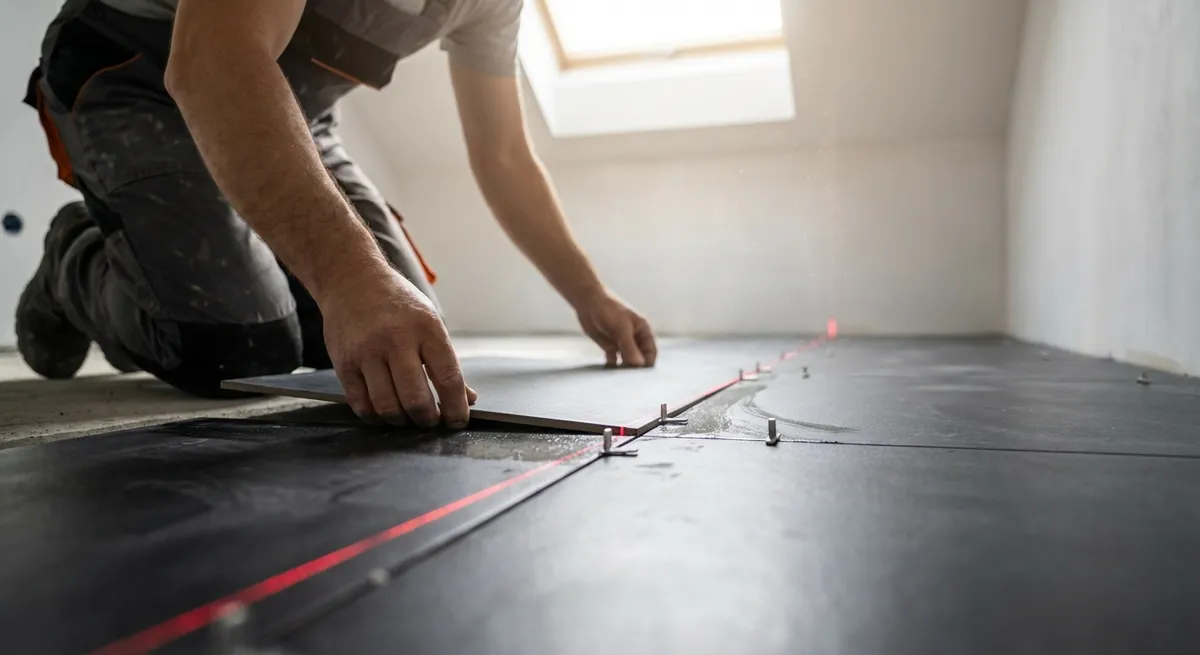
For homeowners, the key question is not “How quickly can you install?” but “How will you prepare the substrate, and how will you measure flatness?” A premium installation involves straightedges, laser levels, and documented tolerances—not just a visual check. The hidden layers may never be seen, but they are what give your tile room its quiet, confident presence.
Exclusive Insight #1: Ask your installer to walk you through their substrate plan before any tile is delivered—what materials they will use, how they will address existing cracks, and how they will verify flatness. The best professionals will welcome the conversation and speak in specifics, not generalities.
The Geometry of Calm: Layout as a Luxury Detail
The difference between “nice tile” and an extraordinary installation often comes down to layout—a discipline that blends mathematics, architecture, and visual restraint.
A sophisticated layout avoids sliver cuts at room edges, obscures unavoidable cuts in less visible corners, and aligns grout lines with architectural features such as window mullions, door casings, and cabinetry. In wet rooms, layout planning includes not only aesthetics, but water management: drain placement, slope, and the direction of tile lines all contribute to both performance and visual coherence.
Large-format tiles and intricate patterns demand dry layouts and full-size mockups, especially where spaces transition—hall to bath, kitchen to patio, shower floor to curb. A premium installer will map out the “story” of the tile from the main sightline of the room, then work outward so that joints, patterns, and focal tiles land precisely where they will be most appreciated.
Exclusive Insight #2: Before installation begins, review a scaled layout or on-floor mockup from the room’s primary entry and seating positions. Evaluate not just the pattern, but where full tiles begin and end relative to thresholds, vanities, and focal walls. A small repositioning at this stage can transform the entire perception of the space.
Materials in Concert: Pairing Tile, Adhesives, and Grout with Intention
Premium tile is only as reliable as the system that supports it. Tile, mortar, grout, membranes, sealers, and movement joints must all be chosen as a cohesive ensemble—not as isolated components.
Porcelain, natural stone, glass, and encaustic cement each have distinct needs. Large-format, dense porcelain often requires specialized mortars with improved adhesion and flexibility. Moisture-sensitive natural stones may require rapid-setting mortars or specific waterproofing approaches to avoid warping and staining. Epoxy or high-performance grouts resist staining in busy kitchens and showers, while carefully chosen grout colors allow patterns to either recede into quiet uniformity or act as sharp graphic elements.
Respected installers approach material selection like a specification exercise, referencing manufacturer guidelines and industry standards rather than relying on a single “go-to” product. The goal is not just durability, but predictability: no curling, no ghosting of adhesives, no premature discoloration of grout, and no forensic problem-solving a year later.
Exclusive Insight #3: Request a written description of the full installation system—tile, mortar, grout, membranes, and sealers—with manufacturer names and product lines. Verify that each product is approved for your tile type and location (steam shower, heated floor, exterior, etc.). This simple step upgrades your project from “installed” to “engineered.”
Precision at the Edges: Transitions, Terminations, and the Art of Finishing
In elevated interiors, the most telling details are found where surfaces meet: tile to wood, tile to carpet, tile to wall, tile to glass. These junctions reveal whether a space has been simply tiled or thoughtfully crafted.
Metal or porcelain trim profiles, mitred corners, and carefully considered thresholds transform terminations into design features rather than abrupt endings. In showers and wet rooms, niche edges, window returns, and bench fronts are opportunities to showcase sharp craftsmanship—aligned joints, perfectly wrapped patterns, and polished stone edges that feel intentional rather than improvised.
Movement joints—often overlooked or resisted—are another hallmark of professional work. Incorporating them subtly along transitions, perimeters, and large fields allows the tiled surface to respond to temperature and structural shifts without cracking. When sized and located thoughtfully, these joints disappear visually while preserving the surface’s integrity.
Exclusive Insight #4: During planning, focus on three specific edge conditions: (1) how tile will meet adjacent flooring, (2) how corners and outside edges will be finished, and (3) where movement joints will be placed. Insist on seeing sample profiles and edge details; these “minor” decisions have a major impact on the perceived luxury of the finished space.
Time as a Material: Curing, Protection, and Long-Term Performance
In high-end tile work, time is treated as a critical material, not a scheduling inconvenience. The most refined installations respect the chemistry of mortars, membranes, and grouts, allowing each layer the curing time it needs to perform as designed.
Rushing to walk on newly laid tile, grouting before mortars have cured, or installing cabinetry too soon over a new assembly invites micro-movements and bond failures that may not show for months. Likewise, luxurious finishes deserve equally considered protection during construction: surface guards, edge protection, and strict controls on heavy traffic or debris prevent subtle scratches and chips that are difficult to remedy later.
For homeowners, the most valuable mindset shift is to view tile installation not as an isolated task, but as a phased process with dependencies—structural, environmental, and temporal. The project schedule should be built around what the materials require, not simply what the calendar prefers.
Exclusive Insight #5: Ask your installer to outline a curing and protection schedule: when you can walk on the tile, when grout can be applied, when sealing will occur, and when heavy fixtures or cabinetry can be installed. Build your broader renovation timeline around these milestones to protect your investment in the most enduring surface in your home.
Conclusion
Flawless tile work is never an accident. It is the cumulative result of disciplined preparation, deliberate layout, system-level material choices, exquisite edge detailing, and a deep respect for time and process. For homeowners committed to elevated spaces, understanding these layers turns you from a passive client into an informed collaborator.
When you evaluate proposals, look beyond the tile itself and into the thinking behind it. The professionals who speak fluently about substrates, layout sightlines, system compatibility, transitions, and curing are the ones most likely to deliver the kind of surface that feels effortlessly calm, structurally sound, and quietly luxurious—day after day, year after year.
Sources
- Tile Council of North America (TCNA) – Handbook for Ceramic, Glass, and Stone Tile Installation - Industry reference for best practices, methods, and standards in tile installation
- MAPEI Technical Resources - Detailed guidance on mortars, grouts, membranes, and system compatibility for different tile types and environments
- Schluter Systems – Installation Handbook - Authoritative information on substrates, waterproofing, uncoupling, movement joints, and edge profiles
- LATICRETE Technical Data Sheets - Product-specific recommendations for high-performance tile installation systems and specialty applications
- U.S. General Services Administration – Tile and Stone Standards (GSA P100 Reference) - Federal-level technical guidance and quality expectations for tile and stone installations