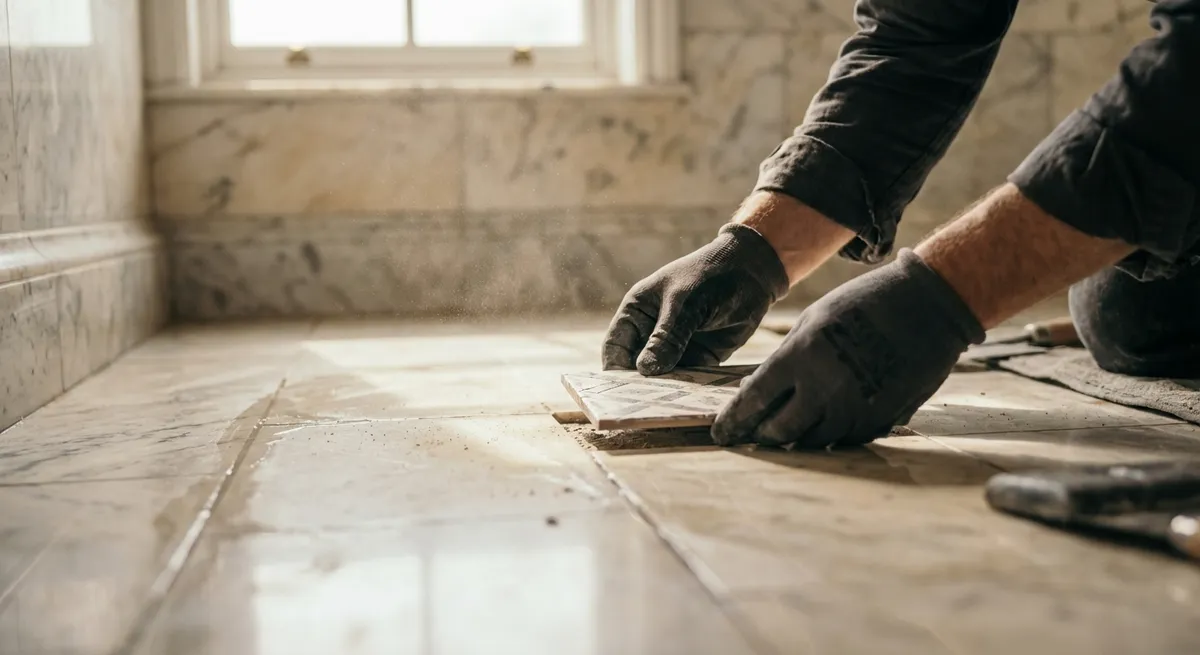
Below, discover five exclusive insights that discerning homeowners and design-forward renovators rely on to ensure every repair serves the overall composition, not just the immediate flaw.
Reading the Surface: Diagnose Before You Touch a Tile
Sophisticated tile repair begins with restraint. Before a chisel or blade comes near the surface, a careful visual and tactile assessment is essential. Subtle clues—slight hollow sounds when tapped, micro-fissures radiating from a corner, irregular grout hairlines—often reveal a deeper structural or substrate issue that a simple patch would only conceal temporarily.
A premium approach treats every visible defect as a symptom to be understood, not merely erased. This might involve checking for movement in the subfloor, identifying whether an expansion joint is missing or undersized, or confirming if the original installation used the correct mortar for the tile type and environment. Especially in larger format tiles or natural stone, minor issues can signal tension building across a wider field.
By investing time in diagnosis, you ensure that each repair addresses root causes—structural stress, moisture intrusion, improper deflection—rather than creating a cycle of recurring failures. The result is not only a cleaner aesthetic outcome, but also a more durable, composed surface that ages with quiet confidence rather than constant intervention.
Color Memory: Honoring the Patina of Existing Tile
When a tile breaks or a small area must be replaced, the intuitive response is to order the same model, color, and size. Yet especially with luxury materials—handmade ceramics, honed marble, or artisan terrazzo—the true challenge is not matching the specification but honoring the patina. Tile is not static; light, cleaning products, and daily foot traffic gradually soften colors and finishes over time.
Homeowners aiming for a refined result understand that the “perfect” match may look wrong if it appears too new. In some cases, a skilled installer will deliberately adjust the sheen of a replacement tile—lightly honing a high-gloss piece, or gently polishing a honed stone—to harmonize with its neighbors. Similarly, grout color may need subtle adjustment: a custom-mixed shade that approximates the aged tone, not the fresh color on the original packaging.
This philosophy of color memory extends to pattern and variation. With natural stone or artisanal tile, a replacement pulled from the wrong part of the batch—or from a newer production lot—can disrupt the visual rhythm. Savvy homeowners will request several candidate pieces and evaluate them in situ, under the room’s actual lighting, to ensure the repaired area fades into the background rather than announcing itself at first glance.
Invisible Strength: Modern Materials Behind Classic Appearances
Discerning tile repair is often a quiet collaboration between traditional aesthetics and contemporary science. What the eye never sees can be the very elements that preserve the elegance of a high-end installation. Advanced polymer-modified mortars, flexible membranes, and improved grout formulations allow repairs to perform better in dynamic conditions, especially over heated floors, wood substrates, or in wet areas.
For example, when addressing cracked tiles on an older floor, a premium repair may incorporate an uncoupling or crack-isolation membrane beneath the replacement tiles—subtly protecting the surface from minor movement below. In showers and spa-like bathrooms, high-performance waterproofing compounds can be integrated around the repair zone to fortify vulnerable transitions, corners, or niches.
Similarly, modern epoxy or hybrid grouts—with superior stain and chemical resistance—can be selectively introduced in high-wear or high-moisture areas, while maintaining the same visual tone as cement-based grout elsewhere. The key is discretion: the repaired area should be visually indistinguishable, yet technically enhanced.
By pairing timeless materials like marble, limestone, and porcelain with intelligent underlayers and bonding agents, homeowners secure a refined surface that feels classic but performs to contemporary standards—an ideal alignment for luxury environments where failure is simply not an option.
Grout as a Design Instrument, Not Just a Filler
Grout is often treated as an afterthought, yet in refined tile repair it becomes a deliberate design instrument. A thin, precisely tooled grout joint can rescue a repair from visual distraction, while a careless application can call attention to even the most skillfully replaced tile. The aim is not merely to refill the gap, but to restore the original rhythm of the joint lines across the entire field.
A discerning homeowner will be attentive to joint width, profile, and texture. Is the original grout slightly recessed or perfectly flush with the tile surface? Matte or subtly sheened? Sharp-edged or softly rounded at the corners? These details matter. Replicating the existing profile may require specialized floats or a particular timing in the cleanup phase, especially with fast-setting or epoxy grouts.
Color selection is equally critical. Even within a single color name, production batches can vary. For partial re-grouting or joint repairs, custom blending dry pigments or mixing two grout colors can produce a near-perfect match to aged grout. In some high-end projects, a “grout map” is created—documenting colors, joint widths, and products used in each area of the home—so that any future repair can be executed with precision.
By treating grout as part of the composition rather than merely a filler, homeowners ensure repairs do not signal disruption. Instead, they help maintain the visual unity that makes a tiled surface feel expansive, ordered, and effortlessly refined.
Curated Intervention: Knowing When to Preserve, Replace, or Reimagine
Perhaps the most underappreciated insight in elevated tile repair is the discipline of knowing when not to chase perfection at the expense of character. In heritage homes or spaces with artisanal tile, a tiny chip or hairline crack may contribute to the quiet narrative of the floor, much like a subtle patina on bronze or a softened edge on a stone stair.
A curated approach to repair considers three paths: preserve, replace, or reimagine. Preservation may involve stabilizing a slightly cracked tile with modern bonding resins from below, then gently polishing the surface so the flaw becomes a near-invisible whisper rather than a structural risk. Replacement is reserved for damage that compromises waterproofing, safety, or the legibility of the design.
Reimagining, however, is where sophisticated homeowners can turn a necessary repair into a subtle upgrade. A localized failure in a bathroom floor, for example, may justify reworking a small area into a framed inset—using complementary stone or mosaic—so that the “repair” reads as an intentional detail. In a long corridor, a series of problematic tiles might be replaced with a central runner pattern, integrating the practical work into a composed, bespoke gesture.
The true luxury lies in choice. By consulting with an experienced tile professional and approaching repairs as part of the home’s ongoing design evolution, homeowners avoid piecemeal fixes and instead cultivate a narrative of thoughtful intervention. Every adjustment, from the smallest grout touch-up to a more substantial inlay, is measured against the overall character of the space.
Conclusion
Exceptional tile work is not defined solely at installation; it is reaffirmed every time a flaw is discovered and addressed. The most refined interiors are those where repairs are executed with the same level of intention, material literacy, and aesthetic sensitivity as the original build. By reading the surface before acting, respecting patina and color memory, leveraging modern materials discreetly, treating grout as a design instrument, and choosing interventions with curatorial care, homeowners ensure their tiled spaces remain quietly composed—resilient, elegant, and enduringly cohesive.
In this elevated view, repair is not an interruption but a continuation of craftsmanship. Each discreet correction safeguards not just the tile itself, but the calm, unbroken visual field that defines a truly sophisticated home.
Sources
- Tile Council of North America (TCNA) – Handbook for Ceramic, Glass, and Stone Tile Installation – Authoritative guidelines on best practices for tile installation and repair, including substrates, membranes, and grout considerations.
- American National Standards Institute (ANSI) – A108/A118/A136.1 Specifications – Technical standards for installation materials and methods that underpin many professional repair decisions.
- Schluter Systems – Tile & Stone Installation Solutions – Detailed information on crack-isolation, uncoupling, and waterproofing systems commonly used in high-end tile repair and upgrades.
- Laticrete – Tile & Stone Installation and Care Systems – Technical resources on advanced mortars, grouts, and waterproofing materials relevant to durable, discreet tile repairs.
- Prosoco – Understanding Patina and Surface Aging – Insight into patina development on surfaces, useful for appreciating and managing aging in stone and tile installations.