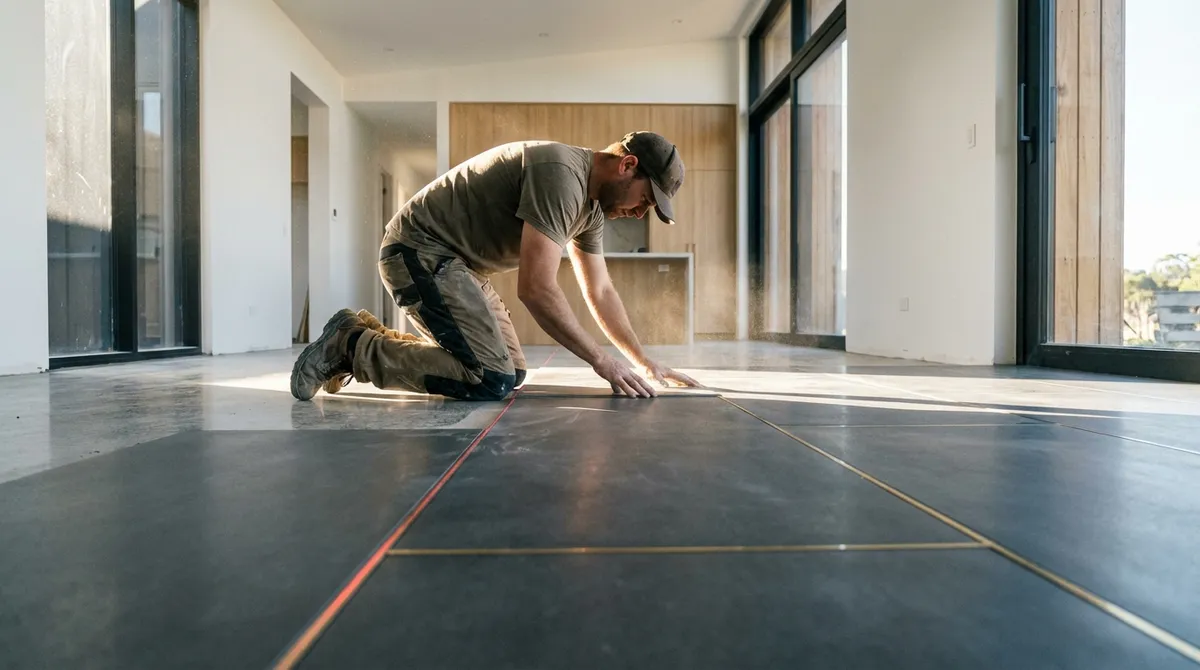
Below are five exclusive, often-overlooked insights that separate ordinary tile work from genuinely elevated execution—guidance for those who expect their spaces to age as gracefully as they were designed.
Designing the Layout as a Composition, Not a Coverage Plan
Most installations begin with the question, “How do we cover this area?” Refined installations begin with, “From where will this be experienced, and what should the eye read first?”
Instead of starting in an arbitrary corner, a sophisticated layout is anchored to primary sightlines—doorways, focal walls, bathtub faces, kitchen islands, or a central axis in a hallway. Tile centerlines can be aligned with architectural features like windows, range hoods, and vanities so that cut pieces are hidden in less visible perimeters, not highlighted at eye level.
For floors, this may mean establishing a central “spine” and balancing cuts evenly on both sides of a room, rather than leaving a narrow, awkward sliver against one wall. On walls, it might mean choosing whether the tile pattern references the vanity, the mirror, or the shower niche as the visual “lead” and letting joints fall deliberately around them.
This compositional approach anticipates obstacles—vents, outlets, drains, thresholds—and integrates them rather than fighting them. The result is a space where the tile feels inevitable, not improvised.
Respecting the Substrate: The Quiet Foundation of Luxury
Under truly refined tile work, the most impressive part may be what you never see: the substrate. A beautiful, high-end tile installed over a poorly prepared surface will always betray itself through lippage, cracks, or hollow spots over time.
A premium installation begins with substrate evaluation: checking for flatness, deflection, moisture, and structural integrity. For large-format tiles, especially, industry standards for flatness are stringent—yet frequently ignored. Self-leveling underlayments, properly installed backer boards, and decoupling membranes are not “extras”; they are the invisible technologies that allow luxury finishes to stay luxurious.
For wet areas, attention to waterproofing is non-negotiable. Continuous, properly lapped waterproof membranes, well-sealed penetrations around fixtures, and carefully detailed transitions at floors, benches, and niches safeguard the assembly beneath the tile. This isn’t just about preventing leaks—it’s about ensuring that your investment in tile and stone is supported by a system designed for decades, not just seasons.
The most sophisticated installations treat the substrate with as much rigor as the finish, recognizing that refinement is built from the inside out.
Joint Strategy: When Grout Lines Become Design Lines
Grout joints are often treated as an afterthought—simply “whatever the tile setter usually does.” In a refined installation, joint width, alignment, and color are deliberate design decisions that influence the entire character of the surface.
A slightly tighter joint on a rectified tile can create a continuous, monolithic aesthetic, ideal for minimal interiors. In contrast, a slightly wider joint on a hand-made or zellige-style tile can honor its irregularity and celebrate its artisanal origin. Neither is inherently “better”; what matters is that the joint is chosen in harmony with the tile’s character and the room’s intention.
Color is equally critical. A near-perfect match creates a calm, seamless field; a subtle contrast can articulate pattern and rhythm without visual noise. For natural stone, selecting a grout tone that echoes a secondary hue in the veining can create an elevated sense of cohesion.
Equally important is grout alignment. For multi-surface environments—tile floors meeting tiled walls, shower walls aligning with bathroom floors—planning consistent joint lines allows transitions to feel organized rather than incidental. This demands coordination before a single tile is set, but the payoff is undeniable: a spatial language that reads as deliberate, not accidental.
Lighting as an Installation Partner, Not a Postscript
Few homeowners realize how profoundly lighting reveals (or ruins) tile work. Raking light—downlights too close to a wall, strong morning sun along a windowed façade—will magnify even minor irregularities, turning small inconsistencies into pronounced visual distractions.
High-end installations account for lighting early. This includes understanding where recessed fixtures, wall washers, and sconces will sit in relation to tiled surfaces. For example, an LED strip grazing a tiled feature wall can be spectacular, but only if the surface flatness and joint consistency are impeccable. Otherwise, the light accentuates imperfections instead of craftsmanship.
Even on floors, large-format tiles under strong natural light can make lippage painfully obvious. A substrate tuned to enhanced flatness standards, meticulous thinset coverage, and proper leveling techniques become critical under demanding light conditions.
Discussing lighting with your designer and tile professional together—before finalizing layouts—ensures the installation is not simply “lit,” but choreographed to perform gracefully under the room’s actual conditions.
Details at the Edges: Where Refinement Is Decided
The true measure of tile sophistication is often found at the edges, not the field: corners, terminations, thresholds, and transitions to other materials. These are the moments where a standard installation reveals its limits—and a crafted installation reveals its discipline.
Instead of leaving exposed raw tile edges, refined work often incorporates mitered corners, color-matched profiles, or carefully selected trim pieces that visually complete the assembly. In showers, the way tile wraps a niche—aligned joints, balanced cuts, and continuous edges—can either look improvised or exquisitely considered.
Transitions between tile and adjacent materials (hardwood, carpet, stone) should be designed, not patched. Elevation changes should be subtle and intentional, not abrupt. Coordinating transitions—height, profile, and color—avoids the common “stitch-together” look and instead creates a flowing, connected experience.
Even functional components—drains, expansion joints, movement profiles—can be elevated. Linear drains that align with grout joints, color-matched silicone at perimeters, and discrete movement joints integrated into the pattern demonstrate an understanding that performance and beauty are not opposing goals, but partners in lasting luxury.
Conclusion
Refined tile installation is the art of leaving nothing to accident. It is the quiet discipline of aligning pattern with architecture, of honoring substrate and structure, of treating grout lines, light, and transitions as design instruments rather than mere technicalities.
For homeowners who value enduring elegance, these nuances are not indulgences—they are safeguards of both beauty and longevity. When you engage with your installer and designer around composition, substrate, joints, lighting, and edge detailing, you’re not micro-managing a project; you’re collaborating in a crafted discipline that transforms tile from simple surface to silent, enduring architecture.
Sources
- Tile Council of North America (TCNA) – Handbook for Ceramic, Glass, and Stone Tile Installation - Authoritative industry standards and best practices for professional tile installation.
- Schluter Systems – Waterproofing, Substrates, and Movement Joints - Technical guidance on substrate preparation, waterproofing, and transition details.
- American National Standards Institute (ANSI) – A108/A118/A136.1 Tile Installation Standards - Defines performance and installation standards for tile-setting materials and methods.
- The National Tile Contractors Association (NTCA) – Technical Articles and Reference Manual - In-depth professional resources on installation techniques and problem prevention.
- National Institute of Standards and Technology (NIST) – Building and Fire Research - Background on building performance, moisture, and durability considerations relevant to tiled assemblies.