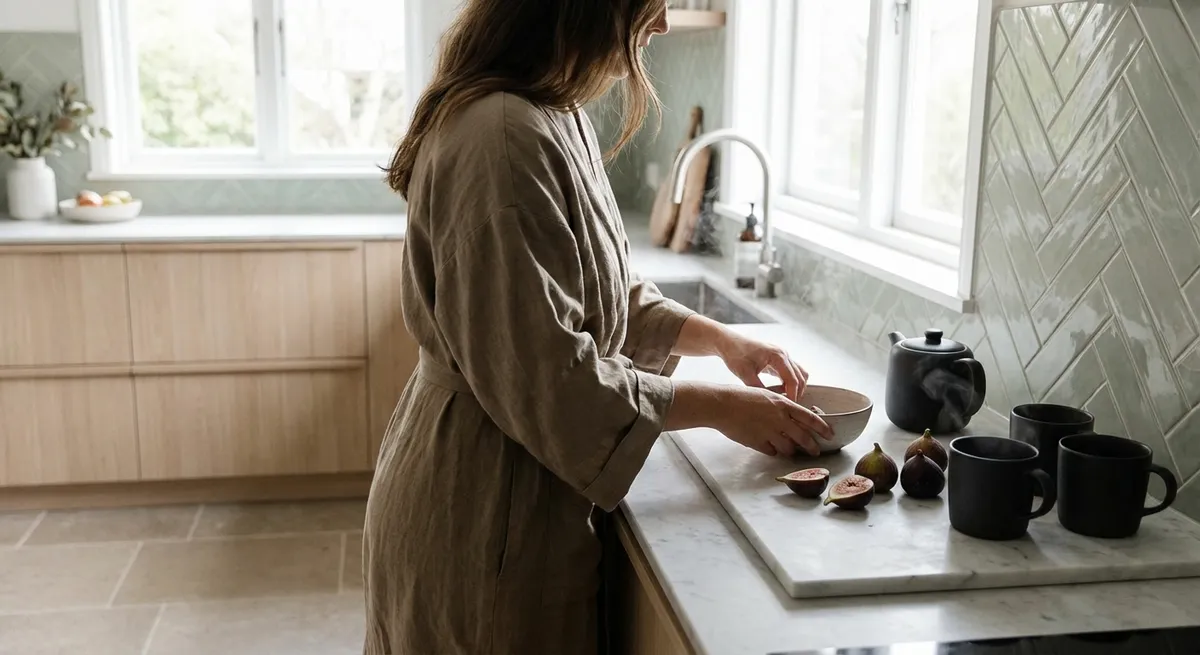
This guide gathers five exclusive, detail‑driven insights for homeowners who want their tiled spaces to feel composed rather than merely completed. Each idea is less about “doing more” and more about doing better—with intention, restraint, and enduring elegance.
Designing with Negative Space: Let the Tile Breathe
Refined tile work is as much about what you leave empty as what you cover. Negative space—areas of wall, floor, or ceiling intentionally left un-tiled—creates visual rest and sharpens the presence of the tile you do use.
Instead of tiling every vertical surface in a bath or kitchen, consider concentrating tile in carefully defined zones: a sculpted backsplash that stops deliberately below a picture light, or a shower surround that aligns with a window header rather than default ceiling height. This intentional “frame” around your tile transforms it from background material into architectural punctuation.
On floors, resist the temptation to bring patterns right up to every wall. A border of quiet, solid tile around a patterned field acts like a mat around artwork, refining the composition and preventing visual fatigue. The same principle applies to feature walls—stop the tile at a considered width that relates to nearby furniture, fixtures, or openings.
The most luxurious tile spaces often feel edited rather than exhaustive. When you design negative space with discipline, your tile installation feels curated—never overwhelming.
Layered Sheen: Mixing Matte, Satin, and Gloss in One Palette
Color often gets all the attention, but in elevated interiors, sheen is the true storyteller. Working with a single color family in different finishes—matte, satin, and gloss—creates depth that reads subtle in photos and extraordinary in person.
Imagine a bathroom where the primary wall tile is a soft, chalky matte, the trim pieces are satin, and a single niche is lined in high-gloss tiles. Under low evening light, the gloss catches reflections like still water, while the matte fades gently into the background. The room feels sophisticated without relying on loud contrast.
In kitchens, consider a matte or satin field tile behind the range, paired with a slim band of glossy pencil trim or glossy tile only behind open shelves. By keeping color constant and varying reflectivity, you create an interplay between light and shadow that feels bespoke and thoroughly considered.
The key is ratio. Let matte or satin finishes dominate for a calm base—around 70–80%—then introduce gloss as an accent, never the main event. This hierarchy keeps the space elegant, prevents glare, and makes the entire room feel more dimensional and tailored.
Architectural Grout: Alignments, Tones, and Micro‑Details
Grout lines are often treated as an afterthought, yet they are the graphic skeleton of every tiled surface. Sophisticated tile design begins with the assumption that grout is architectural, not merely functional.
First, alignment: Strive to align grout joints with existing architectural lines—door jambs, window mullions, cabinetry divisions, even countertop seams. When a vanity drawer front lines up with the tile course behind it, the room reads as intentionally constructed, not loosely assembled. This is an elevated detail that quietly distinguishes professional work from generic installs.
Second, tone selection: Ultra‑high contrast grout (like black on white) can feel trendy and harsh. For a premium feel, consider “near‑tone” grout—one or two shades darker or lighter than your tile. This keeps the pattern legible without shouting, allowing light and form to take precedence over graphic noise.
Finally, joint width: Narrow joints (e.g., 1/16" to 1/8", where feasible per tile manufacturer) immediately signal refinement. Smaller joints blur transitions between tiles, reading more like a continuous surface than a grid. Pair that with thoughtfully chosen grout texture—some homeowners opt for slightly smoother, denser formulations that are easier to clean and look crisper.
When grout is treated as a design element from the beginning, your tile installation gains coherence, calm, and a distinctly tailored character.
Thresholds and Transitions: The Hidden Language of Luxury
Where tile stops is as important as where it starts. The most polished interiors pay meticulous attention to thresholds—the moments where tile meets wood, stone, carpet, or another tile.
Instead of standard metal strips or abrupt cuts, explore stone or porcelain thresholds that sit flush with both surfaces, creating a nearly seamless passage from one room to another. A single piece of stone or large‑format porcelain slab continuing from a tiled bath floor into the shower, with barely perceptible slope, immediately broadcasts a custom‑built sensibility.
In open‑plan spaces, consider using tile layout to define zones without erecting walls. A shift from running bond to herringbone, or from larger to smaller format, can subtly articulate a dining area or entry without any visual clutter. Keep the color family consistent to maintain serenity while letting pattern and scale do the zoning.
Pay special attention to vertical transitions as well: where a tiled wall stops below a ceiling, where a backsplash meets a window frame, or how tile wraps (or intentionally doesn’t wrap) around a corner. A well‑resolved transition reads like fine tailoring at the seams of a garment—barely noticeable but unmistakably high‑end when seen.
Quiet Pattern: Advanced Layouts That Don’t Shout
Pattern in tile is often misunderstood as bold color or busy graphics. In cultivated interiors, pattern is more often created by layout and proportion than by loud motifs.
Consider using classic patterns—herringbone, chevron, basketweave, or modular grids—but executing them in tonal palettes. For instance, a shower floor of small rectangular tiles set in a tight herringbone, in the same color as the wall field tile, will feel intricate yet serene. The pattern is felt more than seen, rewarding closer inspection.
Large‑format tiles can be equally expressive. Book‑matching marble‑look porcelain across a feature wall or floor introduces a sense of natural movement that feels both modern and timeless. In more minimal spaces, offsetting tiles by one‑third instead of half (a “third‑offset” pattern) provides subtle rhythm without appearing overly traditional.
Another elevated strategy is “progressive” pattern: beginning with a simple stacked layout in high‑function areas, then allowing the pattern to become more complex as you move toward a focal point—like a niche, vanity, or soaking tub. This directional storytelling with tile gently guides the eye through the space, inviting a slower, more appreciative experience.
The most successful quiet patterns rarely announce themselves on first glance. They reveal their sophistication gradually—precisely the quality that separates premium design from passing fashion.
Conclusion
Exceptional tile work isn’t defined by price tags or the number of surfaces you cover; it’s defined by intention, alignment, and restraint. When you design with negative space, layer sheen thoughtfully, treat grout as architectural, refine transitions, and use pattern with quiet confidence, your home gains the kind of elegance that feels as good to live with as it looks to photograph.
Tile, in this context, becomes more than a finish. It becomes part of the architecture of your daily life—calm, enduring, and quietly luxurious.
Sources
- Porcelain Tile Use and Design Trends – Tile Council of North America – Technical insights on tile types, installation, and design considerations from an industry authority.
- Selecting Tile and Grout for Bathrooms – National Kitchen & Bath Association – Professional guidance on balancing aesthetics and performance in tile and grout choices.
- Ceramic and Porcelain Tile Design Basics – American National Standards Institute (ANSI A108/A118/A136.1) – Standards overview that underpins high‑quality, code‑compliant tile installations.
- Resilient and Hard Surface Flooring Design Considerations – U.S. General Services Administration – Government guidance on flooring transitions, durability, and performance in hard surface materials.
- Interior Lighting and Surface Reflectance – U.S. Department of Energy – Explains how different surface sheens interact with light, informing decisions about matte, satin, and gloss tile finishes.