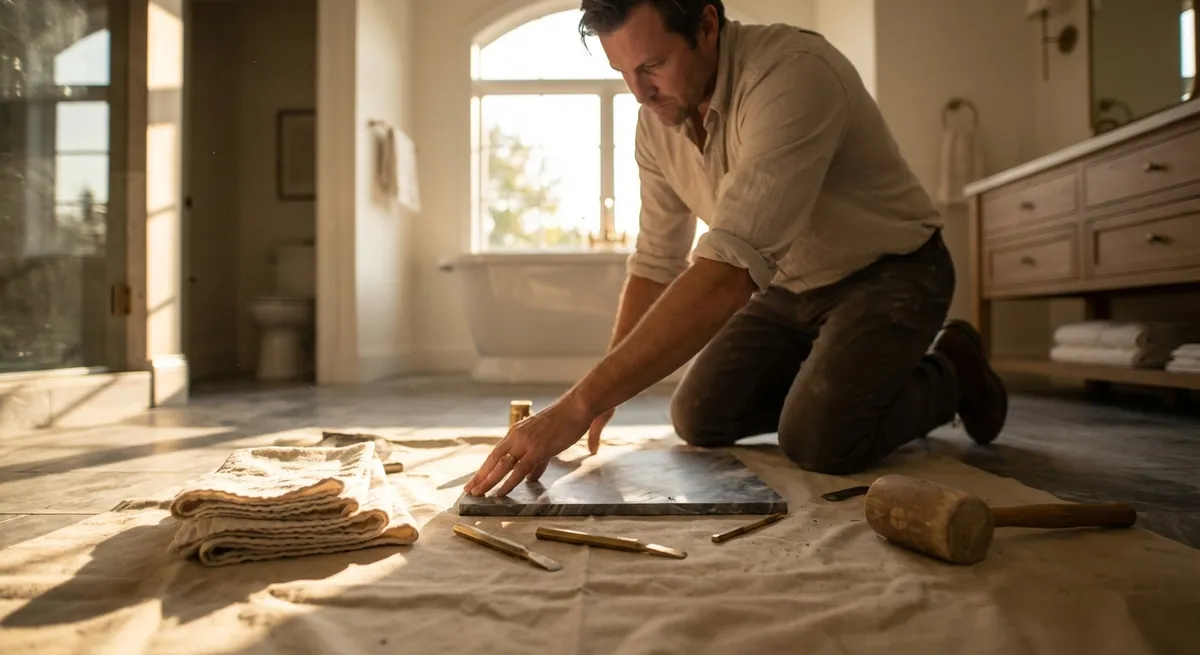
This guide explores repair solutions with a focus on restraint, precision, and long-term integrity. Along the way, you’ll find five exclusive insights that help homeowners elevate repairs from basic patchwork to quietly masterful interventions.
Reading the Surface: Diagnosing the Problem Without Guesswork
Before any repair begins, the surface must be “read” with the same attentiveness used to select the tile in the first place. A hairline crack in a large-format porcelain tile does not tell the same story as hairline crazing in a hand-glazed ceramic. A hollow sound beneath a single tile may signal a localized bond failure, while a chorus of hollow tones suggests structural movement or improper substrate preparation.
A refined repair strategy starts with careful observation:
- Listen as well as look. A light tap with a plastic or wooden handle can reveal voids beneath a tile. Solid areas will sound dull; debonded spots often ring more hollow.
- Trace the pattern of damage. Linear cracking that repeats across several tiles may indicate substrate movement or deflection, whereas random, localized cracks point to impact damage.
- Study the grout. Widened, crumbling, or stained grout lines can reveal water intrusion, subtle substrate shifts, or past improper cleaning.
- Assess adjacent finishes. Expansion joints, thresholds, and transitions to wood or carpet can clarify whether movement is being managed or ignored.
This diagnostic work protects you from cosmetic-only fixes that mask deeper issues. The refined homeowner insists on knowing not just that something failed, but why. Only then can a repair be understated yet enduring.
Precision Tile Replacement: Repair Without Visual “Noise”
Full tear-outs are rarely necessary when the damage is localized. A single cracked or debonded tile can often be removed and replaced in a way that is effectively invisible, provided the process is handled with surgical precision.
Key principles guide an elevated replacement:
- Respect the grout grid. Cuts should follow grout joints wherever possible, allowing the tile to be removed in clean sections without damaging neighbors.
- Control vibration. Oscillating tools with diamond or carbide blades allow careful perimeter cuts, minimizing the risk of chipping adjacent tiles.
- Mind the mortar remnants. Old thinset must be removed down to a uniform, appropriate depth so that the new tile sits flush—neither proud nor sunken.
- Dry-fit with intent. The replacement tile should be checked for height, lippage, and alignment with patterning (veining continuity, directional textures, or printed designs).
- Honor the original joint. Matching joint width, grout type, and color is non-negotiable. Even a half-millimeter discrepancy can catch the eye in a high-end installation.
For premium spaces, it is worth sourcing extra tiles from the original batch when the installation is first done and storing them carefully. Shade variations may make later replacements more noticeable if new production runs differ subtly in tone or finish. A quiet repair is often made possible by foresight.
Exclusive Insight #1: Treat replacement tiles like fine fabric offcuts. Preserve originals from the same dye lot (or batch) as the installed tile, labeled and stored, so that years later, repairs blend seamlessly rather than merely “matching enough.”
Intelligent Grout Renewal: Subtle Color and Texture Corrections
Grout, while often seen as a supporting player, can betray an installation’s age or its underlying issues faster than the tile itself. Discoloration, hairline cracking, or uneven texture can undermine an otherwise impeccable floor or wall. Yet aggressive, full removal is not always necessary—or wise.
Consider a nuanced, tiered approach:
- Surface-only concerns (light staining, slight unevenness) may respond well to professional-grade cleaning and, where compatible, a penetrating sealer that stabilizes color and eases future maintenance.
- Color drift can often be corrected with grout colorant or stain specifically formulated for cementitious grout, applied with care to maintain texture rather than “paint” the joint flat.
- Localized cracking may be resolved by carefully routing out only the compromised sections and regrouting, preserving the majority of undisturbed joints.
- In wet areas, ensure that grout failures are not masking deeper waterproofing issues. Renewing grout should never be a substitute for addressing compromised membranes or improperly detailed transitions.
For high-end installations, the tactile quality of the grout line matters as much as color. Overfilled, smeared, or glossy-looking remedial work stands out against velvety, crisply tooled original joints.
Exclusive Insight #2: Insist on test boards for grout renewal. Before committing to recoloring or regrouting a full area, request a discreet mockup in an inconspicuous zone to evaluate color accuracy, sheen, and texture in your actual lighting conditions.
Structural Subtlety: Stabilizing What You Can’t See
The most successful tile repairs sometimes occur entirely out of view. Reinforcing the substrate, resolving moisture issues, or improving load transfer beneath a tiled surface can prevent recurring damage and preserve the serenity of a space.
Examples of unobtrusive structural interventions include:
- Localized substrate reinforcement. From sistering joists under a flexing floor to adding underlayment only where deflection is borderline, these targeted measures can stabilize movement without redoing the entire room.
- Moisture redirection rather than simple sealing. In showers and wet rooms, identifying and correcting failures in waterproofing at corners, curbs, and transitions is far more effective than simply regrouting and resealing the visible surface.
- Strategic introduction of movement joints. A carefully positioned soft joint (using a color-matched silicone or urethane sealant) at perimeters or transitions can quietly release stress that would otherwise crack tiles or grout.
- Under-tile sound and crack isolation membranes. When future replacement is necessary in a localized area, membranes can help confine cracks below the finish layer, allowing surgically precise surface interventions.
Exclusive Insight #3: Request evidence-based justification for invisible repairs. Sophisticated homeowners should expect drawings, deflection measurements, or moisture readings to accompany any structural remedy, ensuring recommendations are grounded in data rather than guesswork.
Blending Old and New: Harmonizing Patina With Perfection
In established homes—particularly those with natural stone or artisanal tile—age can be an asset. The objective is rarely to make older surfaces look brand new, but to restore harmony between original character and new interventions.
Thoughtful techniques to achieve this include:
- Softening overly fresh repairs. Newly polished stone in a subtly worn foyer can appear abrupt. Gentle honing or controlled etching can temper shine so that repaired areas integrate with their surroundings.
- Selective rather than global refinishing. Instead of re-polishing an entire stone floor, a craftsperson may work in zones, gradually blending from the repaired area into the adjacent surface to avoid sharp visual transitions.
- Respecting historic grout proportions. Older installations often feature slimmer joints or particular mortar tones; matching these is essential to maintaining architectural authenticity.
- Coordinating with surrounding materials. New thresholds, trims, and base details should honor the language of existing woodwork, metal finishes, and hardware to avoid a “patched-in” look.
Exclusive Insight #4: Embrace a design brief for repairs, not just a scope of work. Discuss with your contractor whether the goal is museum-like restoration, quietly aged continuity, or a deliberate contrast. Setting an aesthetic intent at the outset guides every technical decision.
Partnering With Specialists: Curating the Right Expertise
In a premium home, tile repairs are less a commodity service and more a curated collaboration. The right professional will speak fluently about substrate preparation, expansion behavior, material properties, and design continuity—not just grout color and square footage.
When selecting a tile specialist for repair work:
- Look for materials literacy. They should understand the differences between porcelain, ceramic, natural stone, glass, and encaustic tiles, and how each responds to cutting, bonding, and cleaning.
- Ask about standards. Familiarity with ANSI standards and industry best practices demonstrates a commitment to technical rigor, even in small-scale repairs.
- Request a phased strategy. A sophisticated contractor can propose staging: first diagnose, then perform minimal-invasive interventions, and only escalate to more extensive work if necessary.
- Expect sample mockups. Whether testing a grout recolor, a patch in a mosaic pattern, or an edge detail, mockups are a hallmark of premium practice.
Exclusive Insight #5: Treat tile repair as a conservation effort. The best practitioners approach your surfaces the way a conservator approaches fine art—prioritizing minimal intervention, reversibility where possible, and fidelity to the original design intent.
Conclusion
Refined tile repair is not about drama; it is about discretion. The most successful interventions are those that stabilize what is unseen, refine what is visible, and preserve the calm, continuous surface that defines a sophisticated interior. With thoughtful diagnosis, precise execution, and an insistence on both structural and aesthetic integrity, homeowners can transform inevitable wear and minor failures into opportunities to quietly reaffirm the quality of their space.
In a well-considered home, tile repairs are not merely corrections—they are acts of stewardship.
Sources
- ANSI A108 / A118 / A136.1 – American National Standards for the Installation of Ceramic Tile – Technical framework for proper tile installation and many repair best practices
- TCNA Handbook for Ceramic, Glass, and Stone Tile Installation – Industry-recognized methods for substrates, movement joints, and remedial strategies
- Porcelain Tile Certification Agency (PTCA) – Guidance on porcelain tile performance characteristics and durability considerations
- U.S. General Services Administration – Historic Preservation Technical Procedures: Marble and Stone – Detailed insight on sensitive repair, patching, and refinishing of stone surfaces
- National Park Service – Preservation Briefs: Preservation of Historic Tile Floors – Best practices for diagnosing issues and repairing historic tile with respect to original character