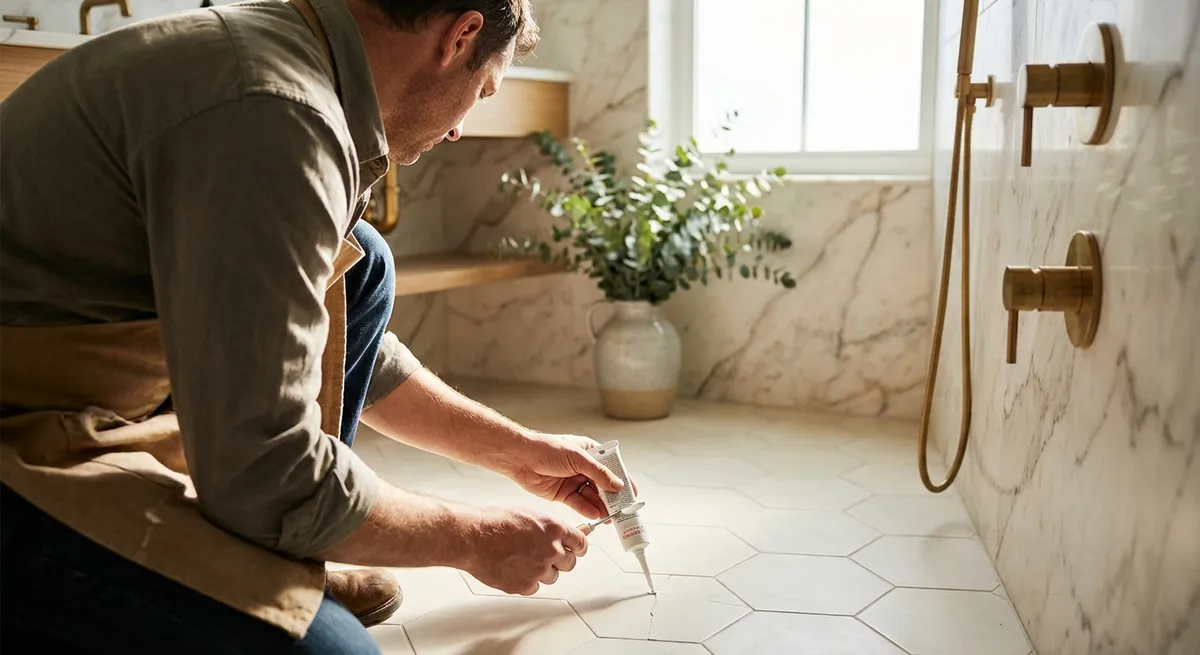
Below are five exclusive insights that elevate tile repair from routine maintenance to an exercise in considered craftsmanship.
1. Reading the Surface: Diagnosing Beyond the Visible Flaw
Effective tile repair begins with a meticulous assessment that looks past the obvious defect. A chipped or cracked tile is often a symptom, not the cause, and refined repair work means understanding the story behind the damage.
A professional will evaluate subfloor preparation, underlayment choice, movement joints, and nearby structural elements—doorways, transitions, and large glazed openings that invite thermal expansion. They will tap tiles and listen for hollow sounds, inspect grout for differential cracking, and check for subtle lippage that hints at underlying movement. In hydronic-heated floors or spaces with radiant mats, they’ll also consider temperature cycling and manufacturer thresholds for expansion.
This diagnostic phase should culminate in a clear rationale: is the damage purely impact-related, or is there ongoing stress in the assembly? Discerning homeowners insist on this level of clarity; a repair that ignores root cause simply postpones a future failure.
2. Curating Replacement Tiles: Color, Batch, and Aging Harmony
Replacing a single tile in a mature installation is as much about visual curation as it is about technical skill. Even when tile from the original collection is still available, batch variations in shade and surface texture can be dramatic under certain lighting conditions.
For premium results, a specialist will:
- Source the closest possible batch, then compare tiles in the intended space under both natural and artificial light.
- Consider the “patina gap”—older tiles may have micro-abrasions, softened edges, or slightly mellowed tones, especially in natural stone or matte porcelain.
- Feather in the replacement tile by subtle edge finishing, carefully matching joint widths and grout depth to the surrounding field.
- Perform a dry layout before committing, examining how the new piece looks from primary sight lines—entry points, seating areas, and reflective surfaces such as glass and polished metal.
In some cases, the most sophisticated choice is to relocate a less noticeable original tile (from under cabinetry or concealed areas) into the prominent location and place the newer tile in the concealed zone. This tile “swap” approach preserves the visual continuity where it matters most.
3. Grout as a Design Instrument, Not Just a Filler
In high-end spaces, grout is more than a gap filler; it is a design element with tremendous influence over the perceived quality of the installation. When repairs are required, grout becomes a powerful tool for rebalancing the visual rhythm of the surface.
Rather than simply regrouting the damaged joint, a refined repair strategy often includes:
- Re-toning selective joints: Introducing a slightly adjusted grout tone in a defined area can help blend an isolated repair into a broader zone, softening the eye’s focus on the repaired tile.
- Texture matching: Sanded vs. unsanded, epoxy vs. cementitious, and specific finishing techniques (flush, slightly recessed, or gently rounded) can be calibrated to match the original work.
- Sealer alignment: Using the same type and sheen level of sealer as the surrounding installation ensures that repaired joints reflect light identically, avoiding patchy or “wet” appearances.
For older grout that has subtly discolored, a skilled professional may recondition a larger field—cleaning, recoloring, and resealing—so the repaired section disappears into a refreshed and cohesive surface, rather than standing out as a new patch in a tired field.
4. Micro-Repair Mastery: Filling, Blending, and Optical Camouflage
Not every tile imperfection requires full replacement. In fact, in certain premium settings—large-format marble, continuous porcelain slabs, or custom mosaics—removal can be more disruptive than restorative. This is where micro-repair and optical camouflage become invaluable.
Expert tile specialists may use:
- High-grade epoxy or UV-curing resins, tinted with mineral pigments to emulate veining, inclusions, or speckling in natural stone and porcelain.
- Micro-sanding and polishing techniques to seamlessly level filled chips or minor cracks, restoring both smoothness and reflectivity.
- Subtle veining continuation: Extending or “completing” a natural stone vein across a repair area so the eye reads the surface as continuous, not interrupted.
- Matte or honed finishes achieved by hand, ensuring the repaired area mirrors the surrounding sheen instead of catching light differently.
These precision techniques are particularly effective around edges: stair nosings, threshold tiles, and shower niches, where visual and tactile quality must be impeccable. A well-executed micro-repair allows the homeowner to preserve original, often difficult-to-source materials while restoring confidence in daily use.
5. Future-Proofing Repairs with Movement, Moisture, and Maintenance in Mind
The highest level of tile repair is anticipatory. Once the immediate issue is resolved, the focus shifts to how that area will perform five, ten, or fifteen years from now—and how gracefully it will age alongside the rest of the home.
Thoughtful professionals will:
- Reassess movement joints and perimeters, introducing or correcting flexible joints at strategic points—doorways, long corridors, large-format expanses, and transitions between heated and unheated zones.
- Upgrade underperforming materials: If the original setting materials are known to be moisture-sensitive or under-specified for the application, a targeted repair can be an opportunity to introduce more robust adhesives, waterproofing, or backer systems in key areas such as showers and wet rooms.
- Refine maintenance protocols: They’ll advise on pH-neutral cleaners, sealer reapplication intervals, and avoidance of harsh abrasives that prematurely age grout and delicate surfaces like marble, limestone, or polished porcelain.
- Document the repair: Detailed notes on products, batch numbers, and methods used give homeowners and future trades a clear roadmap, preserving the continuity of the installation over time.
By treating each repair as part of the long-term lifecycle of the surface, homeowners maintain not only the visual elegance of their tile, but also the underlying structural calm that defines a well-constructed, low-drama home.
Conclusion
Sophisticated tile repair is quiet work. It is less about dramatic transformation and more about restoring equilibrium—between old and new, repaired and original, structure and surface. For homeowners who value enduring quality, a tile repair should feel indistinguishable from the initial installation: materials that belong, details that make sense, and a finish that settles gently into the architecture of the home.
When approached with diagnostic rigor, aesthetic sensitivity, and future-focused planning, even the smallest repair becomes an expression of the home’s overall standard. The result is not just a fixed tile, but a reaffirmed commitment to the refined, composed environment you’ve created.
Sources
- U.S. Department of Housing and Urban Development – Residential Rehabilitation Inspection Guide – Provides technical guidance on diagnosing and addressing building defects, including flooring and tile-related issues.
- TCNA (Tile Council of North America) – Handbook for Ceramic, Glass, and Stone Tile Installation – Industry-standard reference for tile installation methods, movement joints, and substrate requirements.
- Schluter Systems – Technical Resources – Detailed information on waterproofing, uncoupling, and movement accommodation in tile assemblies.
- LATICRETE – Tile & Stone Installation FAQs – Practical insights on adhesives, grouts, and repair strategies for various tile applications.
- University of Minnesota Extension – Maintaining and Repairing Tile Floors – Educational guidance on tile maintenance and common repair considerations for homeowners.