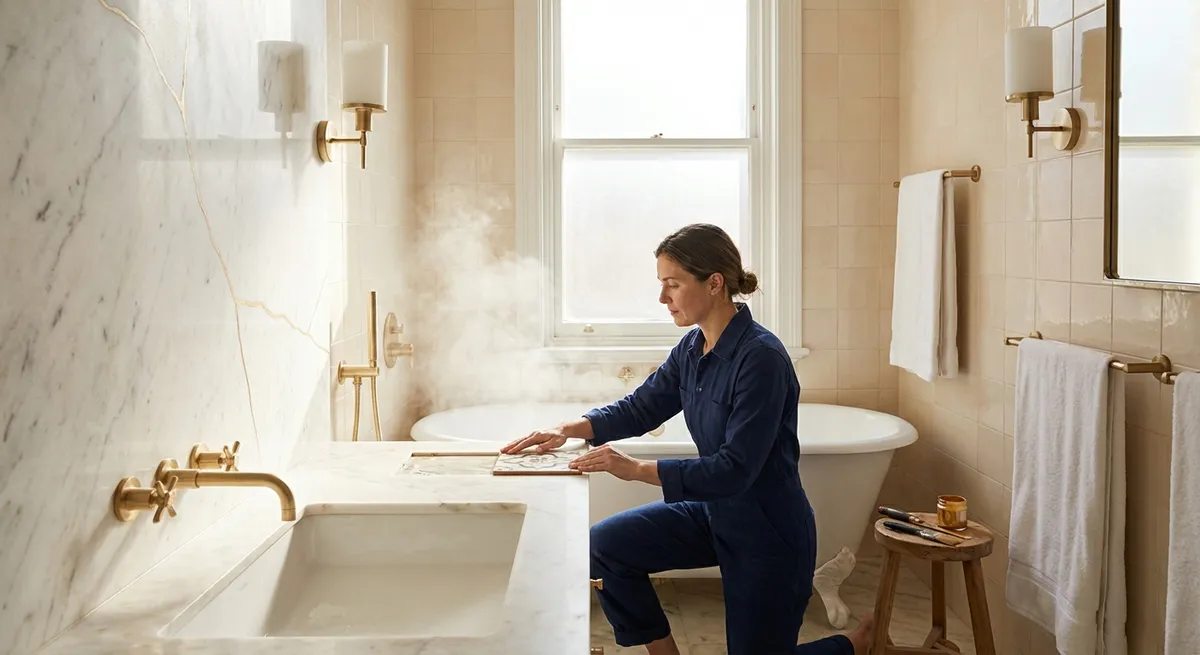
For homeowners who treat their surfaces as part of a curated environment, tile repair is not a purely technical exercise; it is a design decision. The following perspectives are crafted for those who expect subtlety, longevity, and visual continuity—not just a “patch.”
Repair as Preservation, Not Just Correction
Most tile repairs are approached as isolated problems: a crack here, a loose corner there. In refined interiors, this mindset is too narrow. A sophisticated approach treats repair as preservation of an entire visual and structural system.
The first step is always diagnostic, not reactive. Before replacing or patching, a professional should identify what the damage is saying about the installation or the building itself. A single cracked tile at a doorway, for example, may indicate movement in the subfloor or an unaddressed structural joint. Repair that focuses solely on aesthetics can inadvertently mask early warning signs of moisture intrusion, deflection, or substrate failure.
When repair is treated as preservation, your contractor evaluates how each intervention supports the long-term stability of the entire field: grout integrity, underlayment performance, expansion and movement joints, and the building’s natural motion. This approach yields repairs that don’t just look invisible today—they remain quiet and dependable for years, because the underlying cause has been thoughtfully handled, not merely hidden.
Exclusive Insight 1: The Art of Micro-Matching—Beyond “Close Enough” Color
Homeowners often assume that if the tile or grout color “looks close” in the box, the repair will blend. In carefully curated spaces, “close enough” reads as a scar. True premium repair involves micro-matching: a layered process that reconciles variations in color, finish, and aging.
Tiles—even from the same collection—shift subtly in tone between production runs. Exposure to sunlight, cleaning agents, and everyday life alters both tile and grout over time. A sophisticated repair professional will:
- Source or custom-tint grout to align not with the original specification, but with the current aged tone.
- Assess sheen level—matte, satin, high-gloss—and, if necessary, adjust the finish of replacement tiles or use specialized sealers to harmonize the surface.
- Consider directional patterning in stone veining or “print repeat” in porcelain to ensure a new tile is oriented and positioned to visually disappear.
In premium interiors, color and texture alignment function like a tailored seam: the craftsmanship is proven precisely because it is undetectable. Homeowners should expect their repair partner to behave less like a handyman and more like a colorist and finisher, with a disciplined eye for nuance.
Exclusive Insight 2: Strategic Replacement—Why “One Tile Out” Is a Design Decision
Removing and replacing a single damaged tile in the middle of a prominent field—an entry hall, a shower wall, a kitchen backsplash—can be riskier visually than it seems. Even a perfectly matched tile can disrupt the natural rhythm of the layout if its veining, pattern orientation, or joint width is even slightly off.
Elevated tile repair often employs strategic replacement: expanding the scope just enough to protect the integrity of the overall composition. Instead of replacing only the visibly damaged tile, a thoughtful professional might:
- Replace a small cluster within a natural break line—under a vanity, at the edge of a rug, or along a doorway—to conceal transitions.
- “Move” replacement tiles to less conspicuous locations, relocating original tiles into more prominent view where consistency matters most.
- Align replacements at the boundary of a pattern change or architectural element (like a niche or column) so that variations register as part of the design rather than as a repair.
This approach respects the home as a visual narrative. The repair is planned with the same intentionality as the original layout—an edit, not a patch.
Exclusive Insight 3: Acoustics and Hollow Tiles—Listening as a Diagnostic Tool
Visually perfect tiles can still be structurally compromised. A hollow sound when tapped lightly with a non-marring tool is not merely an annoyance; it is a diagnostic clue. In a premium environment, ignoring hollow tiles because “they haven’t cracked yet” is short-sighted.
Hollow tiles may result from insufficient thinset coverage, failure of the bond over time, movement in the substrate, or moisture-related issues. A refined repair strategy involves:
- Systematically mapping hollow areas across the installation to identify patterns rather than addressing them as isolated defects.
- Distinguishing between harmless localized voids (small, stable corners) and higher-risk conditions (large central hollows, areas under load, or wet environments like showers).
- Proactively stabilizing or replacing tiles in critical zones—shower floors, entry thresholds, stair treads—where soundness and safety are essential.
For design-conscious homeowners, this acoustic assessment is not fussy; it is preventative stewardship. Addressing hollow tiles before they manifest as cracks safeguards both the visual composition and the investment in the installation.
Exclusive Insight 4: Refining Grout Repairs—From Harsh Lines to Soft Transitions
Grout is often the first element to telegraph wear—hairline fractures, chipping at corners, or subtle discoloration. Yet heavy-handed grout repairs can draw more attention than the original flaw: overfilled joints, harsh edges, or mismatched texture betray the intervention.
Premium grout repair emphasizes texture and transition, not just gap-filling. Elevated practice includes:
- Partial removal with precision: targeting only compromised sections instead of aggressively grinding out large areas, which can damage adjacent tile edges.
- Textural matching: recreating the original joint profile—concave, flush, or slightly recessed—and mirroring the original tool marks or finishes.
- Tonal gradation: custom-tinting repair grout and, where appropriate, using specialized colorants to soften abrupt shifts between old and new.
In subtle interiors—especially those with pale stone, warm neutrals, or large-format porcelain—grout is a visual framework. When repaired with delicacy, it recedes quietly into the background, allowing the tile to remain the protagonist of the room.
Exclusive Insight 5: Moisture, Heat, and Movement—Respecting the Invisible Forces
Many tile failures that seem sudden are in fact the visible end of a long, invisible process. Moisture intrusion, temperature swings, and building movement quietly accumulate impact over time. In refined homes, where showers often feature large-format slabs, heated floors, or intricate mosaics, these forces deserve explicit attention in any repair strategy.
An expert-level repair will consider:
- Moisture mapping in wet areas: using appropriate tools (such as moisture meters in adjacent walls or floors) to confirm that a “small” shower problem isn’t a symptom of a failing waterproofing system.
- Compatibility with radiant heat: understanding whether earlier installations accounted for temperature cycling and expansion, and adjusting mortars or movement joint strategies accordingly when repairs are made.
- Respect for movement joints: resisting the temptation to “close gaps” or grout over intentionally flexible perimeters and transitions simply to achieve a more “finished” look. Those gaps are often the only thing preventing future failure.
Homeowners should expect their repair professional to speak confidently about expansion joints, uncoupling membranes, waterproofing layers, and vapor management. When these invisible systems are honored—not compromised—the repaired installation gains resilience without sacrificing elegance.
Working with the Right Professional: Signals of Elevated Craft
For the discerning homeowner, the difference between a competent repair and a truly elevated one lies in behavior long before the first tile is cut.
Look for professionals who:
- Begin with questions about the project history—install dates, original materials, any changes to the home—rather than immediately proposing quick fixes.
- Are comfortable declining to reuse low-quality or incompatible products just to save time or cost, especially in high-risk areas like showers and exterior terraces.
- Offer repair options at different levels of intervention (minimal, strategic, or comprehensive), explaining how each choice will behave visually and structurally over time.
- Speak fluently about standards from bodies like the Tile Council of North America (TCNA) or European Norms, and can explain how those guidelines apply to your specific situation in straightforward language.
Tile repair, executed at this level, feels less like damage control and more like conservation. The result is not simply a surface returned to functionality, but a space whose quiet coherence has been thoughtfully protected.
Conclusion
Elegant tiled interiors reward attention—both at the moment of installation and at every moment of care that follows. When a problem appears, the instinct to “fix it fast” is understandable, but in sophisticated homes, repair is an opportunity to reaffirm the standard of the entire space.
Micro-matched materials, strategic replacement, acoustic diagnostics, refined grout techniques, and respect for the invisible forces acting on your home all contribute to a repair that is not just acceptable, but exemplary. Partnering with a professional who shares this sensibility allows your tiled surfaces to age not with visible compromise, but with quiet assurance—remaining as composed, intentional, and enduring as the rest of your home.
Sources
- Tile Council of North America (TCNA) – Handbook & Resources – Authoritative industry standards and best practices for tile installation and performance
- Schluter Systems – Movement Joints in Tile Assemblies – Technical guidance on accommodating movement and preventing tile and grout failures
- Custom Building Products – Technical Bulletins – Detailed information on mortars, grouts, and repair-related considerations
- Mapei – Tile & Stone Installation Systems – Product data and technical insight into adhesives, grouts, and waterproofing for durable repairs
- U.S. General Services Administration – Historic Tile & Terra Cotta Preservation Brief – Perspective on conservation-oriented repair and preservation approaches for tiled surfaces