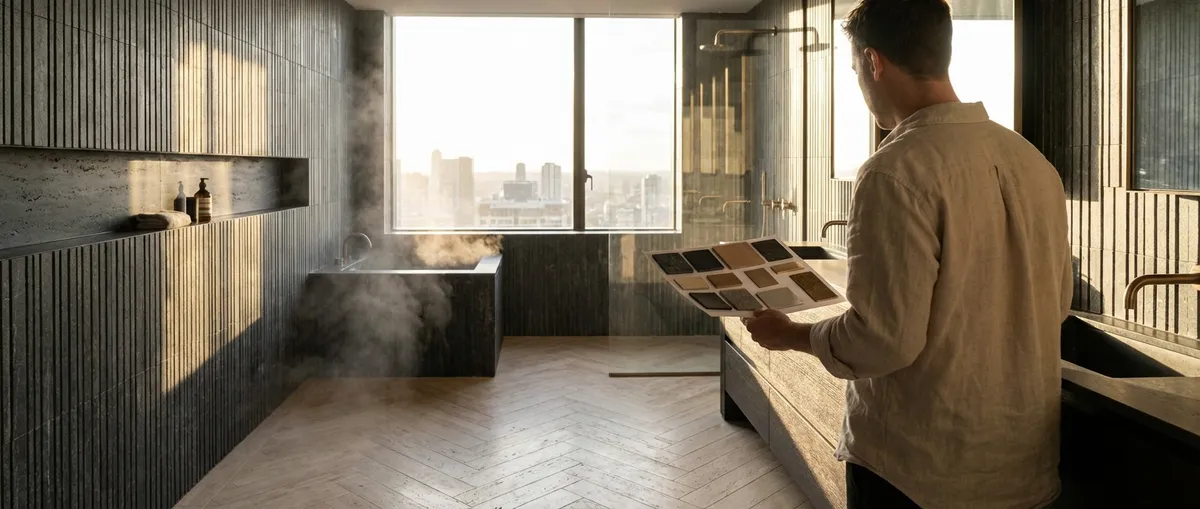
Below are five exclusive, design-forward insights that elevate tile from a surface treatment to a considered, permanent layer of your home’s architecture.
Designing with Light, Not Just Color
Most homeowners begin with color; the most refined schemes begin with light. Tiles interact with daylight and artificial lighting in ways paint never can, because they offer relief, reflectivity, and texture.
Subtle gloss variations—such as pairing a matte field tile with a satin or high-gloss trim in the same tone—create a quiet, almost imperceptible rhythm on the wall. In shadow, the surface reads monochromatic and calm; in direct light, micro-reflections appear and disappear as you move. For north-facing rooms with cooler light, a soft, warm white in a satin finish can prevent the space from feeling clinical. Conversely, in bright south-facing rooms, a gentle matte tile can prevent over-glare, allowing fixtures, art, and furnishings to take visual precedence.
Sophisticated tile design also considers where the eye naturally lands. Highlight the “light moments”—backsplashes behind a range, a shower wall opposite a window, or a column of tile visible down a hallway—using slightly more reflective or sculpted tiles. The result is not a loud feature wall, but a calibrated glow that feels intentional rather than performative.
Exclusive Insight #1: Begin your tile concept by mapping how light travels through each room, then assign finishes—matte, satin, gloss, or textured—based on where you want quietness versus subtle shimmer.
Treating Grout as a Design Material
Grout is often treated as a necessary evil; in elevated interiors, it is treated as a design material in its own right. The relationship between tile tone, grout color, and joint width can shift a space from graphic to serene—or from flat to architecturally expressive.
For a seamless, gallery-like effect, match grout as closely as possible to the tile body, especially for large-format surfaces. This approach allows the tile to read as a monolithic plane, ideal for minimal kitchens and spa-like baths. In contrast, a tone-on-tone variation—say, warm greige grout with oatmeal-colored tile—creates soft gridlines that are legible but not loud, adding structure without announcing themselves.
Joint width is equally crucial. Tight joints convey precision and modernity but demand an impeccable substrate and skilled installation. Slightly wider joints can introduce an old-world or artisanal character, particularly with hand-made or zellige-style tiles, where irregular edges invite a more generous spacing. The decision should be deliberate, proportionate to tile size, and consistent with the architectural language of the home.
Exclusive Insight #2: Select grout after you’ve handled tile samples in the actual space and lighting—test at least two joint widths and three grout tones on a small board to see how the “grid” reads at a distance before committing.
Composing Transitions as Architectural Details
Most tile decisions focus on the “field” area—the expanses of wall or floor. The truly refined home, however, is defined by its transitions: where tile meets paint, plaster, wood, or stone; where one pattern yields to another; and where a tiled surface begins or ends in a room.
Instead of relying on generic metal edge trims as a default, consider alternatives that feel more integrated with the architecture. Bullnose pieces, glazed edges, stone thresholds, or even razor-sharp paint-to-tile transitions (when the substrate is perfectly prepared) can all read more intentional than a visible extruded profile. When metals are appropriate, choose finishes that echo the room’s hardware, but avoid overly shiny trims that can visually “outline” your tile.
Thoughtful transitions also include where you choose to stop tiling. Wrapping tile around a window return, for instance, can create a subtle, built-in frame that feels crafted rather than applied. In showers, aligning the top of the tile with door headers or window heads can bring coherence to the room, tying vertical elements into a shared datum line that feels quietly architectural.
Exclusive Insight #3: Determine all edge conditions—where tile stops, turns, or meets another material—on plan and elevation drawings before selecting trims; this ensures the final space feels deliberate rather than patched together.
Balancing Movement, Scale, and Calm
Pattern and veining can bring drama, but in sophisticated interiors, they are edited with restraint. The goal is not to eliminate visual interest, but to choreograph it so that the eye can rest just as often as it is engaged.
Large-format porcelain that mimics stone can be breathtaking; it can also overwhelm if every surface is animated. Pair expressive floors with calmer walls, or vice versa. If you choose a tile with strong movement (such as marble-look veining or high-contrast terrazzo), ensure that adjacent materials—cabinetry, counters, and wall colors—are visually quieter and more continuous.
Scale also matters. Smaller tiles—such as mosaics or skinny planks—introduce more grout lines and therefore more visual “texture.” In high-traffic floors or compact powder rooms, this can be desirable, providing traction and richness. In primary bathrooms and open-plan kitchens, however, a more generous format can create a sense of calm and continuity, especially when carried across thresholds or into alcoves.
Exclusive Insight #4: Establish a single “primary movement hero” in each space—one tile or stone with pronounced pattern—then ensure all other surfaces act as a supporting cast, echoing its tones but not competing with its visual energy.
Layering Luxury Through Tactility and Thickness
The most memorable tile installations are not always the most colorful; they are often the most tactile. Thickness, relief, and surface texture introduce a level of nuance that photographs may not fully capture, but that is unmistakable in person.
Consider mixing flat field tiles with a controlled amount of dimensional pieces—fluted, beveled, or gently ridged—in strategic zones: a vertical band behind a vanity, an inset niche, or a small backsplash detail. When the color is kept consistent, the interplay of light and shadow reads as a sophisticated texture rather than a busy pattern.
Tile thickness can also be leveraged to create subtle shadow lines and reveals. Slightly recessing a tiled niche, or stepping a tile “frame” proud of a field tile, can introduce a sense of craftsmanship akin to millwork detailing. These moves demand precise planning of substrates and waterproofing, but the payoff is a space that feels custom-built rather than assembled from catalog components.
Exclusive Insight #5: When specifying tiles, look beyond color and size—ask for thickness, edge profile, and available relief options, then use small shifts in depth to create quiet shadow lines that signal bespoke craftsmanship.
Conclusion
Tile, at its most elevated, is not a decorative afterthought but a structural element of the interior story. By designing with light, treating grout as a deliberate material, composing transitions as architectural details, balancing movement with calm, and refining tactility and thickness, homeowners can achieve spaces that feel considered, enduring, and genuinely luxurious.
In a world of quick visual gratification, these details reward those who pay attention. The result is a home that does not shout its sophistication, but reveals it—inch by inch, tile by tile.
Sources
- American National Standards Institute (ANSI) – Tile Installation Standards - Authoritative reference on professional tile installation practices and tolerances
- Porcelain Tile Certification Agency (PTCA) - Provides information on certified porcelain tile and performance criteria for quality selection
- Ceramic Tile Education Foundation (CTEF) - Technical articles on best practices, grout selection, and detailing for high-end tile work
- The Spruce – Choosing Tile Finishes - Overview of tile finishes and how they impact light, reflection, and texture in interiors
- Architectural Digest – Bathroom Tile Ideas - Curated design examples illustrating sophisticated compositions and material transitions