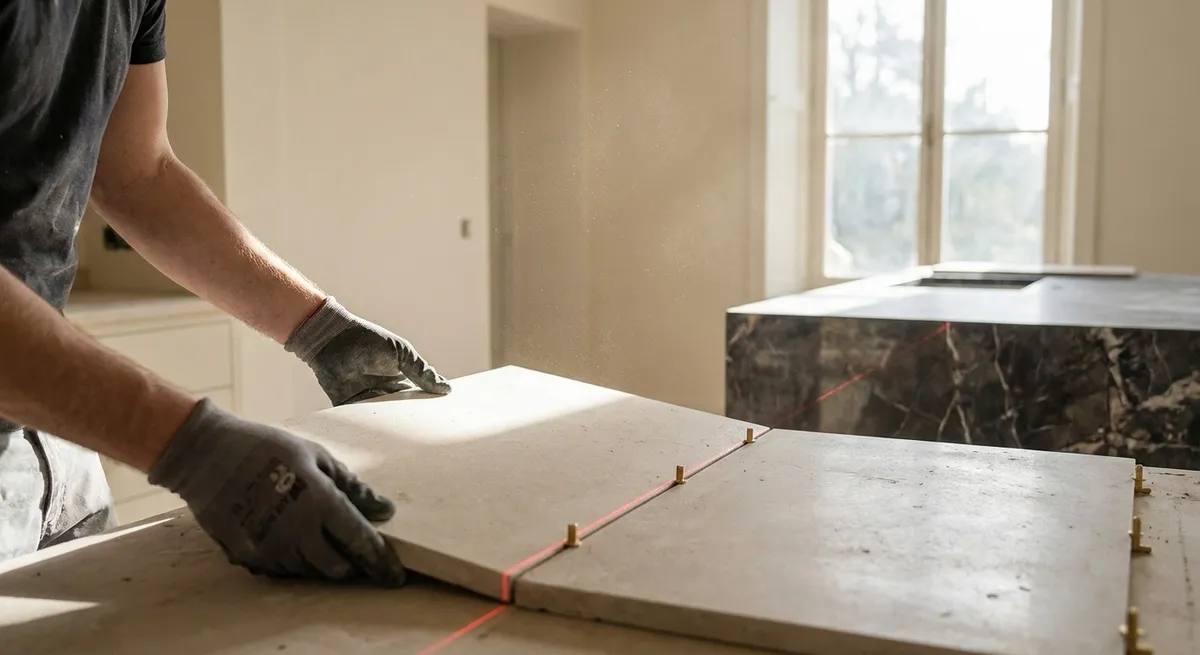
For homeowners planning tile work, understanding the language of high‑end installation is the surest way to elevate results. The following insights reveal how discerning clients and meticulous installers transform tile from a surface material into a design instrument.
The Hidden Blueprint: Reading the Space Before a Single Tile Is Set
Exceptional tile work begins long before thinset touches the substrate. The most skilled installers treat each room as a composition, not a grid to be mechanically filled.
Subtle details shape that composition. Door thresholds, window mullions, the centerline of a bathtub, the axis of a kitchen range—all of these can become anchoring lines for tile layout. A seasoned professional will “walk” the space and study these alignments, sketching options that anticipate how the eye moves through the room.
Equally important is elevation planning. Tile lines that relate elegantly to countertop heights, vanity tops, and niche openings lend visual coherence. A shower niche that lands neatly within full tiles or a base course that dies perfectly into a window stool instantly signals intention rather than improvisation.
As a homeowner, insist on seeing a layout concept before installation begins—ideally with reference measurements, centerlines, and how cuts will fall at key edges. This pre‑planning is the architectural equivalent of a musical score: once established, every tile has a clear role.
Subtle Symmetry: Elevating Layout Beyond Simple Centering
Centering tile in a room is basic; creating visual equilibrium is sophisticated. True luxury in tile layout lies in balanced decisions that take the entire envelope into account.
Perfectly centered fields can still look awkward if they yield sliver cuts at doorways or under cabinetry. A refined installer will sometimes opt for a slight off‑center shift that trades nominal symmetry for proportionally generous edge tiles, especially in highly visible areas. In narrow rooms or corridors, a layout that aligns with the dominant path of travel may be more pleasing than strict geometric centering.
Complex patterns—herringbone, chevron, Versailles, or mixed‑format stone—require even more nuance. The goal is to anchor the pattern to a meaningful line: the long sightline of a hall, the focal wall of a fireplace, or the principal view from an entry. That decision then dictates how the pattern “resolves” at perimeters, niches, and steps.
Ask your installer to address three things explicitly: where the pattern starts, how it terminates at boundaries, and which lines are treated as sacrosanct. This is where an ordinary floor becomes a tailored one.
The Substrate as Foundation Garment: Why What’s Beneath Defines What You See
In premium tile work, the substrate is treated with the same seriousness a tailor reserves for an inner canvas. It is largely unseen, yet it is what allows the outward surface to sit flawlessly.
Tiles do not correct an uneven substrate; they amplify its defects. A difference of a few millimeters in flatness can cause visible lippage—especially with large‑format porcelain or rectified stone. High‑end installations therefore begin with meticulous surface preparation: self‑leveling underlayments, properly fastened and taped backer boards, and verification of deflection limits for framed floors.
In wet areas, waterproofing moves from “recommended” to non‑negotiable. Continuous waterproofing membranes, correctly tied into drains and penetrations, protect not only the tile but the structure behind it. A beautiful shower with poor waterproofing is a time bomb, not a luxury.
Homeowners should request two assurances before approving work: confirmation that substrates meet recognized flatness and deflection standards for tile, and documentation—or at least a walkthrough—of the waterproofing system used. These questions quietly signal that you understand the difference between cosmetic and architectural quality.
Five Exclusive Insights for the Discerning Homeowner
Beyond the fundamentals, there are subtler decisions that distinguish polished tile work from merely competent installation. These five insights are particularly valued by homeowners who care about refined, enduring results.
1. Grout as a Design Instrument, Not a Filler
Grout color is not an afterthought; it defines the rhythm of the surface. A tone matched closely to the tile yields a monolithic, contemporary quietness. A deliberate contrast emphasizes pattern and module, lending energy and graphic structure.
The most elevated projects often choose grout one to two shades off the tile rather than an exact match—enough to articulate joints under different lighting conditions without creating a high‑contrast grid. For natural stone, slightly warmer or cooler grout can subtly enhance veining and depth.
Insist on grouted sample boards or at least digital mockups of two or three grout options in your specific lighting. A 3 mm line on a board becomes an entire field on the floor; what appears “close enough” in a showroom can feel either flat or visually noisy once installed.
2. Edge Profiles as the Jewelry of the Installation
How tile edges are finished is one of the clearest markers of craftsmanship. Sharp, exposed cuts at outside corners or transitions cheapen otherwise beautiful material. The most refined executions use carefully planned edge solutions: mitered stone corners, high‑quality metal profiles, or factory bullnose pieces aligned with precision.
For contemporary interiors, slim, color‑matched metal trims can virtually disappear, letting the tile mass read as a sculpted volume rather than a sheet applied to a corner. In classical or transitional spaces, softly radiused stone edges or stacked bullnose lend a sense of tailored solidity.
Discuss every edge condition in advance: shower niches, niche returns, curb tops, window surrounds, and stair nosings. Elegant tile work is rarely about the field alone; it is won or lost in the margins.
3. Thoughtful Transition Strategies Between Materials
Transitions between materials—tile to wood, tile to carpet, tile to stone—are where many projects betray their budget tier. Abrupt height changes, awkward metal strips, or misaligned joints break visual calm.
Premium solutions aim for flush transitions where possible: coordinated underlayment thicknesses, tapered subfloors, or selecting alternative materials whose total build‑up aligns with adjacent finishes. When elevation differences are unavoidable, purpose‑designed transition profiles in matching metals or subtle shapes maintain a sense of intention.
Just as important is pattern continuity. A tile grid that relates logically to an adjoining wood plank layout, or a stone threshold that mediates two surfaces, reads as a design decision rather than a default. Ask your installer and designer to coordinate not only where transitions occur, but how they look from the most important vantage points in the home.
4. Light as the Final Inspector
Luxurious tile work is evaluated not only in daylight, but under the full choreography of artificial lighting—recessed downlights, wall grazers, under‑cabinet fixtures, and decorative sconces. Each lighting type reveals different aspects: lippage, surface texture, grout consistency, and the true color of the tile.
Grazing light along walls, particularly in showers or feature walls, will exaggerate any irregularities in the substrate or installation. If wall grazing is part of your lighting design, your installer must know this in advance; it often justifies extra time spent on flattening and fine‑tuning.
Before project sign‑off, review the tile work with all lighting schemes activated: daytime, evening ambient, and accent lighting. This is when minute imperfections surface—and when the full value of meticulous preparation becomes clear.
5. Strategic Use of Movement and Expansion Joints
In refined interiors, joints that allow for movement are often hidden in plain sight. Tile, mortar, and substrates expand and contract with temperature and moisture. Proper movement joints are essential for longevity, yet poorly placed ones can interrupt visual flow.
Experienced installers coordinate expansion joints with grout lines, thresholds, and architectural breaks so they appear natural within the pattern. In larger rooms or long corridors, subtle soft joints at calculated intervals prevent cracking without visually fragmenting the floor.
For exterior patios, sunrooms, or spaces with radiant heating, movement joint strategy becomes even more crucial. Request that your installer explain where movement joints will occur and how they will be visually integrated. The most luxurious installations are those that age without calling attention to the engineering that keeps them flawless.
Partnering with the Right Professional
No amount of design discernment can compensate for inadequate technical skill. Luxury in tile is as much about who installs it as what you select.
Look for professionals familiar with industry standards and manufacturer specifications, especially for complex assemblies like steam showers, large‑format panels, and exterior installations. Certifications, continuing education, and visible pride in mockups or sample installations are strong indicators of seriousness.
Equally telling is how an installer talks about time. A willingness to allocate days—not hours—to layout, substrate preparation, and waterproofing often correlates directly with the caliber of the finished work. In tile, rushed is rarely reversible.
As a homeowner, your role is to set the expectation that this is an architectural investment, not a mere finish. The result is an environment where every grout line, corner, and transition reflects an underlying standard of care.
Conclusion
Tile is often described in terms of color, size, and finish, but in sophisticated homes its true luxury is expressed through precision: in the unseen flatness of substrates, the measured geometry of layouts, the discipline of waterproofing, and the quiet logic of transitions. When these elements are orchestrated with intention, tile ceases to be background and becomes an integral part of the architecture.
By engaging deeply with layout decisions, substrate preparation, edge detailing, transitions, lighting, and movement control—and by partnering with professionals who respect these disciplines—you move beyond “nice tile” into the realm of enduring, cultivated surfaces. The beauty you see is only half the story; the rest is the hidden architecture of precision that makes that beauty feel inevitable.
Sources
- [Tile Council of North America (TCNA) Handbook](https://www.tcnatile.com/manual/handbook.html) - Industry-recognized standards and best practices for tile installation and substrate preparation
- [American National Standards Institute (ANSI) A108 / A118 / A136 Series](https://webstore.ansi.org/standards/tcna/ansia1082019) - Technical standards governing installation methods, materials, and performance requirements for ceramic and stone tile
- [Schluter Systems: Waterproofing and Substrate Preparation](https://www.schluter.com/schluter-us/en_US/rooms/bathroom/waterproofing) - Detailed guidance on waterproofing assemblies, movement joints, and edge profiles in wet areas
- [LATICRETE Technical Data Sheets](https://laticrete.com/en/tile-and-stone-installation/system-materials/underlayments-and-membranes) - Manufacturer documentation on self-leveling underlayments, membranes, and installation systems for high-performance tile work
- [National Institute of Standards and Technology (NIST): Building and Fire Research](https://www.nist.gov/topics/buildings-and-construction) - Research resources related to building performance, movement, and moisture that underpin long-lasting tile assemblies