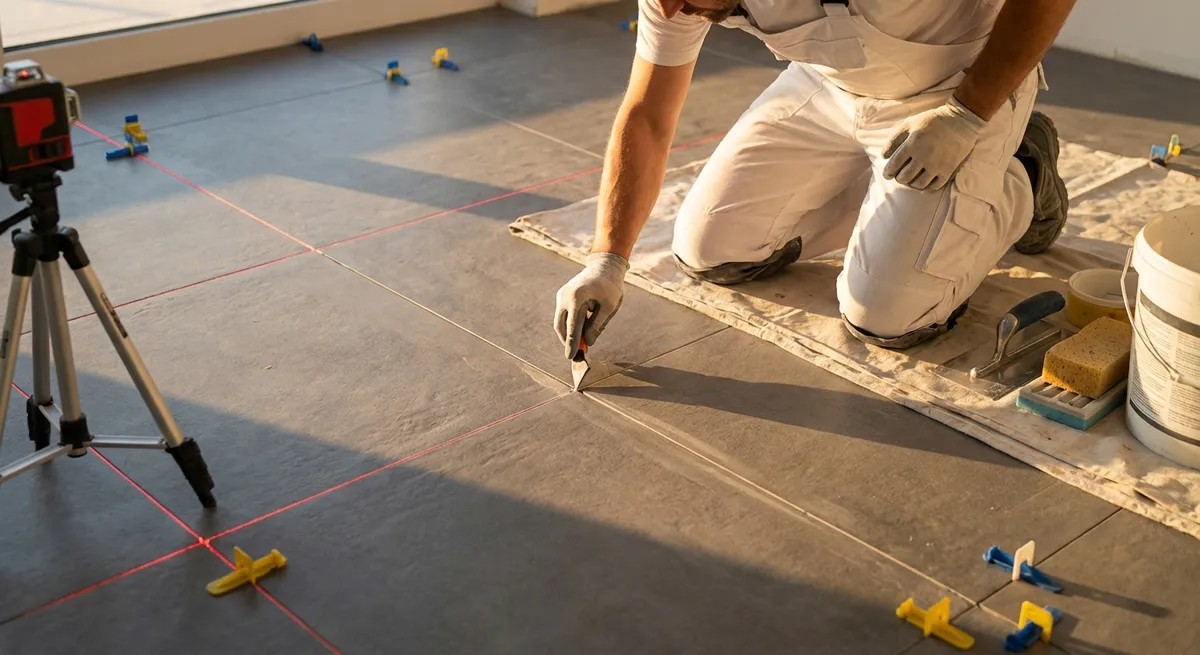
Below are five exclusive, behind‑the‑scenes insights that discerning homeowners can use to guide conversations with their installer—and to ensure that every square inch of tile lives up to the architecture around it.
Curated Substrates: Why the Hidden Layer Determines the Final Look
Premium tile work begins long before the first tile is set. The substrate—the surface beneath the tile—is the foundation of every decision that follows, and its quality is often the difference between a room that feels quietly flawless and one that always seems slightly “off.”
Refined installations start with an uncompromising flatness standard. While many contractors speak only of “level,” seasoned tile professionals are obsessed instead with “flat.” Large‑format porcelain, stone, and thin gauged panels mercilessly reveal even minor undulations in the substrate, casting distracting shadows and lippage in raking light. A properly prepared surface may involve self‑leveling underlayments, patching compounds, or a decoupling membrane—all chosen to suit the structure and the tile format, not simply what is on the truck that day.
Moisture management is equally critical. In wet environments, a high‑end project will specify a complete waterproofing system—membranes, seams, corners, and penetrations integrated as one—rather than isolated patches of protection. The intent is not only to protect the home from future damage, but also to ensure that the tile assembly moves as a unified, stable layer over time.
A homeowner who asks, “How are we preparing the substrate, and which system are you using?” signals a level of sophistication that encourages craftsmanship. The response should reference specific products, standards, and methods—not vague assurances.
Intelligent Layouts: Designing to the Architecture, Not the Room Size
Exceptional tile work feels inevitable, as though it could not have been executed any other way. That sense of inevitability is achieved through careful layout, designed in dialogue with the architecture rather than simply “starting in the center and going out.”
A refined layout respects sightlines first. Where will your eye naturally fall as you enter the room? Along which walls does the light travel at dawn and dusk? Premium installers and designers will place full tiles—or thoughtfully balanced cuts—at the most visible thresholds and focal walls, allowing smaller or irregular cuts to retreat into less visible corners and under cabinetry. The floor or wall then reads as an intentional plane, not an afterthought.
Proportions between tile size and room scale are equally significant. Long, plank‑style tiles can visually elongate a narrow room when oriented correctly, but can also fight with the architecture if they run against the flow of the space. In bathrooms, aligning grout joints with key elements—like the centerline of a vanity, a window mullion, or a niche—creates a visual rhythm that subtly heightens the sense of order.
Before installation, insist on a dry layout or detailed plan. Ask your installer to show how cuts will fall on all walls, at doors, and around fixtures. A few hours of layout refinement on paper or on the floor can elevate the finished result from simply “well installed” to architecturally integrated.
Strategic Joint Design: Grout as a Deliberate Design Element
In luxury spaces, grout is never a mere filler; it is a design instrument. The choice of joint width, grout color, and joint alignment has as much impact on the final impression as the tile selection itself.
Narrow joints, correctly executed, lend a seamless, tailored look—particularly appropriate for large‑format or rectified porcelain. But the goal is not “as thin as possible”; it is “proportionate and stable.” Too narrow a joint can telegraph minor size variations and lead to chipping at the edges over time. Discerning installers balance visual minimalism with the requirements of industry standards and the specific tolerances of the tile.
Color is where nuance truly emerges. Perfectly matched grout can create a monolithic, stone‑like effect, ideal for spa bathrooms or gallery‑like living spaces. A softly contrasting tone, just a half‑step away from the tile, introduces a gentle grid that can lend structure to an otherwise quiet surface. Strong contrast transforms the grout into graphic geometry—most compelling when used to emphasize pattern rather than merely outline every tile.
Beyond color and width, joint alignment—stacked, offset, or patterned—should be determined by the architecture and the tile format. High‑end installers will adjust offsets for long planks to avoid “peaked” joints, especially with bowed tiles. The result is an even, luxuriously smooth plane, free of distracting high and low points under light.
Light‑Conscious Installation: Managing Shadows, Reflections, and Raking Light
Luxury tile installations are designed not only for how they look in static conditions, but for how they respond to changing light throughout the day. Understanding raking light—the dramatic, low‑angle light that scoops across surfaces in the morning or evening—is essential to preserving a refined aesthetic.
Under raking light, even minor surface irregularities become exaggerated: lippage appears more pronounced, substrate waves reveal themselves, and imperfect grout smoothing casts fine shadows along every joint. Premium installers anticipate this by tightening tolerances and adjusting methods in spaces with expansive windows, glass doors, or strong directional artificial lighting.
Tile orientation also influences how light is read. In long corridors, aligning plank tiles with the direction of light can create a more seamless, elongated visual field. In shower walls or feature partitions, vertical layout can elevate ceiling height and harness top‑down light to flatter the surface, rather than highlight inconsistencies.
For homeowners, the most powerful step is to review the space under “real” lighting conditions before finalizing installation decisions. Visit the site at different times of day, switch on all planned fixtures where possible, and examine how mock‑ups or laid‑out tiles interact with those conditions. Then, confirm with your installer: “How are we minimizing visible lippage and shadowing under this light?” A thoughtful answer will typically reference substrate preparation, layout adjustments, and joint strategy.
Performance Materials: Adhesives, Membranes, and Details That Age Gracefully
In refined homes, beauty must be matched by longevity. The most elegant tile work is the product of intelligent material pairing—ensuring that every component, from adhesive to movement joint, is selected not just to install the tile, but to preserve it gracefully over time.
High‑performance thinsets and mortars are formulated for specific conditions: large‑format tiles, exterior applications, glass tile, or installations over heated floors. A sophisticated specification looks beyond generic “tile adhesive” and instead matches a mortar’s performance characteristics—flexibility, open time, bond strength—to both the tile and the substrate. This helps mitigate cracking, debonding, and warping as the building naturally moves.
Equally critical are movement and soft joints, often overlooked in less considered projects. In larger spaces, premium installations incorporate carefully positioned movement joints—sometimes color‑matched to be nearly invisible—that absorb expansion and contraction from temperature, sunlight, and structural shifts. The absence of these details can lead to tenting tile, cracked grout, and subtle failures that undermine the sense of solidity.
In wet areas, consider complete systems: waterproofing membranes integrated with compatible mortars, sealants, and drains. When each component is designed to work in concert, the assembly is more predictable, more durable, and more likely to maintain that freshly finished appearance over years of use.
A homeowner’s most effective question is deceptively simple: “Which installation system are you using, and is it backed by a manufacturer warranty when installed to their specifications?” A confident, system‑based answer is a strong indicator that the installer is thinking long‑term, not just until the final payment.
Conclusion
Truly elevated tile installation is an orchestration of invisible decisions—substrate precision, architectural layout, deliberate joint design, light‑conscious execution, and high‑performance materials working together to create a surface that feels calm, composed, and enduring.
For homeowners, the path to this level of refinement is not learning to set tile, but learning which questions to ask and which details to insist upon. When you engage your installer as a collaborator in these finer points, you invite a higher standard of craftsmanship—one that honors the tile you’ve chosen and the architecture that surrounds it.
In the end, the most luxurious tiled spaces don’t call attention to the work itself. They simply allow the room to feel effortlessly complete.
Sources
- Tile Council of North America (TCNA) – Handbook and Standards - Authoritative reference for tile installation methods, substrate requirements, and performance standards
- ANSI A108/A118/A136.1 Tile Installation Standards (via TCNA) - Details on professional installation practices, mortars, and grout specifications
- Schluter Systems – Movement Joints - In‑depth guidance on designing and placing movement joints in high‑end installations
- LATICRETE – Large and Heavy Tile Installation Tips - Technical insights on substrates, lippage control, and mortar selection for large‑format tile
- MAPEI – Surface Preparation Requirements - Comprehensive discussion of substrate flatness, moisture conditions, and their impact on long‑term tile performance