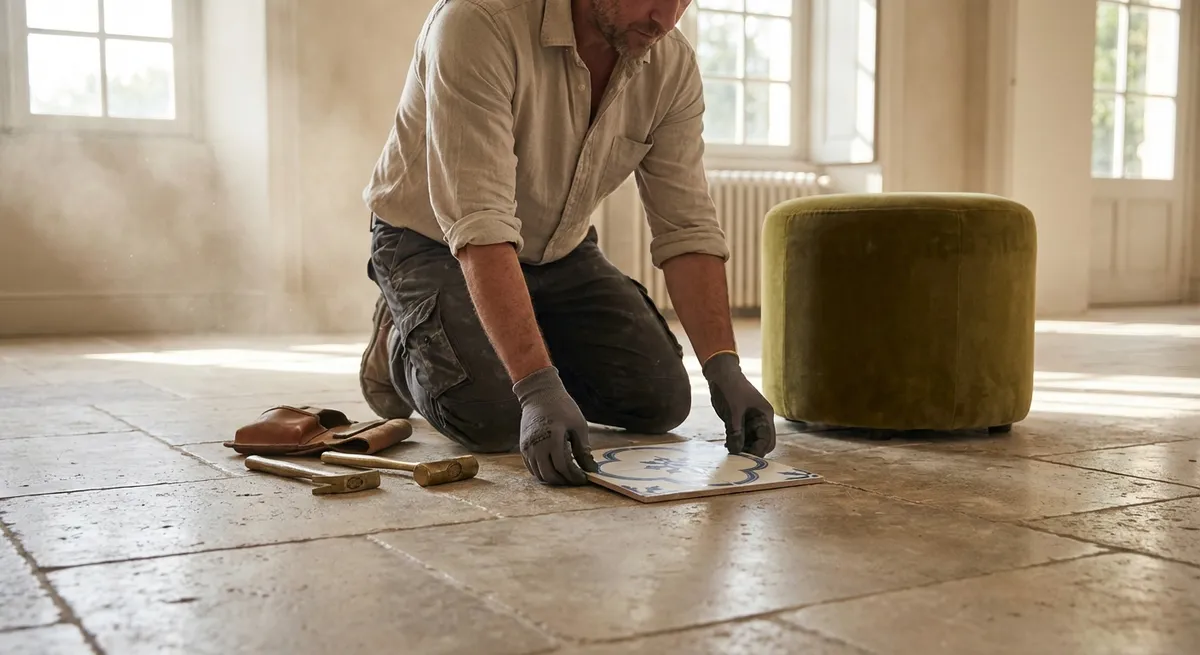
Below are five exclusive, detail-driven insights that transform tile repair from a necessary chore into a carefully orchestrated craft.
1. Reading the Surface: Diagnosing the Problem Behind the Flaw
A chipped edge or hairline crack is rarely the entire story. Refined tile repair begins with a forensic reading of the surface—understanding what prompted the failure before attempting any correction.
Sophisticated installers will first distinguish between cosmetic and structural issues. A single cracked tile in an otherwise stable field may result from an isolated impact, while a pattern of fractures aligned in a straight line can indicate substrate movement, improper underlayment, or a lack of expansion joints. Hollow-sounding tiles when tapped gently with a wooden handle can signal inadequate coverage of thin-set, leading to debonding over time.
Moisture testing in wet areas, such as showers and spa rooms, reveals whether water intrusion has undermined the setting bed. In older installations or heavily used kitchens, grout failure might reflect not simply wear but chemical damage from harsh cleaners. A repair that overlooks these root causes may look pristine for a season, then fail again. A judicious homeowner insists on a thorough diagnosis—substrate checks, moisture assessment, even removal of a sacrificial tile if necessary—before sanctioning any intervention.
2. The Palette of Perfection: Mastering Color and Texture Matching
In premium interiors, the eye is exquisitely sensitive to small variations in tone and sheen. A successful tile repair hinges not only on structural soundness but on an almost obsessive commitment to visual continuity.
For stone and high-end porcelain, a seasoned professional will keep retained “attic stock” from the original installation—a small inventory of surplus tile stored away for future repairs. When that is unavailable, the solution may involve sourcing from the same quarry or manufacturer batch, or selecting a visually compatible tile and then refining it on-site through honing, polishing, or micro-beveling to echo the existing field.
Grout demands similar precision. Modern grout systems now allow custom pigment blends, enabling an exact chromatic match to an aged joint that has mellowed over time. A luxury-minded repair may even involve gently cleaning and refreshing adjoining grout to transition the new work seamlessly into the old, avoiding the sudden “new line” effect. For glossy glazed tile, matching the level of reflectivity—satin, semi-gloss, or high polish—is as important as hue; even a perfect color can betray itself under raking light if the sheen is slightly off.
3. Precision Removal: Protecting Surrounding Tile as a Design Asset
The measure of a refined repair is often not what is replaced, but what is preserved. Removing a damaged tile without disturbing its neighbors is a delicate exercise, particularly with large-format or rectified tiles where joints are razor-thin and tolerances are unforgiving.
An elevated approach typically begins with controlled cuts along the grout joints to isolate the damaged tile, using high-quality blades and dust-mitigation methods suitable for a finished home. The objective is to free the tile in small, manageable sections rather than prying it out in a single forceful motion, which risks chipping adjacent edges or fracturing the substrate. During this process, a professional will constantly evaluate the condition of the setting bed: if the mortar remains sound and fully bonded, it can sometimes be leveled and reused; if it is compromised, a meticulous removal and resurfacing follows.
The surrounding tiles are treated not as obstacles but as fragile architectural elements worthy of protection—masked, cushioned, and shielded throughout the work. This care is particularly critical around natural stone, decorative borders, inlays, and custom patterns, where even one unintended chip can disrupt an otherwise tailored composition.
4. Reinforcing What You Don’t See: Substrates, Movement, and Longevity
A truly sophisticated repair prioritizes what remains invisible after the last tile is set—the integrity of the layers beneath. Premium tile assemblies rely on a careful interplay of rigid support and controlled movement; a proper fix respects this balance rather than merely “sticking a new tile down.”
Where a crack has telegraphed through the surface, the substrate may require reinforcement or isolation. Professionals may introduce crack-isolation membranes or uncoupling layers beneath the repaired section to accommodate differential movement between structures and finishes. In wet environments, correctly detailed waterproofing—continuous, properly lapped, and compatible with the mortar system—is essential to prevent recurring failures and hidden mold.
Attention to movement joints is crucial. Perimeter and field-expansion joints, often overlooked in original installations, can be subtly introduced during the repair to relieve stress, preserving the flawless plane of a large tiled expanse. Premium mortars and setting materials, chosen for flexibility, bond strength, and compatibility with the tile type (porcelain, natural stone, glass), further enhance the longevity of the repair. The homeowner may never see these decisions, but they are precisely what make a repaired surface feel uneventful and enduring years later.
5. Curated Finishing Touches: Blending the Repair into Daily Life
The final stage of an elevated tile repair is less about tools and more about choreography—how the renewed surface integrates effortlessly into the cadence of daily living. This is where subtle finishing decisions complete the illusion of uninterrupted perfection.
Edges are refined: micro-bevels on replacement tiles are adjusted to echo the wear of adjacent pieces; stone surfaces are honed or polished in place to ensure a continuous plane under both hand and foot. Grout lines are tooled to match the existing profile—slightly concave, flush, or gently crowned—rather than simply filled. In high-traffic or high-luxury areas, a professional may recommend an appropriate penetrating sealer for stone and grout, chosen not to alter color or gloss but to preserve the repaired zone against stains and everyday use.
Just as importantly, an elevated repair includes a brief “care dossier” for the homeowner: compatible cleaning products that will not etch marble or bleach grout, guidance on avoiding aggressive scrub pads, and subtle behavioral tweaks—such as soft casters under bar stools or felt pads beneath furniture—that protect the newly perfected surface. The repair thus extends beyond the moment of completion, aligning craftsmanship with long-term stewardship.
Conclusion
In a refined home, tile repair is not an unfortunate necessity but an opportunity to reaffirm standards of excellence. The most successful interventions are practically invisible: they respect the original design intent, honor the interplay of materials and structure, and anticipate how the surface will be lived with for years to come. By insisting on precise diagnosis, uncompromising color and texture matching, careful tile removal, structurally sound reconstruction, and curated finishing, homeowners elevate repair from a basic fix to a quiet restoration of order—where the only thing anyone notices is how beautifully the room holds together.
Sources
- The Tile Council of North America (TCNA) Handbook - Industry guidelines on tile installation standards, substrates, and movement joints
- Schluter Systems – Technical Resources - Detailed information on crack-isolation, uncoupling membranes, and waterproofing assemblies
- Custom Building Products – Grout & Mortar Selection Guide - Guidance on selecting appropriate mortars and grouts for different tile types and conditions
- U.S. Environmental Protection Agency – Mold & Moisture Control - Background on moisture-related failures and best practices to prevent mold in wet areas
- National Institute of Standards and Technology (NIST) – Ceramic Tile Properties - Technical insight into ceramic and glass tile characteristics and performance