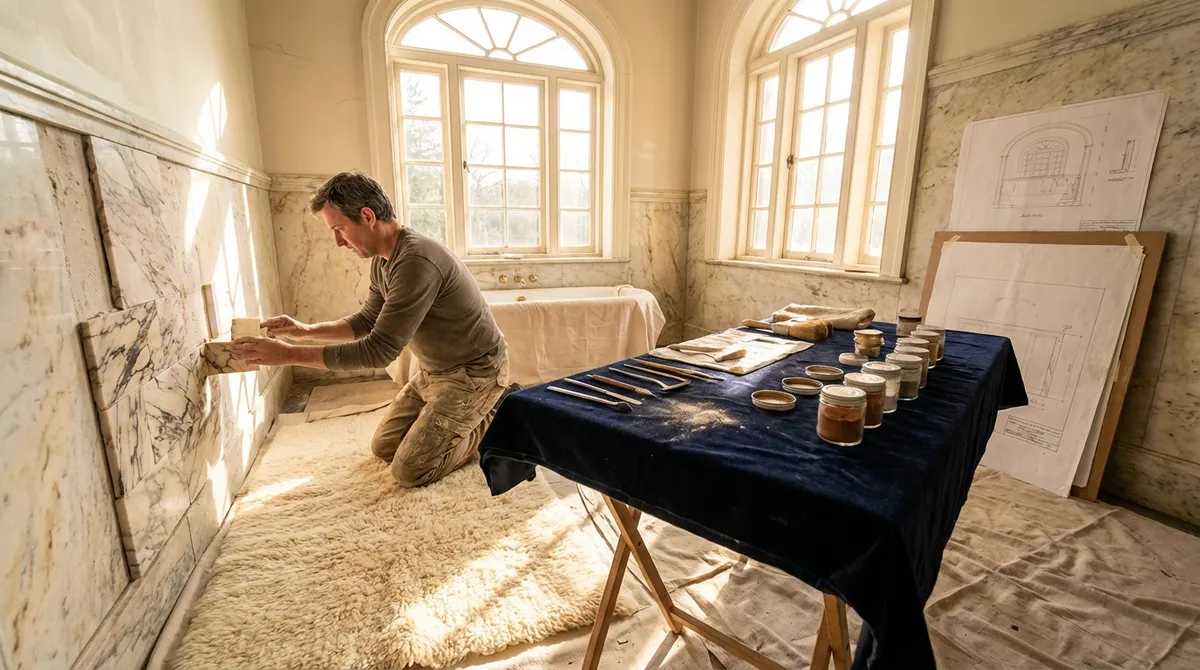
This guide explores repair solutions through a more discerning lens, with five exclusive insights tailored to those who expect their spaces to perform and present at the highest level.
Reading the Surface: Diagnosing Beyond the Obvious
Before any repair begins, a seasoned professional treats the tiled surface almost like a conservator approaching a work of art: patient, analytical, and deeply attentive to nuance.
Subtle discrepancies in grout coloration may indicate past spot repairs, moisture intrusion, or previous movement in the substrate. A hollow sound beneath footfall can reveal a debonded tile or voids in the adhesive bed, even when the surface appears pristine. Slight lippage between tiles—especially in large-format or natural stone—can signal subfloor deflection or inadequate substrate preparation rather than installation error alone.
A refined repair strategy starts by understanding the original assembly: substrate type, waterproofing method, adhesive class, grout composition, and movement joint placement. This context allows the repair to correct root causes (structural movement, moisture, improper setting materials) rather than merely disguising symptoms. For high-end homes with complex tilework, the most valuable repair is often the one that prevents future failures across the entire installation.
Preservation Over Replacement: Respecting Original Character
In a premium space—whether it’s hand-glazed ceramic in a powder room or bookmatched marble in a primary bath—full replacement can feel like sacrilege. The goal becomes preserving as much of the original work as possible while returning the surface to a visually uncompromised state.
Where tiles are discontinued or rare, a specialist may delicately remove damaged pieces to salvage them for less-visible areas, then “relocate” intact originals to more prominent zones. Repaired or color-matched tiles can then be concealed in recesses, behind fixtures, or under cabinetry. In heritage or custom installations, this practice protects the authenticity of the most visible surfaces.
Even when replacement tiles are available, they may not have aged identically. Sun exposure, cleaning products, and natural patina can subtly alter tone and sheen. A sophisticated repair approach will consider intentional placement of new tiles where transitions are logical—at corners, thresholds, or natural breaks—so any micro-variation reads as intentional rather than accidental.
Precision Color Matching: Grout and Glaze as a Fine Art
For many homeowners, grout is an afterthought. For a refined repair, it is a critical design element. Mismatched grout can make even a small repair loudly visible, breaking the visual rhythm of a wall or floor.
Advanced repair work often involves custom grout blending—mixing multiple shades to achieve a precise match to the existing, aged grout rather than the original fresh color. Slightly warming or cooling the tone, adjusting brightness, and considering how grout appears when dry versus when sealed are part of a more sophisticated process. Some specialists will create test joints on sample boards, aging them with mild cleaners or sealers until the hue aligns with the surrounding installation.
For chipped or lightly damaged tiles, high-quality porcelain or epoxy repair kits and pigmentable fillers can restore both color and texture in situ. Achieving a convincing result requires layering tints, mimicking veining or subtle speckling, and matching gloss levels through careful sanding and topcoating. When executed properly, these micro-restorations become visually undetectable at normal viewing distance, maintaining the serenity of the entire surface.
Strategic Reinforcement: Strengthening What You Don’t See
The most elegant repairs are not just cosmetic—they reinforce the structure behind the beauty. Where tiles have cracked along structural lines or high-traffic paths, an astute professional will investigate the underlying dynamics: subfloor movement, deflection, thermal expansion, or inadequate movement joints.
In some cases, tiles can be carefully removed and reinstalled over a properly prepared substrate incorporating modern underlayments, decoupling membranes, or improved waterproofing systems. In heated floors, a repair might involve verifying sensor placement, insulation quality, and compatibility of setting materials with radiant systems to avoid future failures.
Expansion and movement joints—often considered visually intrusive—can be discreetly integrated along perimeters, transitions between materials, or architectural lines (niches, benches, thresholds). By placing them thoughtfully and using high-performance, color-matched sealants, a skilled repair can both protect the installation and preserve visual calm. The result: a floor or wall that feels visually uninterrupted yet is structurally poised to handle real-world demands.
Curated Materials: Selecting Repair Products for Luxury Surfaces
High-end tile installations deserve materials that match their caliber. In repair work, this means choosing mortars, grouts, sealers, and ancillary products with performance and longevity in mind—not merely convenience.
For large-format porcelain or natural stone, deformable, high-performance adhesives reduce the risk of future cracking from minor movement. In wet areas, selecting grouts with low water absorption and high stain resistance (such as epoxy or advanced hybrid formulations) can significantly improve long-term appearance. Sealers should be carefully chosen based on tile type—impregnating sealers for natural stone, breathable formulations for sensitive substrates, and non-yellowing products in sunlit areas.
Equally important is compatibility: repairing an older cementitious grout with an incompatible modern product can create differential hardness or color shift over time. Knowledgeable professionals will often contact manufacturers, review technical data sheets, and even conduct small-scale tests to ensure the chosen system supports both the existing installation and the desired aesthetic.
These elevated choices may not be immediately visible to the eye, but their effects are: fewer stains, more stable joints, and surfaces that maintain their composure under daily use.
Conclusion
Thoughtful tile repair is less about “patching” and more about stewardship—of materials, craftsmanship, and the architectural narrative of a home. A well-executed mend respects the original vision while quietly upgrading performance behind the scenes.
For the discerning homeowner, partnering with a repair professional who understands diagnostics, preservation, color theory, structure, and materials science transforms tile repair from a necessary chore into a refined craft. The reward is a space that continues to feel impeccably composed, even after life has left its subtle marks.
Sources
- U.S. Department of Housing and Urban Development – Residential Rehabilitation Inspection Guide (HUD) - Offers professional guidance on diagnosing and addressing building issues behind finishes, including tile assemblies.
- Tile Council of North America (TCNA) Handbook - Authoritative reference on tile installation standards, movement joints, substrates, and repair-related considerations.
- Schluter Systems – Technical Articles on Substrates and Uncoupling Membranes - Provides education on managing movement, deflection, and waterproofing beneath tile to prevent and address failures.
- Laticrete – Grout and Mortar Technical Data Sheets - Detailed information on advanced mortars, grouts, and their proper use in high-performance tile repairs.
- University of Florida IFAS Extension – Tile and Grout Care - Practical guidance on long-term maintenance and preservation of tile and grout surfaces in residential settings.