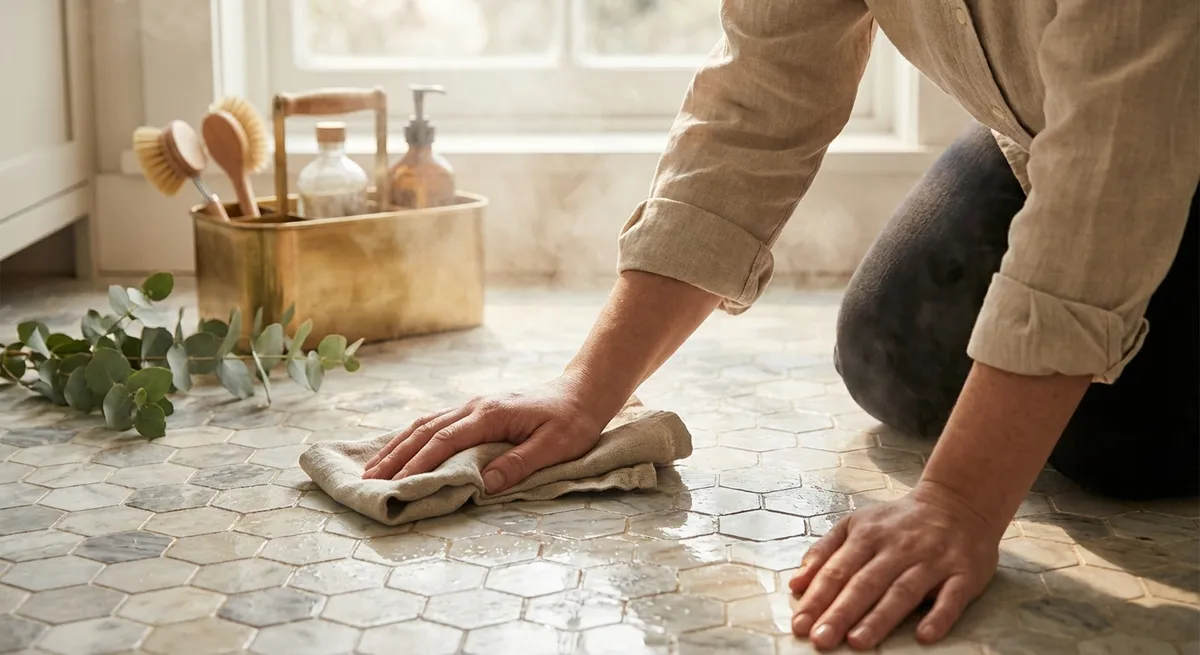
This guide distills maintenance into a series of thoughtful rituals, with five exclusive insights that discerning homeowners rarely hear from standard care sheets. The aim is not perfectionism, but a cultivated serenity—where grout lines stay crisp, finishes remain luminous, and every tiled surface feels deliberately preserved rather than merely “cleaned.”
Designing a Maintenance Ritual, Not a Cleaning Schedule
Most homeowners approach tile care reactively: spills, stains, and haze dictate when and how cleaning happens. A more elevated approach is to design a maintenance ritual that aligns with how each space is actually used, much like curating a wardrobe according to lifestyle rather than impulse.
Begin by mapping your home’s “tile zones” according to intensity of use: entry, kitchen, baths, laundry, terraces, and quiet rooms. Each zone deserves its own rhythm. High-traffic corridors may call for light dry maintenance several times a week (microfiber dusting, a quick sweep), while a guest bath may only require a weekly refresh. This zoning philosophy prevents over-cleaning—especially on natural stone—and reduces wear from unnecessary scrubbing or harsh agents.
Consider also the time of day. Early-morning or late-evening care feels less like housework and more like a resetting ritual: a quiet pass with a soft dust mop, a quick towel-dry of a shower floor, the polishing of a vanity splashback. This small shift, from “chores” to “rituals,” tends to produce better, more consistent care—because it becomes part of the home’s daily cadence, not a dreaded task backlog.
Insight 1: The 24-Hour Rule for Grout Longevity
The most overlooked determinant of a tile installation’s long-term elegance is not the tile itself, but the grout. Its crispness, color, and cleanliness are what separate a newly renovated space from one that feels subtly tired. A simple yet powerful principle for preserving grout is the “24-hour rule.”
Any spill with pigment (coffee, tea, red wine, turmeric, cosmetics, hair dye) or acidity (citrus, vinegar, tomato, certain cleaning products) should be rinsed from grout within 24 hours—ideally much sooner. While premium grout and sealers provide a safety margin, they are not invulnerable; many stains do not appear instantly but slowly migrate into the pores. By treating the 24-hour window as sacred, you dramatically reduce discoloration without resorting to aggressive later corrections.
Implement this rule discreetly: keep a small, elegant tray or caddy of neutral pH cleaner and soft cloths beneath the kitchen sink and in each main bath. When a spill occurs, it becomes a gentle, one-minute “reset,” not an emergency. Over the years, the payoff is significant: grout lines retain their original shade, transitions stay visually clean, and the entire installation remains coherent.
Insight 2: Precision Tools for “Invisible” Cleaning
Luxurious tile surfaces are best maintained with tools that never announce their presence. Scratched glazes, dulled stone, and frayed grout lines are usually the legacy of using the wrong implements rather than the wrong cleaners. For refined interiors, the quality and material of tools matter as much as the solutions in the bottles.
Invest in a set of dedicated, high-quality microfiber cloths (tightly woven, non-abrasive), a rubber-blade squeegee with a replaceable edge, and a soft-bristle brush specifically designed for grout—not a general-purpose scrub brush. Avoid colored scouring pads, metal scrapers, and stiff nylon brushes on delicate finishes; these can quickly compromise both tile and grout, especially on satin or honed surfaces.
In showers and wet rooms, a daily or every-other-use pass with a squeegee over walls and glass is one of the most “invisible” maintenance steps you can take: it prevents mineral buildup, reduces water spots, and shortens deep-cleaning sessions dramatically. On floors, a high-quality dry dust mop with electrostatic properties often suffices between wet cleans, minimizing the need for mops and buckets that can introduce excess moisture into grout. The goal is to leave no trace of the cleaning process—only the quiet, undisturbed beauty of the tile.
Insight 3: Calibrated Cleaners for Different Tile Personalities
Not all tiles respond gracefully to the same chemistry. Treating porcelain, ceramic, natural stone, and cement tile as if they were interchangeable is a subtle but common mistake, one that slowly erodes finishes and shortens the lifespan of sealers and grout. Elevated maintenance begins with an understanding that each material has its own “personality.”
Porcelain and high-quality ceramic tile are comparatively forgiving and often do best with a neutral pH, manufacturer-approved cleaner and warm water. Natural stone—especially marble, limestone, and travertine—demands greater discernment; acidic cleaners, even “natural” options like vinegar or lemon-based solutions, can etch the surface and dull the polish. Cement tiles and some encaustic designs are porous by nature and should only be cleaned with mild, neutral products to avoid both etching and color leaching.
Adopt a calibrated approach:
- Reserve neutral pH cleaners as your everyday standard.
- Use slightly alkaline, tile-safe solutions only when dealing with oils or heavy kitchen residues—and never on acid-sensitive stone.
- Keep specialized stone cleaners on hand where marble or limestone are featured, particularly in baths and entryways.
Before introducing any new product, conduct a discreet test in an inconspicuous area. Luxury is rarely loud; it is revealed in the surfaces that have not been damaged by well-meaning but unsuitable chemicals.
Insight 4: Moisture Management as a Design Detail
Moisture is tile’s ally during installation and its long-term adversary in use. Elegant bathrooms and wet rooms are rarely defined by their tile selection alone, but by how actively they manage moisture over time. When water is allowed to linger, it invites efflorescence (salty deposits), mold in grout joints and corners, and subtle degradation of sealers and setting materials.
Consider moisture management a design detail. Ensure that ventilation—both mechanical and natural—is sufficient for the scale and usage of the space. After showering, leave the door open, the fan running for at least 20–30 minutes, and, when feasible, a window slightly ajar. In high-end installations, homeowners often underestimate the benefits of disciplined air movement; it preserves both tile and adjacent finishes such as cabinetry and plaster.
On floors, particularly in entries and around exterior thresholds, use well-designed, low-profile mats that capture water without visually disrupting the tile field. Rotate and dry these periodically so that moisture is not trapped against the grout lines. In spa-like bathrooms, develop the simple habit of towel-drying stone benches, thresholds, and niche ledges after use. These tiny, almost ceremonial gestures cumulatively safeguard against discoloration and biofilm growth, allowing the space to stay as crisp as the day it was completed.
Insight 5: The Annual “Condition Report” for Tile and Grout
The most exclusive properties often employ conservators and facility managers who perform regular “condition reports” on historic finishes. There is no reason a private residence cannot adopt a scaled-down version of this practice for its tile installations. Once a year—preferably at the same time you review other home systems—conduct a calm, methodical inspection of all tiled areas.
Look not only for obvious cracks or chips, but for subtle cues: hairline grout fractures, faint discoloration near plumbing fixtures, inconsistent sheen on stone, or the beginnings of efflorescence along base edges. Gently press a few suspect grout joints with a fingernail; if they feel chalky or friable, note them. Observe intersections between planes—corners, curb transitions, niches, and thresholds—where movement and water often conspire.
From this, create a brief, prioritized list: areas to re-seal, joints that may need re-grouting or a flexible sealant, elements that warrant a professional assessment (particularly in showers and exterior terraces). Approaching tile care as an annual “review” rather than an emergency response prevents small issues from becoming invasive repairs. It also preserves the architectural coherence of the home: every tiled surface feels intentionally maintained, with no zones that betray neglect or deferred care.
Conclusion
Truly elevated tile interiors are not defined solely by the selections made during design and installation, but by the quality of attention they receive afterward. When maintenance becomes an artful aftercare—anchored in rituals, precision tools, calibrated chemistry, moisture management, and quiet annual reviews—tile ceases to be a background material and becomes an enduring architectural asset.
By embracing these five insights, homeowners move beyond generic cleaning advice into a realm of stewardship more commonly associated with galleries and grand hotels. The reward is subtle yet unmistakable: grout that remains sharp, finishes that age with dignity, and tiled spaces that feel as composed and luxurious in ten years as they did in the first week after installation.
Sources
- [U.S. General Services Administration – Historic Tile and Terra Cotta Maintenance](https://www.gsa.gov/technical-procedures/maintenance-of-ceramic-tile-and-terra-cotta) - Technical guidance on cleaning and preserving tile and terra cotta in significant buildings
- [Tile Council of North America (TCNA) – Care & Maintenance Guidelines](https://www.tcnatile.com/faqs/42-cleaning-and-maintenance.html) - Industry-recognized recommendations for proper tile and grout care
- [Natural Stone Institute – Stone Care & Maintenance](https://www.naturalstoneinstitute.org/consumers/cleaningandmaintenance/) - Authoritative advice on safe cleaning methods and sealing practices for natural stone surfaces
- [U.S. Environmental Protection Agency – Mold and Moisture Control](https://www.epa.gov/mold/mold-course-chapter-2) - Explains the relationship between moisture, mold, and building materials, including grout and tile assemblies
- [The Spruce – How to Clean Tile Floors the Right Way](https://www.thespruce.com/how-to-clean-tile-floors-1900404) - Practical overview of everyday tile floor cleaning, complementing more advanced maintenance strategies