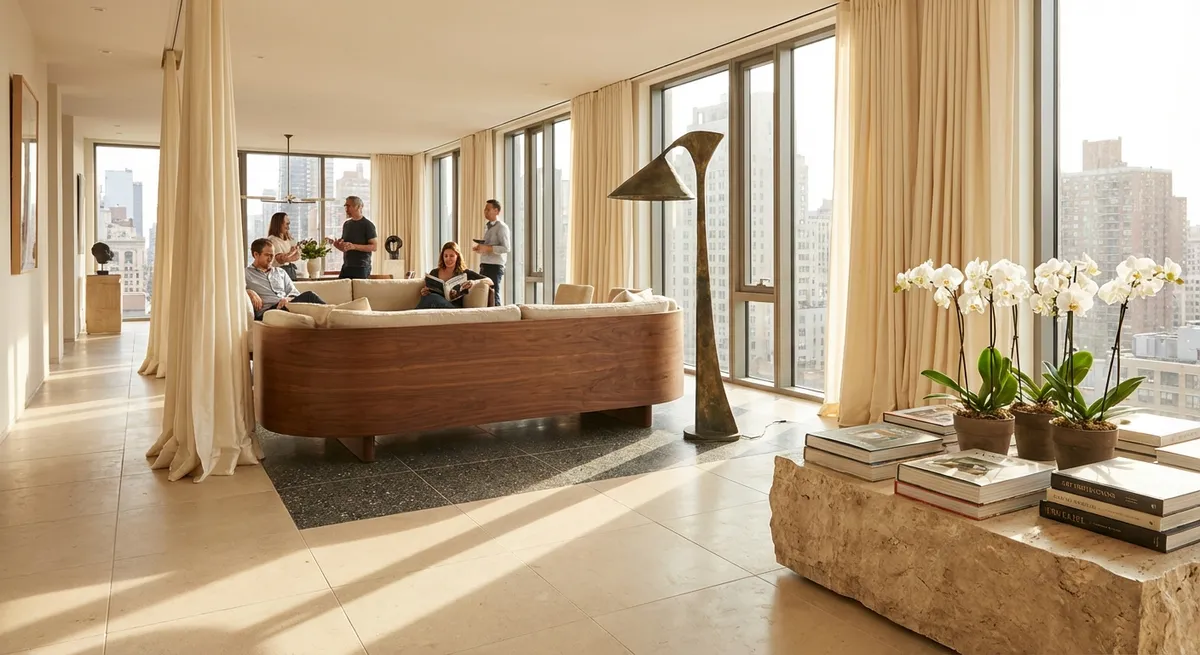
This guide explores refined tile design strategies for homeowners who value restraint over spectacle. Within it are five exclusive insights—subtle yet transformative—that differentiate a merely “nice” tile job from a composed, gallery-worthy interior.
Curated Color: Building a Palette Around Architectural Light
Color in tile is not chosen from a fan deck; it is discovered in the way your home receives light.
Begin by observing each space at three moments: morning, midday, and evening. North-facing rooms often flatly diffuse light, rewarding warmer tile tones—ivory, sand, oat, soft taupe—that restore dimension. South-facing rooms, with their intensity, can handle cooler greys, mineral blues, and graphite without feeling austere.
Use tile as the anchor of the palette, not the accent. Select a primary field tile first, then allow paint, textiles, and hardware to orbit its undertone. When the tile leans warm grey with a whisper of beige, select wall colors that share that warmth rather than competing cool tones. This continuity is what makes a room feel resolved.
For a sophisticated effect, limit the scheme to three tonal values:
- A light value that holds most of the surface (walls or floor)
- A mid-tone to ground the composition (often the floor or vanity front)
- A dark note used sparingly for contrast (niches, trims, or borders)
Treat bold color with discipline. Deep green or marine blue tiles are most successful when paired with generous neutrals and restrained pattern. This keeps the space collectible and enduring rather than loud and fatiguing.
The Art of Scale: Balancing Large Formats, Mosaics, and Negative Space
Refined tile design is, at its core, a study of scale.
Large-format tiles (24"x24", 24"x48", and beyond) lend a calm, architectural quality, especially on floors and shower walls. They reduce grout interruptions and visually expand the room. However, when every surface is large-format, the space can feel flat—like a rendered image rather than a lived environment.
Counterbalance expanses of large tile with strategic areas of small scale:
- A mosaic floor in a shower paired with large-format shower walls
- A slim mosaic border that quietly outlines a soaking tub platform
- A compact herringbone or chevron behind a vanity, framed by larger field tiles
Consider scale in relation to room dimensions. Oversized tiles in a narrow powder room should run along the longest wall or dimension to elongate the space. In square rooms, a balanced grid—centered and aligned to the architecture, not just the walls—prevents awkward slivers at corners.
Leave room for negative space. Not every surface needs a statement tile. A single feature plane—a shower wall, a backsplash, a fireplace column—can hold pattern or texture, while adjacent surfaces remain calmly tiled in a simpler field tile. The silence of the surrounding surfaces is what makes the focal surface feel intentional rather than busy.
Surface Tactility: Quiet Texture That Rewards Proximity
In elevated tile design, interest is not only seen from across the room—it is felt at arm’s length.
Rather than relying solely on bold patterns, explore subtle surface treatments:
- Matte vs. satin finishes: Matte tiles absorb light softly, ideal for serene baths; satin glazes introduce a gentle sheen that feels luxurious but not glossy.
- Structured tiles: Linear, ribbed, or softly fluted tiles add shadow play without aggressive patterning, especially effective on feature walls or vanity backsplashes.
- Honored imperfections: Hand-molded or zellige-style tiles, with their slight variation and wavering edges, bring a human, artisanal quality that suits both modern and classic homes.
Tactility should align with function. High-traffic floors benefit from honed or textured finishes for slip resistance and to gracefully mask micro-scratches. Wall surfaces near soaking tubs or vanities can tolerate smoother, more light-reactive finishes that glow under ambient or candlelight.
A compelling approach is to keep the color nearly identical across surfaces but vary the texture. Imagine a bathroom where the vanity wall is clad in a subtly fluted off-white tile, the shower in a flat matte version of the same tone, and the floor in a softly honed porcelain echoing that shade. The room reads as a single calm color story, but reveals rich nuance as you move through it.
Precision Patterns: Understated Layouts with Architectural Intent
Pattern in tile is not limited to the printed design on its surface; it is encoded in the layout itself. The most elevated rooms treat layout as quietly as a tailored seam on a bespoke suit.
Instead of defaulting to the most common patterns, consider refined configurations:
- Stacked vertical: Rectangular tiles installed in a strict vertical stack add height and modernity, especially behind vanities or on shower walls. When combined with a slim grout joint, the effect is monolithic and serene.
- Offset with restraint: A one-third offset on elongated tiles prevents the “bowing” effect that can appear with half-offset planks, while still introducing rhythm.
- Framed fields: In larger rooms, border tiles can subtly frame a central “carpet” of a different tile or pattern, recalling European stonework without feeling ornate.
- Window and door casings
- Niches and built-ins
- Vanity and countertop edges
- Tub outlines and shower thresholds
Grout alignment is critical. Before a single tile is set, map how grout lines will relate to:
A niche that is perfectly centered within a tile, with grout lines crisply aligned, will always feel more luxurious than one where tiles are arbitrarily cut around it. This is where design planning and installation precision converge into visible quality.
Grout color is your final design tool. Closely matching grout to the tile color creates a seamless, architectural surface. Choosing a slightly darker or lighter grout can outline the pattern subtly, ideal for herringbone or hexagonal layouts. Reserve high-contrast grout (like dark grout with white tile) for spaces where you truly intend the pattern to dominate.
Layered Zones: Designing Cohesive Tile Stories Across the Home
Exceptional tile design is rarely about one room in isolation; it is about a coherent story that threads through the home.
Begin by identifying the “tone-setting” space—often the kitchen or main bath. The tile choices here should establish the vocabulary: key materials (porcelain, stone, glass), a primary neutral, and one or two recurrent motifs (such as vertical stacking, hand-made texture, or gentle veining).
From there, craft refined variations:
- A powder room might reinterpret the kitchen’s neutral backsplash with a more dramatic format or bolder variation of the same hue.
- The primary bath could echo the kitchen’s stone-like porcelain on floors, then introduce a related but more textured tile for shower walls.
- A fireplace surround might use the same family of tile as the entry, but in a different scale or layout, reinforcing continuity.
Consider how transitions feel underfoot. Moving from wood to tile should feel deliberate: thresholds that align with doorways, tile patterns starting on center lines rather than at random cuts, and floor tiles that relate in tone to adjacent surfaces. This level of planning creates quiet luxury that most guests will not consciously identify, but will unmistakably sense.
For homeowners who entertain, think in terms of pathways of experience. The journey from entry to kitchen, from kitchen to powder room, from living area to terrace—all of these can be subtly choreographed with tile:
- A slightly more textured tile at exterior thresholds to handle moisture and grit
- A more luminous or patterned tile in powder rooms—small spaces where intensity is welcome
- Softer, more neutral tile treatments in main circulation areas to keep the home’s visual choreography calm and gracious
These layered decisions result in a home that feels both cohesive and richly detailed, with each tiled surface playing its part in a larger, curated composition.
Conclusion
Premium tile work is less about chasing the latest pattern and more about orchestrating light, proportion, and material with discipline. When you treat color as an architectural decision, scale as a tool for calm, texture as an intimate experience, pattern as quiet structure, and the entire home as a unified story, tile ceases to be a finish and becomes part of the home’s character.
For homeowners willing to think a layer deeper—beyond what is simply “beautiful” toward what is enduringly considered—tile can deliver spaces that feel collected, composed, and effortlessly refined for years to come.
Sources
- [Ceramic Tile Trends – Tile Council of North America (TCNA)](https://www.tcnatile.com/industry-issues/ceramic-tile-trends.html) - Overview of current tile material and design trends from an industry authority
- [Porcelain Tile Selection – The Tile Council of North America & Why Tile](https://whytile.com/why-tile/choosing-tile/porcelain-tile/) - Detailed guidance on choosing porcelain tile, including performance and design considerations
- [Slip Resistance and Surface Finishes – U.S. Access Board](https://www.access-board.gov/ada/guides/chapter-3-floor-and-ground-surfaces/) - Technical information on floor surface characteristics and slip resistance in building design
- [Kitchen and Bath Planning Guidelines – National Kitchen & Bath Association (NKBA)](https://nkba.org/info/kitchen-bath-planning-guidelines) - Professional space-planning standards that influence tile layout and surface decisions
- [Lighting and Color Perception – MIT OpenCourseWare](https://ocw.mit.edu/courses/4-211-evidence-based-design-fall-2012/resources/mit4_211f12_reading3/) - Educational resource on how light affects perception of surfaces and color in architectural spaces