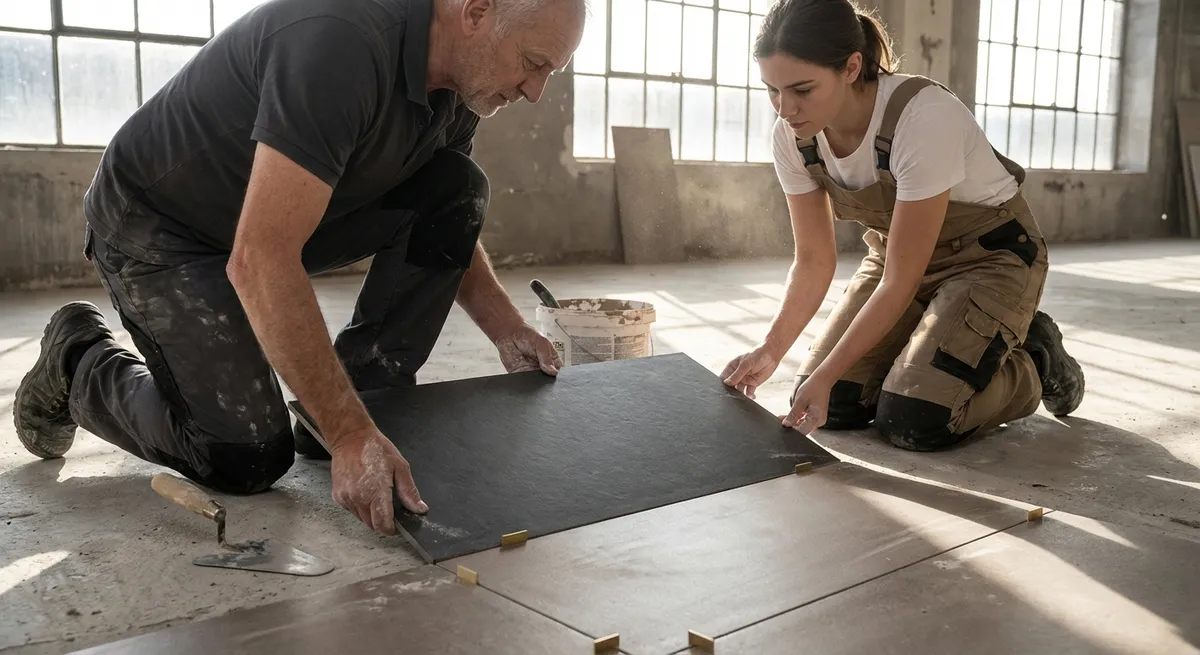
Below, we explore a more elevated approach to tile installation, including five exclusive insights that discerning homeowners can leverage to guide their contractors, refine their specifications, and ultimately achieve work that feels resolutely bespoke rather than simply “well done.”
Designing the Substructure: Where True Luxury Begins
Premium tile work begins beneath the visible surface. A flawlessly executed pattern can still disappoint if it rests on inconsistent substrates or weak subfloors. Large-format tiles, natural stone, and ultra-thin porcelain panels all place heightened demands on flatness and rigidity, and many projects fail before a single tile is laid simply because the underlayment was treated as an afterthought.
A properly prepared substrate is neither perfectly smooth nor completely rigid; it is appropriately flat, stable, and compatible with your chosen tile and setting materials. Cement backer boards, uncoupling membranes, and self-leveling compounds each have specific roles and limitations. For instance, large porcelain tiles may require tighter flatness tolerances than small mosaics, while stone installations often demand more robust support to prevent cracking from subtle deflection over time.
True refinement means asking targeted questions before work begins: How will the floor be flattened? Which underlayment system is being used and why? How will transitions to adjacent flooring be handled to avoid clumsy height differences? When these details are resolved upfront, every visible choice—pattern, grout width, tile finish—rests on a foundation that quietly supports excellence.
Grout as a Design Instrument, Not a Compromise
Grout is often treated as a functional necessity, something to “match” and move on from. Yet the most artful installations treat grout as an integral design medium—one that can either dissolve into the background or intentionally underscore the geometry of the tile.
Narrow joints can create a monolithic, seamless feel—but only when the tile caliber (size consistency) and substrate preparation are up to the task. Wider joints, when deliberate, can soften a rigid layout, introduce character, or create a quiet rhythm in spaces such as foyers or spa-like baths. The finish of the grout—sanded, unsanded, or epoxy—subtly affects light reflection, texture, and maintenance demands.
For sophisticated interiors, color selection becomes crucial. A near-perfect color match allows the tile itself to take center stage, while a tonal contrast (just one or two shades darker or lighter) can gently articulate patterns like herringbone, chevron, or Versailles without veering into high-contrast “graphic” territory. In wet areas, performance considerations such as stain resistance, color consistency, and mold resistance are as important as aesthetics. The most successful designs treat grout not as a concession to practicality, but as the thread that quietly stitches the entire composition together.
Precision Layouts: Planning Every Line of Sight
Exceptional tile work reveals itself most clearly in the layout—how joints align with architectural features, how cuts terminate at thresholds, and how patterns relate to a room’s primary viewpoints. A “centered” room, while a useful starting point, is not always the most visually satisfying solution. A premium installation prioritizes what the eye will see first and most often.
This may mean aligning grout lines with key elements such as shower niches, window reveals, and vanity edges, or deliberately centering a feature tile panel on a primary wall rather than the room’s footprint. In hallways and long rooms, a layout that follows the dominant axis of the space can feel more composed than one that merely echoes the shape of the floor.
Thoughtful planning also mitigates awkward slivers—those narrow strips of tile at edges that immediately give away rushed or generic layout decisions. For example, adjusting the starting line by just a few centimeters can transform an entire shower from visually busy to serenely composed. Elegant installations always leave the homeowner feeling that the space was custom-drawn around the architecture, not that pre-boxed tile was simply placed inside it.
Five Exclusive Insights for Homeowners Pursuing Exemplary Tile Work
Discerning homeowners often sense when tile work is “off,” even if they cannot pinpoint why. These five insights provide language and concepts to help you collaborate more effectively with your installer—and to secure outcomes worthy of your investment.
Specify Lippage Tolerances in Advance
Lippage—where one tile edge sits higher than its neighbor—can subtly undermine the perceived quality of even expensive materials. Rather than accepting “within standards” as a sufficient answer, request a discussion of lippage tolerances before work starts. Ask whether tile leveling systems will be used, especially with large-format tiles. While zero lippage is rarely achievable, a stricter-than-minimum threshold for key areas (kitchen, main bath, entry) signals a project where flatness and comfort underfoot truly matter.
Insist on a Mockup for Complex Patterns and Grout Colors
Flat samples and online visuals are only approximations. For intricate layouts, textured tiles, or nuanced grout pairings, ask for a small, on-site mockup before full installation proceeds. This can be as simple as a single square meter of tile with your intended grout color. In premium spaces—a shower feature wall, a fireplace, a main entry—this step can prevent costly disappointments and gives you the confidence to approve the design not in theory, but in reality.
Evaluate Edge Profiles as a Deliberate Design Decision
Visible tile edges—at niches, corners, steps, and terminations—are critical moments where installations often look “builder-grade.” Discuss edge strategies explicitly: mitered corners for a sculpted, monolithic effect; metal trims in brushed finishes that echo door hardware; or bullnose tiles for a more traditional, softened profile. Overlooking this single detail can downgrade an otherwise exquisite tile selection; addressing it with intention can make the installation feel fully bespoke.
Match Setting Materials to the Tile’s Performance Demands
Not all adhesives, mortars, and waterproofing systems are interchangeable. Porcelain tiles, large-format panels, natural stone, and glass each have specific requirements for adhesion, flexibility, and moisture management. Ask which system is being used (including the brand and product line) and why it suits your tile choice and substrate. In wet zones and heated floors, ensure the system is fully compatible and rated for those conditions. The most elegant surfaces are those that remain dimensionally stable and visually consistent year after year.
Design for the Way Light Moves Across the Surface
Tiles do not exist in isolation; they are constantly interpreted by changing light. Directional textures, glossy finishes, and large uninterrupted expanses behave differently under morning light, artificial downlights, and evening shadows. Request that your tile layout and orientation consider primary light sources. A vertically oriented tile may accentuate height in a shower but also exaggerate minor lippage when struck by a strong side light. A matte finish may better flatter uneven walls in older properties. This level of consideration distinguishes installations that merely look good in photographs from those that feel quietly flawless at all hours.
Elevated Tile for the Daily Ritual
Tile is one of the few design elements you will encounter every day: under bare feet, in the rhythm of your morning shower, in the quiet echo of footsteps across an entry hall. When installation is treated as a technicality, even high-end materials can feel ordinary. But when the substrate, layout, grout, and edges are all composed with care, tile becomes more than a finish—it becomes an enduring framework for how you live in your home.
Approach your next project as a collaboration between design intention and technical mastery. Ask informed questions, invite mockups, and give your installer the opportunity to showcase their craft at a higher level. The result is not simply a “new bathroom” or “updated kitchen,” but a suite of surfaces that feel resolved, intelligent, and quietly luxurious long after the dust sheets are gone.
Sources
- Tile Council of North America (TCNA) Handbook - Industry reference for tile installation standards, methods, and best practices.
- American National Standards Institute (ANSI) A108/A118/A136.1 - Technical standards for tile installation materials and methods used by professionals.
- Schluter Systems – Tile Installation Systems - Manufacturer guidance on underlayments, waterproofing, and edge profiles relevant to premium installations.
- Laticrete Technical Data Sheets - Detailed product information on mortars, grouts, and setting materials for various tile types and conditions.
- International Association of Certified Home Inspectors – Tile Installation - Overview of common tile installation issues and inspection considerations for long-term performance.