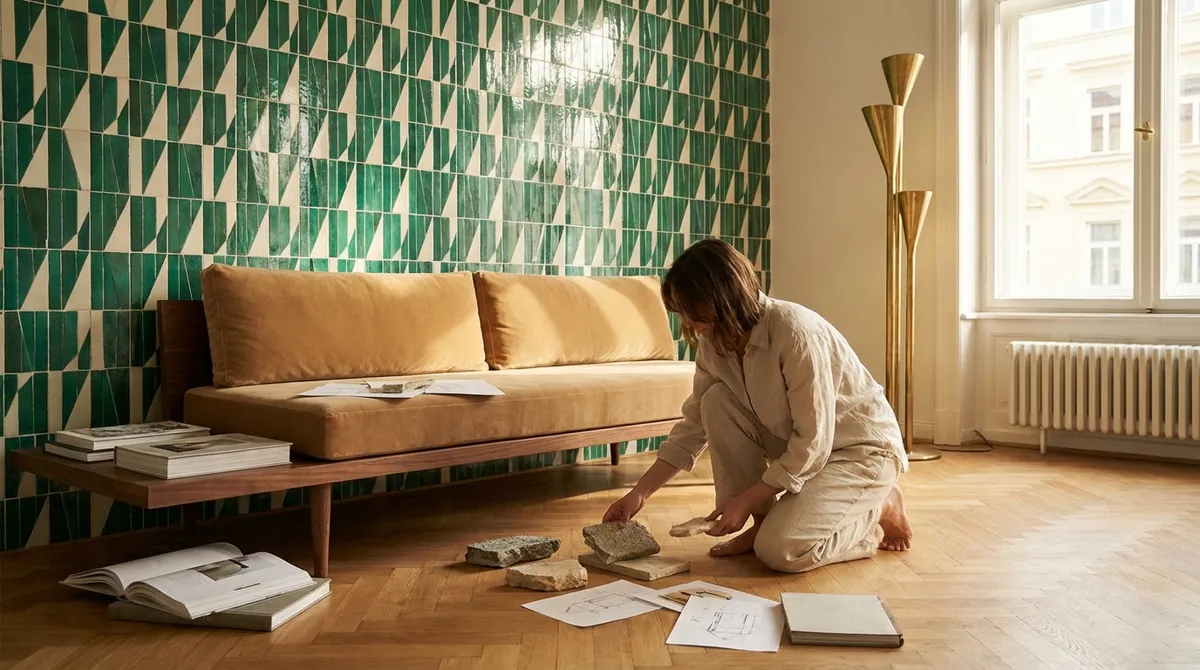
Below, we explore how to think like a curator, not a consumer—plus five exclusive insights that discerning homeowners can use to orchestrate truly exceptional tiled rooms.
Designing from the Ground (or Wall) Up
Sophisticated tile design begins with a simple shift: treat tile as a primary design decision, not an afterthought. Before you choose paint, hardware, or even cabinetry finishes, define the role your tile will play in the space. Is it the quiet foundation, the focal artwork, or the connective tissue between rooms?
By deciding early whether your tile should recede or command attention, you can align every other material choice accordingly. Subtle stone-look porcelain, for instance, becomes a serene base for bolder millwork and fixtures, while a dramatic veined slab or patterned mosaic requires a supporting cast of quieter surfaces. This hierarchy keeps the room from feeling cluttered and helps each element read as intentional rather than accidental.
Think in terms of zones: wet areas, circulation paths, feature walls, and quiet backgrounds. Each deserves its own tile strategy, but all should feel like variations within a single, well-composed story.
The Art of Restraint: Palette, Proportion, and Pattern
In high-end interiors, excess variety rarely reads as luxury; restraint does. Tile is particularly sensitive to this principle because it introduces both texture and grout lines, which quickly add visual information. The result can be either beautifully rhythmic or visually noisy.
A sophisticated tile palette typically limits itself to two, occasionally three, tile “voices” within a single continuous space:
- One foundational field tile (often matte, finely textured, or subtly veined)
- One accent or feature tile (pattern, gloss, or sculptural relief)
- One transition or trim solution (bullnose, metal profile, or stone threshold)
Within that framework, proportion matters as much as color. Large-format tiles reduce grout lines and create a calm surface—ideal for floors or expansive shower walls—while smaller formats are best reserved for areas that benefit from texture and grip, such as shower floors or niche details. Pattern should be used with similar discipline: a herringbone or chevron floor is striking, but it should not compete with a bold veined stone slab and intricate shower mosaic in the same visual field.
The most refined rooms speak in a limited but deeply considered vocabulary of surfaces. The key is not how many tiles you love, but how few you truly need.
Light, Reflection, and the Quiet Drama of Surface
Elevated tile design is as much about light as it is about pattern. The way tile interacts with both natural and artificial light can shift the mood of a room from utilitarian to cinematic.
Gloss and matte should be chosen strategically, not by default. High-gloss wall tiles can reflect light beautifully in a compact powder room or along a backsplash, producing subtle shimmer rather than aggressive shine when balanced with matte counters and cabinetry. In contrast, large glossy floors can create glare and reveal every footprint; matte or honed finishes usually read as more architectural and forgiving underfoot.
Attention to directionality also matters. Linear grains or directional patterns should be oriented to guide the eye: lengthwise down a hallway, vertically to heighten a low ceiling, or horizontally to visually widen a narrow bath. Even a simple rectified porcelain tile can feel unexpectedly elevated when its alignment acknowledges the architecture of the space.
Layered lighting seals the effect. Washing a tiled wall with a soft wall grazer, pairing under-cabinet lighting with a subtle textured backsplash, or spotlighting a sculptural tile panel can transform neutral surfaces into quiet focal points.
Five Exclusive Insights for the Tile-Conscious Homeowner
For homeowners who are serious about exceptional tile work, these five insights move beyond generic advice and into the realm of truly cultivated decision-making:
- Specify grout as a design element, not a default.
Ask to see grout samples against your tile in both natural and artificial light. A tone-on-tone grout blurs lines for a more monolithic surface, while a slightly contrasting grout can articulate pattern and layout like a finely drawn line. For large-format luxury looks, matching grout closely to the tile elevates the finish; for classic layouts like subway tile, a subtle contrast can celebrate the geometry without veering into harsh gridlines.
- Use transitions to signal quality.
Elegant edging is one of the clearest tells of a premium installation. Instead of raw tile edges or mismatched trim, consider stone or solid-surface thresholds between flooring types, slim metal profiles in finishes that echo your hardware, and purpose-made bullnose or pencil trim at outside corners. These details prevent “visual fraying” at edges and corners and immediately telegraph a higher level of craftsmanship.
- Treat layout drawings like a tailored garment fitting.
Before a single tile is set, request a scaled layout or dry-fit plan for key views: the main wall you see when entering the bathroom, the shower niche alignment, or the kitchen backsplash across the cooktop. Discuss where full tiles will “land” and where cuts will occur. A half-tile at eye level or a sliver at a doorway is the design equivalent of an ill-fitting seam on a bespoke suit—avoid it by planning the grid around focal points.
- Consider tactile experience, not just appearance.
Under bare feet, a finely textured porcelain, honed stone, or matte encaustic tile feels markedly different from a slick glazed surface. In showers and spa-like baths, prioritize tiles with appropriate slip resistance while still caring about handfeel where you might touch walls or seating. In kitchens, slightly textured backsplash tiles can disguise water spots while still wiping clean. True luxury is felt as much as it is seen.
- Design for patina and time, not just the first photograph.
Ask how your chosen material will age. Will a natural stone develop a soft patina that complements your aesthetic, or do you expect near-clinical perfection over decades? If you favor immaculate surfaces, select high-performance porcelain that mimics stone without its sensitivity. If you enjoy subtle aging, embrace materials and sealers that allow for gentle character rather than staining. Matching your maintenance expectations to your material choice is one of the most sophisticated decisions you can make.
Harmonizing Rooms Through Continuity and Contrast
A refined home rarely treats each room as an isolated vignette; instead, tile becomes a narrative thread. Continuity does not mean repetition of the exact same tile everywhere, but rather a deliberate use of related tones, finishes, or formats.
You might echo the soft grey veining of a foyer floor tile with a quieter, smaller-scale version in a powder room, or repeat a particular warm beige undertone from a kitchen backsplash in the primary bath floor. Using consistent grout tones across adjacent spaces can also tie them together subtly, even when the tile changes.
At the same time, strategic contrast keeps the home from feeling monotonous. Restrict bold moves to specific “moments”: a tiled fireplace surround that reads like sculpture, a niche backed in a specialty mosaic, or a single feature wall in a shower executed in a more dramatic stone-look slab. These accents should feel like deliberate statements against a background of calm, not like unrelated experiments.
Thoughtful continuity and contrast ensure that as you move from room to room, the tile story feels composed, not coincidental.
Conclusion
Exceptional tile work doesn’t shout; it whispers in alignment, in the way grout fades into the background, in the confidence of a restrained palette and properly scaled formats. When treated as the architectural canvas rather than mere decoration, tile has the power to anchor a home’s aesthetic and elevate everyday rituals.
For the homeowner willing to engage with the finer points—light, layout, touch, and time—tile becomes an instrument of quiet sophistication. Every surface, every edge, every joint is an opportunity to express discernment. Design the room around your tile with this level of intention, and the result is not just a finished space—it is a cultivated environment that feels complete the moment you step inside.
Sources
- Tile Council of North America (TCNA) Handbook - Authoritative industry guidance on tile installation standards, formats, and best practices
- Ceramic Tile Distributors Association – Design & Trends - Industry insights into current tile design directions, finishes, and applications
- Porcelanosa – Tile Collections and Technical Data - Example of high-end tile options, formats, and surface technologies used in luxury interiors
- U.S. Environmental Protection Agency – Indoor Air Quality and Building Materials - Context on material choices, finishes, and their implications for healthy, long-lasting interiors
- University of Minnesota – Lighting and Interior Design Principles - Explanation of how light interacts with surfaces, informing decisions about gloss, texture, and tile placement