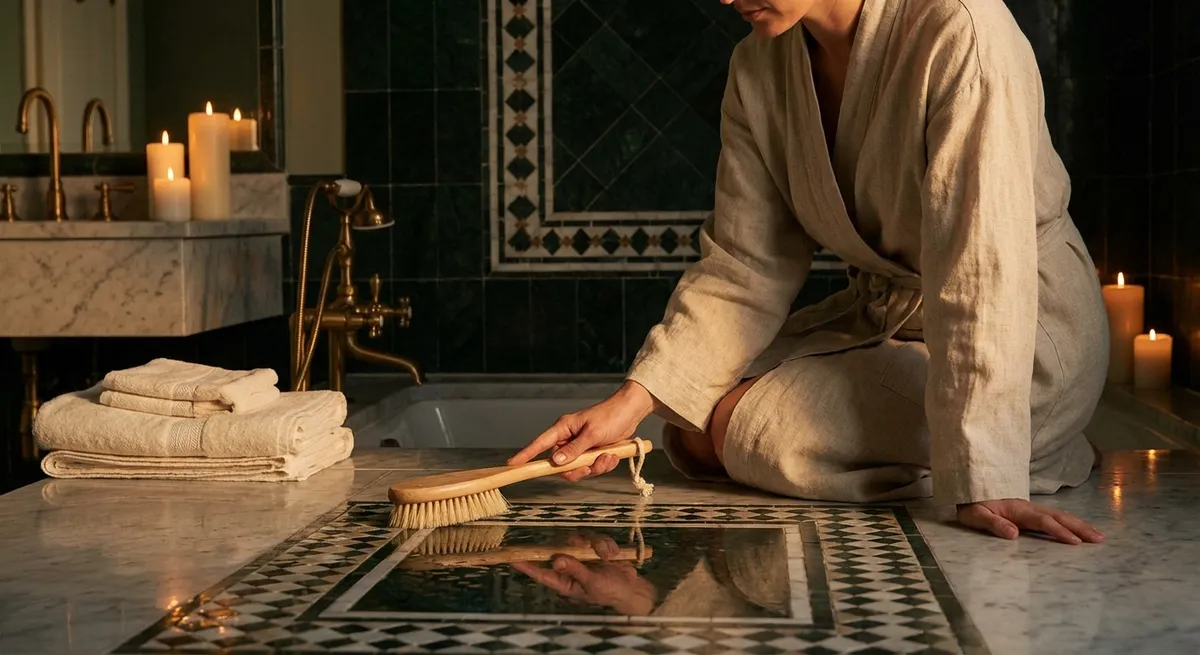
Below are five exclusive, detail-driven maintenance insights that sophisticated homeowners and design-conscious renovators can use to preserve not just the life of their tile, but its presence.
1. Treat Grout as an Architectural Line, Not a Gap
Most homeowners think in terms of tile, yet it is the grout that visually organizes the surface. When grout breaks down—staining, cracking, or crumbling—the entire installation looks tired, regardless of how pristine the tile remains.
Begin with a mindset shift: every grout joint is a deliberate line in your architecture, not a disposable filler. Clean it accordingly. Replace generic “grout cleaners” with a pH-neutral cleaner for routine care, reserving specialized grout treatments only for deeply embedded discoloration. Wipe spills immediately from grout, particularly those rich in pigments or acids—red wine, coffee, turmeric, and citrus are notorious offenders.
For showers and wet rooms, consider a quarterly inspection under bright, directional light. Look for subtle shading changes, hairline cracks, or darkening at corners; these often precede more serious issues. When you do reseal grout, work methodically in narrow sections, wiping away excess from the tile face with a microfiber cloth to avoid the cloudy halos that betray rushed work. Think of grout sealing as you would a bespoke suit fitting: quiet, precise, and never hurried.
2. Elevate Daily Cleaning into a Low-Impact Ritual
Truly premium tile maintenance is defined by what you don’t do as much as what you do. Over-cleaning with aggressive products is one of the most common ways luxury surfaces are prematurely aged.
Establish a restrained daily or weekly routine built around three principles: lift, don’t scour; neutralize, don’t strip; and dry, don’t air-surrender. Use a soft microfiber dust mop or vacuum with a hard-floor attachment to lift grit before it can act as a fine abrasive. Follow with a pH-neutral cleaner diluted precisely according to manufacturer instructions; with quality cleaners, more concentrate does not mean “more clean,” it simply leaves residue.
For high-gloss porcelain or polished stone, choose a mop with a low-profile head and minimal water. Excess moisture seeps into vulnerable joints and can dull certain natural stones over time. The final, often overlooked step: drying. A quick pass with a dry microfiber pad on high-traffic or visually prominent areas prevents spotting and streaking, yielding that quiet, uninterrupted sheen associated with professionally maintained spaces.
3. Align Protection with Lifestyle, Not Just Material
Most guidance divides maintenance strictly by tile category: porcelain, ceramic, marble, limestone, and so on. A more refined approach goes a step further and aligns protection with how a space is used, not just what it is made of.
A polished marble foyer that hosts frequent evening gatherings demands a different strategy than a seldom-used guest bath, even if they share the same stone. In high-traffic entertaining zones, combine high-quality sealers with strategic furnishings. Discreetly placed area rugs, slim-profile runners, and felt pads under furniture feet create a protective ecosystem that supports the tile rather than conceals it. Choose rugs with breathable backings to avoid trapped moisture and ghost outlines.
In kitchens, assume constant micro-spill exposure. Position cutting boards and prep zones away from vulnerable stone splashbacks where possible. If you have natural stone countertops adjacent to tile walls, rigorously protect the junction line where oils, sauces, and steam tend to accumulate. In wet rooms, particularly with matte or textured tile, think in terms of airflow as a maintenance tool: a properly sized and regularly used exhaust fan, coupled with leaving shower doors partially open, dramatically reduces the moisture burden that encourages soap film and mildew.
4. Respect the Finish: Honed, Polished, and Textured Require Different Minds
An elevated tile installation is not just defined by material choice, but by the finish—honed, polished, tumbled, flamed, textured, or lappato. Each finish reflects and absorbs light differently, and each has its own maintenance temperament.
Polished stone and high-gloss porcelain reward subtlety. Avoid abrasive powders, stiff brushes, and untested “shine enhancers,” which can strip factory finishes or create uneven gloss. Instead, focus on maintaining clarity: pH-neutral cleaners, soft pads, and prompt removal of hard-water spots around fixtures. For homeowners in areas with mineral-rich water, a high-quality water softener or point-of-use filtration system is often a better long-term investment than a cabinet full of specialty descalers.
Honed and matte finishes, while often more forgiving visually, can be deceptive. Their ability to disguise fine etching or film build-up encourages neglect. Periodically test the surface by wiping a small area with a slightly stronger—but still appropriate—cleaner and a white cloth. If the cloth shows a subtle gray or off-white residue, you’re removing invisible build-up and restoring the intended depth of the finish.
Textured and slip-resistant tiles, especially outdoors or in spa-like interiors, demand mechanical assistance rather than chemical escalation. Soft-bristled scrub brushes and low-speed scrubbers can reach into micro-textures without damaging them. Choose targeted cleaners designed specifically for textured porcelain or stone, and always rinse thoroughly to avoid leaving surfactant films in the recesses.
5. Adopt a Seasonal Inspection Mindset, Not a Reactive One
Luxury tile installations age most gracefully when homeowners approach maintenance as a seasonal review rather than a series of emergency responses. Twice a year—often aligned with wardrobe changes or major cleaning periods—perform a deliberate, room-by-room tile inspection.
Start with the floor plane. Walk barefoot over tiled areas and pay attention to subtle transitions: a single “hollow” sound underfoot can signal a tile beginning to debond, particularly in large-format installations. Inspect perimeter joints and movement joints; any cracking, gaps, or hardening sealant there can quickly translate into more serious issues, especially near wet areas or exterior thresholds.
Next, scrutinize vertical surfaces. Around showers, tubs, and kitchen splashbacks, look for tiny shifts: a hairline crack where wall tile meets countertop, slight darkening of grout near niches, or faint “ghost” outlines of past moisture exposure. These early clues allow for precise, minimally invasive interventions rather than disruptive repairs.
Finally, reevaluate your existing protection strategy: Do high-traffic tiles still bead water and resist staining the way they did after sealing? Have new furnishings altered traffic patterns or introduced new risk points (a bar cart over stone, a plant stand over heated floors)? Treat your tile not as a static installation, but as an integral part of a living environment that evolves with your habits and furnishings.
Conclusion
Refined tile maintenance is not a battle against stains and scratches; it is a quiet partnership with the materials underfoot and around you. When grout is treated as an architectural element, daily cleaning becomes a low-impact ritual, protection is aligned with lifestyle, finishes are respected on their own terms, and seasonal inspections replace emergencies, tile surfaces do more than “hold up”—they mature.
In homes where every detail is considered, the most luxurious surfaces are those that seem to require no effort at all. In reality, they are the result of nuanced, intelligent care—small, consistent decisions that allow tile to retain its composure and quiet authority for decades.
Sources
- Natural Stone Institute – Caring For Natural Stone – Guidance on proper maintenance, sealing, and cleaning of natural stone surfaces
- Tile Council of North America (TCNA) – Tile Care & Maintenance – Authoritative recommendations for cleaning and maintaining ceramic and porcelain tile
- U.S. Environmental Protection Agency – Safer Choice Products – Database of safer cleaning products, useful for selecting low-impact tile cleaners
- MAPEI – Grout and Sealant Technical Resources – Technical documents on grout, sealers, and joint performance in tile installations
- Schlüter-Systems – Movement Joints and Moisture Management – Technical information on movement joints, waterproofing, and long-term performance of tiled assemblies