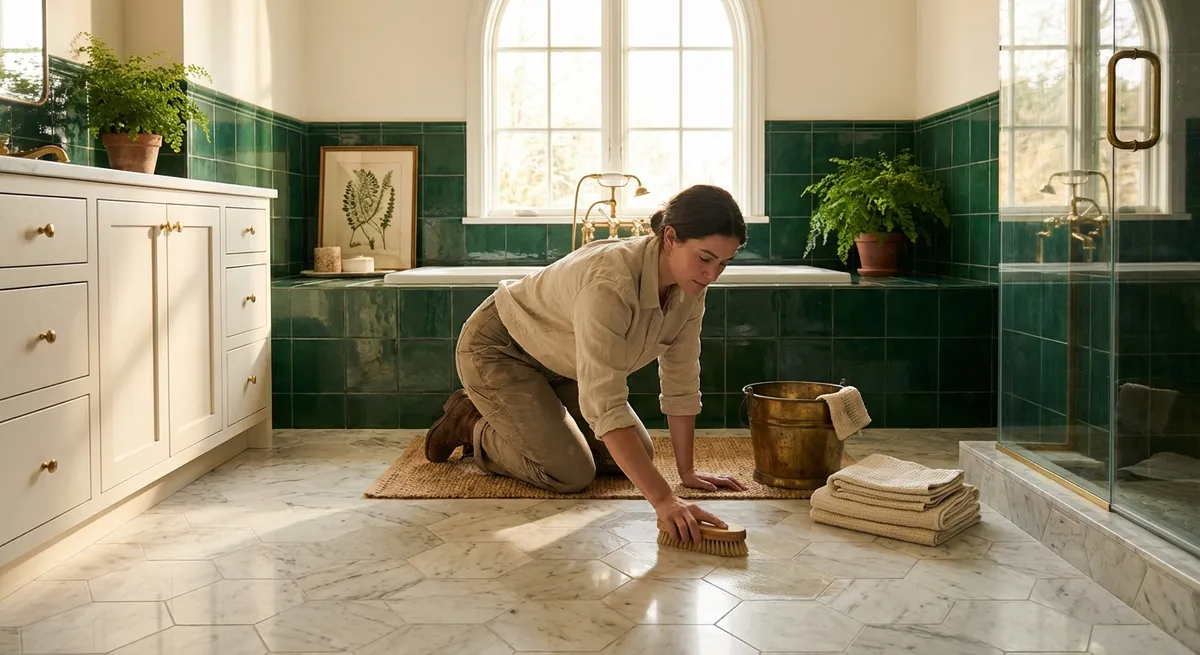
Maintenance as Preservation, Not Cleanup
Sophisticated tile care begins with a change of mindset: you are not “cleaning” tile; you are preserving a surface architecture you have already invested in. That distinction changes everything—frequency, technique, and even the products you choose.
Instead of waiting for visible soiling, you establish gentle, low-impact routines that prevent build-up from ever marring the surface. A once-weekly, pH-neutral damp mop on floors and a soft microfiber wipe on walls preempt dulling films of dust, skin oils, and airborne pollutants. This minimal but consistent approach is easier on grout, avoids the overuse of harsh chemicals, and keeps high-sheen finishes from developing fine haze. Over time, the tile reads as consistently new—not because it is constantly scrubbed, but because it is rarely allowed to tip into “dirty” territory in the first place.
By committing to preservation rather than reactionary cleaning, you reduce the need for aggressive interventions that can etch natural stone, degrade sealers, or prematurely wear grout lines. Think of each light maintenance touch as an investment in the tile’s long‑range appearance, not a chore performed under duress.
The Microclimate Strategy: Tailoring Care Room by Room
Refined maintenance acknowledges that tile lives in different “microclimates” throughout the home. A marble mosaic in a lightly used powder room will age very differently from large-format porcelain in a busy kitchen, or a honed limestone in a steam shower. Applying a single generic cleaning rule to all of them is a fast way to degrade performance and finish.
Begin by mapping your home’s tiled areas not by location, but by exposure: moisture, heat, UV light, oils, and abrasives. A south-facing kitchen floor that receives strong afternoon sun may need more frequent dust-mopping to keep micro-grit from acting like sandpaper underfoot, especially on glossy glazes. A shower niche that regularly hosts high-end skincare products may be quietly accumulating oil residues and surfactants that stain grout and alter stone over time.
From this mapping exercise, you create bespoke micro-routines. In a steam shower, you might squeegee walls and glass after each use and leave the door ajar to lower humidity, reducing mineral deposits and mildew pressure on grout and caulk. In a cooking-intensive kitchen, you may wipe the backsplash with a warm, pH-neutral solution after evening cleanup, paying particular attention to the gas range zone where vaporized oils collect. Each space receives care calibrated to its actual risks, ensuring tile maintains its intended character in context, not in theory.
The Invisible Shield: Elegant Use of Sealers and Barriers
Discerning homeowners understand that the most effective tile maintenance is often invisible. Sealers, barrier mats, and carefully chosen textiles act as a refined undercurrent of protection, preserving the purity of the tile’s visual statement without announcing themselves.
For porous materials—natural stone, cement tile, certain unglazed ceramics—a high-quality impregnating sealer is non-negotiable. Applied correctly, it penetrates below the surface, reducing absorption without leaving the plasticky sheen associated with lower-tier products. The aim is to preserve the tile’s authentic texture and color while providing a critical buffer against oils, wine, cosmetics, and mineral-rich water. Resealing schedules should be guided not by arbitrary timelines, but by simple, discreet absorption tests: a few drops of water should bead rather than immediately darken the tile or grout.
Beyond sealers, strategically placed walk-off mats at entries and runners in heavy traffic zones can dramatically reduce micro-scratching from grit. Choose low-profile, high-quality textiles in a restrained palette that complement your overall scheme rather than competing with it. Under dining tables, a flat-woven rug can catch chair-slide friction and minor spills, safeguarding the tile pattern beneath. These interventions work quietly in the background, allowing the tile to remain the visual protagonist while the real wear happens one layer above.
Precision in Products: Curating a Minimal, High-Performance Kit
Premium installations deserve a curated maintenance kit rather than a clutter of generic cleaners. The goal is a tightly edited selection of products, each chosen for compatibility with your specific tile and grout, and each used with intention rather than habit.
A pH-neutral, manufacturer-approved tile cleaner forms the core of this kit. It should be free of acid, bleach, and abrasive particles, and ideally formulated to leave no sticky residue that can attract more soil. For natural stone, avoid vinegar, lemon-based cleaners, and “all-purpose” sprays that tout heavy-duty descaling; while they may brighten ceramic, they can etch marble, limestone, or travertine in a single pass. A separate, stone-specific cleaner is often essential in mixed-material spaces like bathrooms, where ceramic floor tile and marble vanity tops coexist.
Augment this core with a few specialized tools: non-scratch white pads for occasional targeted agitation, a premium squeegee for glazed shower walls and glass, and tightly woven microfiber cloths for buffing without lint. For grout, keep an oxygen-based cleaner on hand rather than chlorine bleach, which can weaken grout over time and adversely affect nearby metal fixtures or natural stone. This small but thoughtful kit allows you to address almost any issue with confidence, avoiding improvisation with whatever’s under the sink.
Reading the Surface: Developing a Conservator’s Eye
Perhaps the most exclusive insight—and the one most often overlooked—is the practice of observing your tile as a conservator would. Instead of glancing over an entire floor or wall, you periodically study smaller sections in good light, training your eye to catch subtle shifts before they become problems.
Look for microcracks in grout lines near structural transitions (doorways, thresholds, shower corners), which may hint at movement that needs a flexible joint or professional evaluation. Watch for early signs of efflorescence—whitish, powdery deposits on grout or porous tiles—which may suggest moisture migration that calls for improved ventilation or waterproofing inspection. On polished stone or glossy porcelain, notice any areas that seem slightly duller or more scratched; these can guide you in adjusting furniture pads, housekeeping tools, or even footwear policies.
In wet zones, monitor caulked joints for the faintest sign of pulling away or pinhole gaps, particularly around tubs, shower pans, and niches. Early intervention with professional-grade caulking preserves the integrity of the waterproofing system behind the tile and prevents dark staining or mold bloom at the surface. By cultivating this attentive, almost curatorial way of seeing, you transform maintenance from periodic crisis response into a quiet practice of ongoing refinement—one that ensures your tile ages gracefully, with character but not neglect.
Conclusion
Enduring tile elegance is rarely the result of a single heroic effort. It is composed of small, precise choices repeated over time: a preservation mindset, respect for each room’s microclimate, invisible layers of protection, a disciplined product palette, and a conservator’s eye for nuance. When these practices converge, your tiled surfaces do more than survive the demands of daily life—they mature into a quietly confident backdrop for everything that happens in your home. In that space between vigilance and ease, tile ceases to be a maintenance concern and becomes what it was always meant to be: a permanent expression of your standards.
Sources
- Marble Institute of America (Natural Stone Institute) – Care & Cleaning - Authoritative guidance on appropriate cleaners, sealing, and routine maintenance for natural stone installations.
- Tile Council of North America (TCNA) – Maintenance Guidelines - Industry standards and best practices for cleaning and maintaining ceramic and porcelain tile surfaces.
- U.S. General Services Administration – Historic Tile & Terra Cotta Maintenance - Technical conservation insights on preserving tile and terra cotta, relevant to a conservator-level approach at home.
- Centers for Disease Control and Prevention – Mold Prevention Strategies - Guidance on moisture management and ventilation that supports healthy, mold-resistant grout and caulk in wet areas.
- University of California, Berkeley – Household Chemicals and Surface Damage - Information on how certain common cleaners and chemicals can damage finished surfaces, including stone and tile.