Below are five exclusive, detail‑driven insights designed for homeowners who expect their tile to age not just gracefully, but beautifully.
1. Treat Grout as a Design Material, Not a Cleaning Afterthought
Grout lines are the visual scaffolding of any tiled surface, yet they are often treated as a byproduct rather than a design element with its own maintenance language.
Premium maintenance starts with understanding your grout type. Cementitious grout, for instance, is porous and benefits greatly from a penetrating sealer; epoxy grout, by contrast, is more stain‑resistant and demands different care. Using a harsh, high‑alkaline cleaner on sealed cementitious grout can prematurely strip sealer, leaving lines vulnerable to staining that visually ages the entire surface.
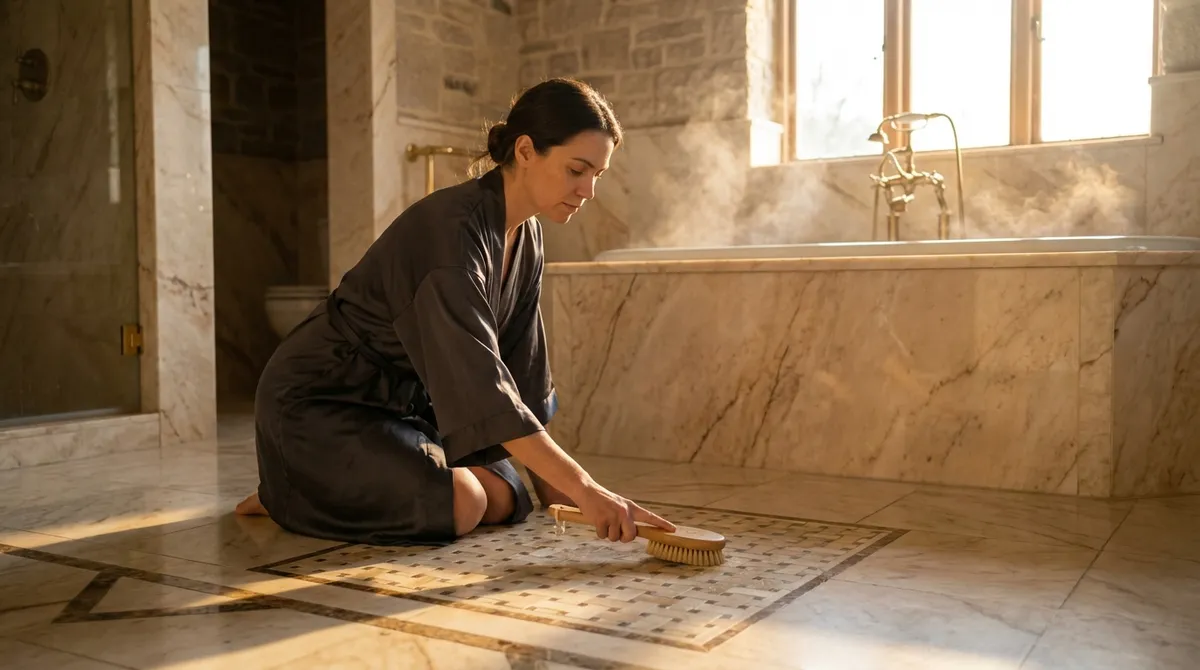
Adopt a two-tier approach: a pH‑neutral cleaner for regular upkeep, and a carefully selected, grout-safe restorative cleaner no more than a few times per year for deeper refreshes. When you do clean, work in the direction of the grout joints, not across them, to avoid forcing soiling deeper into pores. A soft-bristled brush with carefully modulated pressure will lift residues without fraying the grout surface, which can otherwise make lines appear rough and prematurely “tired.”
Finally, schedule grout inspections with the same intent you’d bring to an annual wardrobe edit: once a year, examine for micro-cracking, dull patches, or areas where water lingers instead of beading. Addressing these slight imperfections early preserves the crisp linearity that makes a tiled surface look meticulously composed.
2. Design a “Tile-Friendly” Cleaning Wardrobe, Not a Random Product Shelf
Exceptional tile maintenance begins in the cleaning closet, not at the floor. Curating a dedicated, tile-specific set of tools and products avoids the slow, cumulative damage caused by using whatever happens to be on hand.
At minimum, a considered tile “wardrobe” includes:
- A premium pH‑neutral cleaner formulated explicitly for stone or tile
- A soft microfiber mop or cloth system reserved exclusively for hard surfaces
- Separate color-coded cloths for kitchens and baths to avoid cross-contamination
- A non-abrasive scrubbing pad for localized buildup
- A squeegee for glass and high-gloss or polished wall tile in wet areas
Avoid improvising with vinegar, lemon, or generic multi-surface degreasers; what feels “natural” or “strong” can be chemically hostile to natural stone, polished porcelain, or cement tile. Over time, acidic products etch, cloud, or strip protective treatments, diminishing the finish’s sophistication.
The goal is not to clean with intensity, but with refinement. Think of each product as part of a cohesive system, where chemistry, tools, and technique align to maintain the original depth of color, clarity of polish, and tactile quality of the tile.
3. Calibrate Care to the Tile’s Finish, Not Just Its Material
Most homeowners know whether their surfaces are porcelain, ceramic, or stone. Far fewer tailor maintenance to the finish—matte, honed, polished, textured—which is where true luxury care lives.
Polished stone or porcelain, with its mirror-like surface, shows residues and streaks more readily. It responds best to dilute, pH-neutral solutions and well-wrung microfiber, followed by a light buffing pass with a dry cloth to restore optical clarity. Any product that leaves a film, including many “all-in-one” cleaners, will subtly mute the surface’s luminosity.
Honed and matte finishes, often chosen for their understated elegance, can disguise light soiling but reveal uneven wear if cleaned inconsistently. Here, a regular schedule is essential: even if floors do not look dirty, fine abrasives from dust can gradually flatten micro-textures, dulling the surface over time.
Textured or anti-slip tiles, especially in outdoor or spa-adjacent spaces, demand an approach that balances hygiene with respect for the relief pattern. A soft-bristle deck brush used in straight, controlled strokes, combined with a rinsing routine that removes loosened dirt fully, will prevent soil from nesting in low points. The objective is to preserve the designed texture—not slowly fill it with residue that blurs its detail.
By caring for the finish, not just the material label, you sustain the visual and tactile intent the designer originally specified.
4. Establish Micro-Routines in High-Impact Zones
Sophisticated tile maintenance is less about weekend “deep cleans” and more about orchestrated micro-rituals that intercept wear before it becomes visible.
In kitchens, the strip of floor in front of the cooktop and sink is your “high-traffic runway.” Here, commit to a 30-second end-of-day pass: a quick sweep or vacuum on hard-floor mode to collect fine grit, followed by targeted spot cleaning where splashes occur. This keeps oils and acids from food from slowly building a patina that disrupts the tile’s intended color and texture.
In bathrooms, reserve 60 seconds after showers or baths for steam-aware care. A fast squeegee pass over wall tile and glass, followed by wiping down horizontal tile ledges, dramatically reduces water spotting, mineral buildup, and mildew potential. Over time, this single ritual protects grout coloration, prevents hazing on darker tiles, and keeps the room smelling clean without resorting to heavy chemicals.
Entryways benefit from layered defense: a high-quality exterior mat to capture grit before it crosses the threshold, plus an interior textile or low-profile mat to absorb residual moisture. Together, they minimize micro-scratching on tiles and keep polished or darker finishes from appearing prematurely dull or “tracked.”
These small, repeatable gestures eliminate the need for aggressive corrective cleaning later—preserving both the integrity of the surface and the calmness of your home.
5. Respect the Seasonal Rhythms of Tile and Stone
Tile may seem inert, but the environments it inhabits are anything but. Seasonal changes in humidity, temperature, and use patterns subtly influence how your surfaces age. A refined maintenance strategy anticipates these rhythms.
In colder months, central heating dries the air, and abrasive grit from outdoors is more prevalent. This is the moment to amplify dust and grit control with more frequent light vacuuming (using a hard-floor setting) and periodic damp mopping with minimal moisture to avoid driving fine particulates into micro-textures or grout joints.
Warm, humid seasons increase the risk of mildew in showers and around wet rooms. Rather than reacting with harsh disinfectants, invest in gentle, tile-safe cleaners with antimicrobial properties and support them with better air movement: use exhaust fans faithfully, crack windows when practical, and keep shower doors or curtains open after use to encourage drying.
Natural stone or specialty tiles may require seasonal resealing or inspection, especially in areas with fluctuating moisture exposure or strong sunlight. Penetrating sealers don’t last indefinitely; watch for signs such as water no longer beading on the surface or darkening when wet. Scheduling these evaluations at the same time each year—a quiet, recurring appointment with your home—keeps protection proactive rather than remedial.
By aligning your care habits with seasonal behavior, you encourage tile and grout to age with intention, not merely endure.
Conclusion
Elegant tile work invites a different standard of attention—one grounded in restraint, discernment, and an appreciation for subtlety. The most luxurious surfaces are rarely the ones subjected to the harshest products, but the ones maintained with the greatest intelligence: grout treated as an equal design partner, cleaners curated like a wardrobe, finishes cared for in their own language, micro-routines orchestrated where life actually happens, and maintenance tuned to the seasons.
When these practices become habit, the result is not just cleanliness, but continuity. Your tile doesn’t simply remain intact; it continues to feel composed, deliberate, and quietly exceptional—year after year.
Sources
- U.S. Environmental Protection Agency – Safer Choice: Cleaning Products - Offers guidance on safer, surface-appropriate cleaning chemistry for residential use
- Tile Council of North America (TCNA) – Maintenance Guidelines - Provides industry-standard recommendations for cleaning and maintaining various tile types
- MAPEI – Guide to Grout and Sealers - Technical information on grout types, sealing needs, and performance characteristics
- Natural Stone Institute – Stone Care and Maintenance - Authoritative guidance on caring for different stone finishes and selecting appropriate products
- The Spruce – Proper Use of pH-Neutral Cleaners - Explains pH-neutral cleaning and why it matters for delicate or sealed surfaces