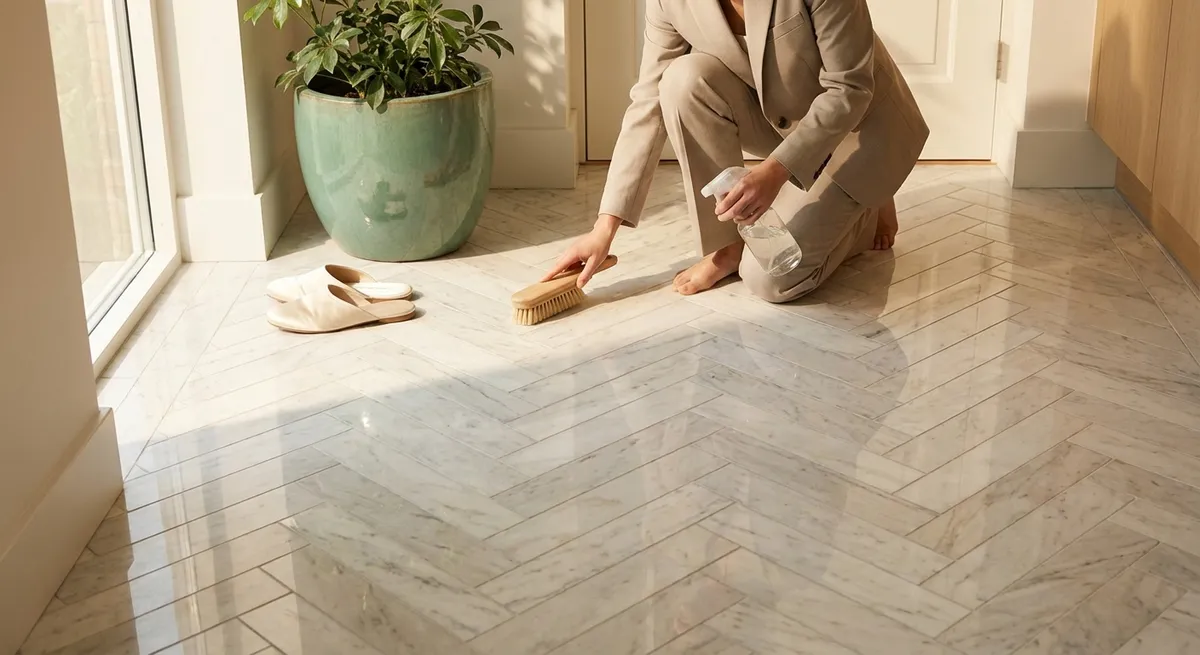
This is your guide to five exclusive, rarely-discussed maintenance insights that distinguish an ordinary tile floor from a truly refined one.
Insight 1: Training the Tile, Not Just Cleaning It
Most homeowners think of tile care as an occasional cleaning task. In elevated interiors, tile is not merely cleaned; it is “trained” over time to age gracefully. This means adopting low-abrasion, pH-appropriate routines that condition surfaces rather than strip them.
On glazed ceramic and porcelain, repeated use of harsh alkaline or acidic cleaners slowly dulls the factory finish, breaking down micro-coatings and opening the door to stains and scale. A more cultivated approach uses a neutral-pH cleaner that leaves no residue, paired with microfiber tools that lift rather than drag debris. Natural stone—marble, limestone, travertine—requires even more restraint: only stone-safe, pH-balanced formulas, soft pads, and absolutely no generic bathroom acids or vinegar-based “hacks.”
Over time, this disciplined regimen ensures the tile’s surface chemistry remains stable, its gloss or matte architecture intact. The goal is not the aggressive “reset” of a deep scrub, but a series of understated, consistent cleanings that prevent buildup from ever becoming visible. In a decade, the floor should whisper that it has been cared for, not fought with.
Insight 2: Grout as a Design Element, Not a Maintenance Afterthought
In luxury projects, grout is treated with the same seriousness as the tile itself. Its color, texture, and crispness frame every edge, yet it is often the first element to betray a home’s age. The most refined homes treat grout maintenance as a curatorial exercise.
First, grout sealing is scheduled, not “remembered.” Cementitious grout is typically resealed every 1–3 years, depending on traffic and cleaner choice. Rather than waiting for discoloration, homeowners calendar this alongside other annual home services. Professional-grade penetrating sealers, matched to the grout’s porosity, help repel oils, dyes, and everyday spills before they migrate below the surface.
Second, there is a quiet discipline about what touches the grout. Colored soaps, oil-heavy cleaners, and dark-pigmented cosmetics in showers are managed with elegant accessories—trays, recesses, and caddies that reduce direct exposure. For floor grout, entrance mats with high scraping power at exterior doors dramatically cut down on invisible grit and soil that grind into the joints.
Finally, selective recoloring is used as a refinement tool, not a rescue. When grout shade begins to drift, a high-end grout colorant or stain-seal system can restore uniformity and add an additional protective layer. In a premium home, grout lines are not allowed to narrate years of spills and shortcuts; they are curated to remain as deliberate and composed as day one.
Insight 3: Micro-Climate Management for Crack-Free Elegance
The most expensive tile in the world cannot compensate for a home that moves too dramatically beneath it. Temperature and humidity swings subtly influence substrates, adhesives, and grout, sometimes telegraphing as hairline cracks, tenting, or hollow spots years later. Savvy homeowners treat their interiors as micro-climates, not just rooms.
Maintaining a consistent indoor climate—both temperature and relative humidity—does more than protect artwork and millwork. It reduces expansion and contraction cycles in subfloors, underlayments, and even large-format tiles themselves. In regions with extreme seasonal variation, thoughtful use of humidifiers, dehumidifiers, and well-calibrated HVAC systems helps prevent the stresses that slowly fatigue tile assemblies.
Radiant floor heating demands particular finesse. Rapid temperature changes, or running the floor significantly hotter than recommended, can place unnecessary stress on tiles and grout. A refined regimen gradually ramps temperatures up and down, treating the heated slab as a slow, stable thermal mass. Paired with high-quality expansion joints and perimeter movement allowances, this quiet climate discipline dramatically reduces the likelihood of long-term structural issues.
The result is not just comfort—it is continuity. Floors remain smooth, uncracked, and acoustically solid underfoot, reflecting an environment that is as controlled as it is luxurious.
Insight 4: Optical Maintenance—Managing Light, Reflection, and Sheen
In distinguished homes, tile is curated as much for its relationship with light as for its color or pattern. Maintenance that ignores this optical dimension inadvertently cheapens the effect over time. Streaks, micro-scratches, and patchy sheen levels can flatten an otherwise exquisite installation.
Polished porcelain and high-gloss stone are especially unforgiving. They demand carefully wrung microfiber mops, ultra-clean mop water, and a strict no-residue philosophy. Any cleaner that leaves surfactants or soaps behind will show as streaks and dull patches under raking light. For these surfaces, less is truly more—minimal product, well-diluted, paired with immaculate rinse water.
Matte and honed finishes have their own optic: they reveal patchy wear, “traffic lanes,” and inconsistent sealers. The cultivated approach is to align maintenance with the tile’s intended sheen level. Stone sealers are chosen for their invisible finish, not their gloss. Any polishing agents are reserved for materials designed to be polished, never used as universal enhancers.
Lighting design and cleaning patterns are coordinated as well. In hallways and long runs, cleaning strokes follow the primary light direction, reducing the appearance of streaks. Under large windows and sliders, routine quick passes remove tracked-in mineral dust before it can etch or haze the surface. The outcome is a floor that always reads as intentional: reflections remain sharp where they should be, and matte tiles stay velvety rather than chalky.
Insight 5: Proactive Detailing—Touchpoint Protection Before Damage Appears
Truly high-end tile maintenance is not reactive; it anticipates points of stress and reinforces them before failure. The most refined homes treat tile like a bespoke garment: reinforced where it is handled most, protected where friction is inevitable.
Furniture interfaces are a classic example. Rather than generic felt pads that compress, shift, and collect grit, discerning homeowners opt for high-quality, replaceable glides selected for both the tile type and furniture weight. These are inspected and replaced on a schedule, not only when a scratch appears. Dining chairs, bar stools, and movable island seating are particular priorities.
Entry and transition areas receive tailored protection. At exterior doors, a layered mat strategy—scraping mat outside, absorbent mat inside—drastically reduces grit, water, and de-icing chemical transfer onto tile. In kitchens, discrete runners or custom insets are placed in front of sinks and cooktops to intercept spills, grease, and dropped utensils before they ever reach grout.
Detailing also extends vertically. Shower niches, benches, and lower wall courses in wet areas are quietly monitored for early signs of grout hairline cracking, caulk fatigue, or subtle discoloration. Addressing these micro-signals immediately with matching caulks and sealers prevents the kind of moisture intrusion that eventually leads to staining, efflorescence, or loose tiles.
By thinking in terms of touchpoints—where people, water, furniture, and light interact most intensely with tile—homeowners create an invisible protective infrastructure. The result is that “wear” never has the chance to become visible; it is intercepted upstream, leaving only a sense of enduring newness.
Conclusion
Exceptional tile work is never only about installation. The surfaces that continue to look gallery-worthy a decade later are the ones that have been maintained with intention, restraint, and foresight. By training the tile rather than scrubbing it into submission, curating grout as a design element, managing your home’s micro-climate, respecting the optics of sheen and light, and proactively reinforcing the most vulnerable touchpoints, you elevate maintenance from chore to craft.
In refined homes, tile does not merely survive daily life—it dignifies it. The quiet discipline behind that result is invisible to most, but unmistakable to those who know where to look.
Sources
- U.S. Environmental Protection Agency – Safer Cleaning Products – Guidance on selecting safer, low-residue cleaning products suitable for interior surfaces
- Mayo Clinic – Indoor Humidity: What’s Ideal? – Overview of recommended indoor humidity ranges that also help stabilize building materials
- University of Tennessee Extension – Care and Maintenance of Ceramic Tile – Technical guidance on appropriate cleaners, grout care, and long-term tile maintenance practices
- Natural Stone Institute – Stone Care and Maintenance – Best practices for the maintenance and sealing of natural stone surfaces in residential settings
- Schluter Systems – Movement Joints and Control of Tile Assemblies – Technical insight into how movement and climate affect tile installations and the role of movement accommodation in longevity