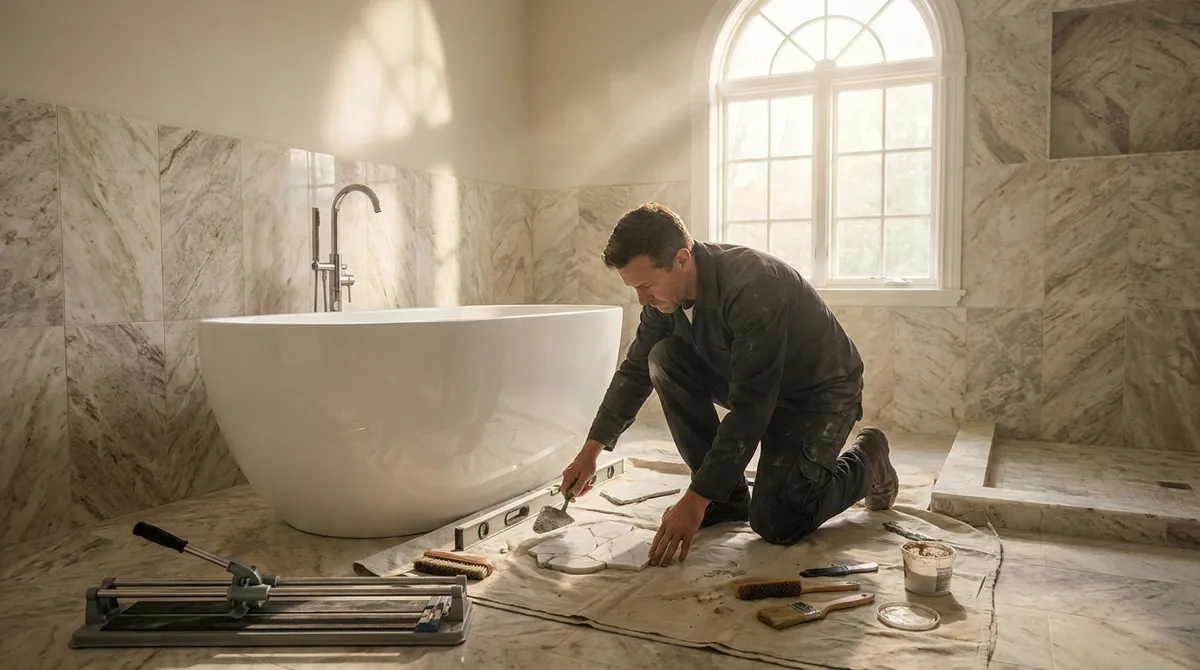
This guide explores sophisticated repair strategies that respect the architecture of your home. Rather than defaulting to full replacement, we focus on precision corrections, material intelligence, and the kind of invisible craftsmanship that seasoned tile professionals rely on. Along the way, you’ll find five exclusive insights that discerning homeowners can use to evaluate work, choose solutions, and maintain a standard that feels genuinely elevated.
Reading the Surface: Diagnosing Issues Without Destruction
Before a chisel ever meets grout, the most valuable tool on site is discernment. Effective repair begins with understanding not just what has failed, but why.
Experienced tile specialists will “listen” to the floor by tapping tiles and mapping hollow zones, run straightedges to identify subtle lippage, and examine grout coloration as a clue to moisture or movement. They will also consider the age of the installation, the substrate used, and any changes to HVAC, humidity, or structure over time.
Just as important is restraint. A refined repair avoids unnecessary demolition by isolating the true point of failure—whether it is a localized hollow area, a weak spot in the underlayment, or a small section of grout that never fully cured. The aim is to minimize disturbance to surrounding tile while restoring structural integrity and aesthetic coherence.
Exclusive Insight #1: Treat sound mapping as non‑negotiable.
Before agreeing to any invasive work, ask your tile professional how they will test and map the issue—tapping, thermal imaging, moisture reading, or other non-destructive methods. A vague “we’ll know once we tear in” is not the answer you want in a premium space.
Micro-Interventions: When “Minor” Repairs Require Major Precision
Refined homes are rarely forgiving of patchwork. Micro-interventions—small, highly controlled repairs—must be executed at a level where correction becomes visually silent.
For hairline cracks in stable tile, a specialist may use color-matched epoxy or resin in ultra-fine applications, followed by subtle polishing. In some stone and porcelain tiles, this can arrest further cracking and visually neutralize the flaw without replacement. For minimal lippage in a non-wet area, a technician might selectively polish a tile edge, visually reducing the step without disturbing the field.
Where grout has fractured but the tile remains sound, the best approach often involves carefully removing only the affected joints, vacuuming dust fully, and re-grouting with a premium, color-stable product. The color match must account for both the current tone and how the grout will age—something that requires experience, not guesswork.
Exclusive Insight #2: Ask for test swatches in situ, not just in the showroom.
Any resin, filler, or grout used for repair should be sampled directly on a discreet area of your actual installation. Lighting, tile absorption, and existing patina can all alter the perception of color and sheen in ways that are impossible to judge from a sample board alone.
Respecting the Substrate: Elegant Repairs Start Below the Tile
Many visible failures are merely symptoms of an invisible issue: movement, moisture, or inadequate support beneath the tile. Elegant repair work addresses the substrate, not just the surface.
Where hollow tiles are localized, a professional may carefully remove individual tiles, correct the underlying thinset coverage, and improve decoupling or support as needed. In some cases, a high-quality injection system can be used under certain conditions to re-bond loose tiles without removal—but this requires discipline, proper materials, and a realistic understanding of when it is appropriate versus when it is merely postponing the inevitable.
On plank-style tiles or large-format slabs, minor flex in the subfloor can telegraph as cracks over time. A serious repair strategy may recommend reinforcing the subfloor or adding a proper uncoupling membrane in selective zones where tiles will be reset. While this adds scope to the repair, it protects the integrity of the remaining installation.
Exclusive Insight #3: Prioritize structural truth over cosmetic speed.
If a proposed solution corrects what you see but does nothing to address movement, moisture, or substrate issues, you are buying time, not resolution. Insist that your tile professional clearly explain what they believe is happening beneath the surface—and how their repair addresses it.
Curated Materials: Matching, Blending, and Embracing Subtle Evolution
The most sophisticated tile repairs are rarely about a perfect match so much as a graceful blend. Older installations may involve discontinued lines, evolving glazes, or natural stone that has mellowed over time.
For stone, a skilled fabricator can often source a slab or tile with similar veining and then refine the finish—honing, polishing, or brushing—to harmonize with existing material. For porcelain, it may be a matter of selecting from archived stock, or, if that is not possible, using layout tactics (such as placing a slightly different batch in a less visually dominant area) to disguise variation.
Grout also deserves careful curation. Modern high-performance grouts offer superior stain resistance and color stability compared with many older products. When used in a targeted repair, they can subtly elevate the entire installation—especially if the repair includes carefully re-grouting key zones such as thresholds, edges, or focal lines.
Exclusive Insight #4: Consider deliberate “placement hierarchy” for replacement tiles.
When an exact match is impossible, your professional can reposition existing tiles—moving the closest matches into the focal area and relocating the more varied pieces to edges, under cabinetry, or behind fixtures. This curated redistribution can make an imperfect set of tiles appear masterfully intentional.
The Art of Disappearance: Finishing Touches That Separate Adequate from Exceptional
Once the primary repair is complete, the refinement lies in finishing. This is where an installation becomes not just corrected, but convincingly whole.
Professional cleaning of the entire field after repair is essential. Residual haze, micro-scratches, or inconsistent sheen can draw the eye to the repaired area even when the work is structurally perfect. In some materials—particularly natural stone—an all-over light hone or polish may be used to unify the surface, making old and new read as a single, continuous plane.
Silicone joints at perimeters, corners, and wet areas should be revisited as part of any significant repair. High-quality, color-matched silicone, neatly tooled, frames the installation and prevents moisture from undermining fresh work. Thoughtful lighting also plays a role: adjusting accent lighting, beam angles, or color temperature can dramatically reduce visible lippage or highlight the material rather than its seams.
Exclusive Insight #5: Treat lighting as part of the repair strategy, not an afterthought.
Before final sign-off, evaluate the repaired area under your actual lighting conditions—daylight, evening, task lighting, and accent lighting. A minor adjustment in angle or intensity can shift the emphasis from joints and transitions back to the beauty of the tile itself.
Conclusion
In a refined home, tile is not merely a surface; it is a statement about how you live, what you value, and how attentively your environment is crafted. When flaws appear, the most successful repairs are those that honor this standard—solutions that are technically robust, visually discreet, and executed with an understanding of the space as a whole.
By demanding careful diagnosis, micro-interventions instead of heavy-handed demolition, substrate-aware strategies, curated material choices, and a considered approach to finishing and lighting, you transform “tile repair” from a necessary inconvenience into an opportunity: a moment to reaffirm the quiet excellence that defines your home.
Sources
- U.S. Department of Housing and Urban Development – Residential Rehabilitation Inspection Guide – Provides technical context on evaluating existing building conditions, including flooring and substrate issues.
- Tile Council of North America (TCNA) – Handbook for Ceramic, Glass, and Stone Tile Installation – Industry reference for best practices in tile installation and repair methodologies.
- Schluter Systems – Technical Articles on Substrates and Uncoupling Membranes – Explains substrate movement, uncoupling principles, and how they relate to tile failures and repairs.
- Laticrete – Grout and Adhesive Technical Data Sheets – Offers detailed information on modern grout and adhesive performance, useful for specifying high-end repair materials.
- International Association of Certified Home Inspectors (InterNACHI) – Tile Floor Inspection Guide – Outlines common tile defects and diagnostic approaches that align with professional assessment standards.